Table of Contents
- The AI Bet That Ignited a Labor War
- Hyundai Humanoid Robots: The Strategic Vision
- The Union’s Fierce Response and Core Demands
- The US Shift: Complicating the Domestic Crisis
- The Global Debate: Automation vs. Jobs
- Key Takeaways and the Road Ahead
- Sources
The AI Bet That Ignited a Labor War
In a move that could define the future of manufacturing, Hyundai Motor Group has placed a colossal bet on artificial intelligence and robotics. But this high-stakes gamble has triggered an immediate and furious backlash from an unexpected source: its own workforce. The company’s plan to deploy Hyundai humanoid robots on its major assembly lines has sent its powerful South Korean labor union into a state of open revolt, setting the stage for a critical clash between technological ambition and worker security .
Hyundai Humanoid Robots: The Strategic Vision
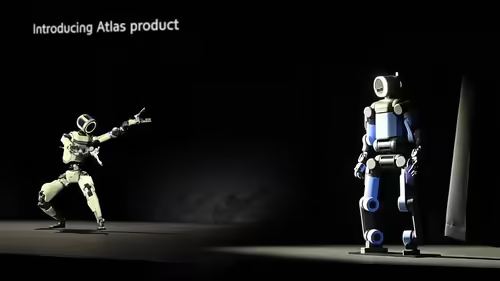
This isn’t just a whim; it’s the culmination of a strategic vision years in the making. In 2021, Hyundai made a landmark $1.1 billion acquisition of Boston Dynamics, the robotics pioneer famed for its agile “Spot” dog and the advanced “Atlas” humanoid robot . This was just the beginning. The company has since poured billions more into its robotics ecosystem, including a recent $6 billion investment announced to supercharge its AI and mobility ambitions .
The goal is clear: to create a new era of human-robot collaboration in its factories. At CES 2026, Hyundai unveiled its transformative AI Robotics Strategy, with a bold roadmap to mass-produce its own humanoid robots by 2028 . The plan is to integrate these sophisticated machines into its global operations, starting with its new U.S. factory in Georgia, where they aim to automate a significant portion of vehicle assembly work .
From Boston Dynamics to the Factory Floor
The integration of Boston Dynamics’ technology is central to this plan. As part of its strategy, Hyundai has committed to purchasing tens of thousands of robots in the coming years, signaling a massive scale-up from experimental prototypes to industrial reality . This move positions Hyundai not just as a carmaker, but as a leader in the emerging field of industrial robotics.
The Union’s Fierce Response and Core Demands
For the workers on the front lines, however, this vision looks less like progress and more like a threat to their livelihoods. The Korean union has issued a stark warning: without a formal labor-management agreement, “not a single” robot will be allowed on the production floor . Their core argument is that the primary motive behind this automation push is not innovation, but profit—specifically, boosting the bottom line by drastically reducing the human workforce .
The union’s stance is uncompromising. They have formally rejected the deployment of the Atlas robot and other AI-powered systems until their concerns are addressed through a binding agreement . They point to Korea’s “yellow envelope law,” which protects workers from unfair dismissal, as a potential legal barrier to any unilateral move by the company . This is not just a negotiation; it’s a vow to block the rollout entirely .
The US Shift: Complicating the Domestic Crisis
To make matters worse for domestic morale, Hyundai’s robotics push is happening alongside a significant strategic shift of production capacity to the United States. The company’s massive $26 billion U.S. investment plan includes building new factories and deploying its robotic workforce there . For the union in Korea, this dual strategy—automating jobs at home while moving production overseas—feels like a double betrayal. It fuels their suspicion that the company is actively seeking to diminish its reliance on its traditional, highly organized, and well-compensated Korean workforce .
The Global Debate: Automation vs. Jobs
The standoff at Hyundai is a microcosm of a much larger global debate. As AI and robotics advance at a breakneck pace, industries worldwide are grappling with the same fundamental question: how to balance efficiency and innovation with social responsibility and job security. A report from the World Economic Forum suggests that while AI may displace 85 million jobs by 2025, it could also create 97 million new roles, demanding a massive reskilling effort [World Economic Forum].
However, this optimistic forecast offers little comfort to workers facing immediate displacement. The transition is rarely smooth, and the new jobs often require vastly different skill sets. Hyundai’s challenge is to navigate this transition in a way that doesn’t leave its loyal employees behind. [INTERNAL_LINK:future-of-work-ai-automation] provides more insights into this complex global shift.
Key Takeaways and the Road Ahead
The conflict over Hyundai humanoid robots is far from over. It represents a pivotal moment for the company, its workers, and the entire automotive industry. On one side is the undeniable momentum of technological progress and the competitive pressure to innovate. On the other is the legitimate fear of a workforce that has built the company’s success. The path forward will require more than just technical prowess; it will demand genuine dialogue, transparent planning, and a shared vision for the future that includes both humans and their robotic counterparts. How Hyundai resolves this crisis will be watched closely by manufacturers around the world.
Sources
- Times of India: Unions in Korea are up in arms against Hyundai Motor’s biggest AI bet
- Web Search Results: , , , , , , , , , , ,
- World Economic Forum: The Future of Jobs Report 2023