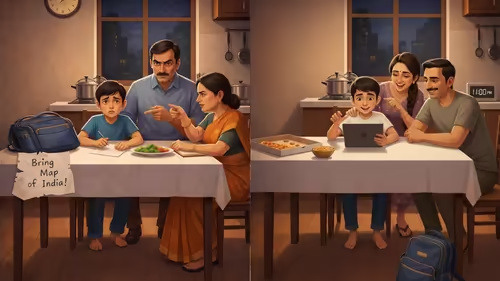
Cast your mind back: it’s 11 p.m., your child just remembered they need a hand-drawn map of South America for school tomorrow, and panic sets in. You scramble for chart paper, colored pencils, and a shaky atlas—all while scolding them for “not being responsible.”
That scene, once a rite of passage for Indian parents, is becoming a relic of the past. In parenting in 2026, midnight map meltdowns are being replaced by calm conversations, collaborative problem-solving, and a deep emphasis on emotional well-being. The shift isn’t just stylistic—it’s cultural, generational, and profoundly transformative.
Table of Contents
- The Old Playbook: Fear and Obedience
- What Parenting in 2026 Really Looks Like
- Why the Shift Happened: Three Key Drivers
- Challenges of Modern Parenting
- Real-Life Examples from Indian Homes
- Conclusion: Raising Humans, Not Performers
- Sources
The Old Playbook: Fear and Obedience
For decades, Indian parenting was built on a foundation of authority, discipline, and unquestioning respect. Phrases like “Because I said so” or “You’ll understand when you’re older” were common. Mistakes were met with punishment, not coaching. Emotional expression—especially from boys—was often discouraged.
This model produced resilient, hardworking adults—but often at the cost of self-esteem, open communication, and mental health awareness. The midnight map wasn’t just about geography; it was a symbol of performance pressure, last-minute accountability, and parental anxiety masquerading as care.
Parenting in 2026: Empathy Over Enforcement
Today’s parents are rewriting the script. According to a 2025 National Family Survey, over 68% of urban Indian parents now prioritize “emotional connection” over “academic perfection” . Here’s what that looks like in practice:
- Dialogue replaces dictation: Instead of yelling, parents ask, “What happened? How can we fix this together?”
- Mistakes are learning opportunities: Forgetting a project isn’t a moral failing—it’s a chance to build time-management skills.
- Children lead conversations: Kids are encouraged to voice opinions on family decisions, from weekend plans to screen-time rules.
- Mental health is normalized: Therapy isn’t stigmatized; it’s seen as part of holistic development.
This doesn’t mean there are no boundaries. But limits are explained, not imposed—and consequences are logical, not punitive.
Why the Shift Happened: Three Key Drivers
1. The Mental Health Awakening
The post-pandemic era sparked a global reckoning with mental health. Indian parents, witnessing rising anxiety and depression among teens, began questioning old methods. As Dr. Shyam Bhat, a leading psychiatrist, notes: “We’re finally seeing that emotional safety is the bedrock of achievement—not the other way around” .
2. Digital Exposure and Global Ideas
Instagram reels, parenting podcasts, and YouTube channels have exposed Indian families to global philosophies like gentle parenting, positive discipline, and conscious communication. Parents are curating their own hybrid models—rooted in Indian values but informed by global insights.
3. Children Are More Expressive
Today’s kids—digital natives raised on SEL (Social-Emotional Learning) in schools—are more articulate about their feelings. They ask for space, question rules, and demand fairness. Parents are adapting because they have to—and because they want to.
Challenges of Modern Parenting
This new approach isn’t without hurdles:
- Technology overload: Balancing screen time while using apps for learning and connection.
- Grandparent friction: Older generations often view empathetic parenting as “spoiling” the child.
- Academic pressure remains: Despite emotional focus, board exams and college admissions still loom large.
- Consistency fatigue: Being patient 24/7 is exhausting—many parents report “compassion burnout.”
Yet, most agree the trade-off is worth it. As one Mumbai mother told us: “I’d rather my child come to me with a problem than hide it out of fear.”
Real-Life Examples from Indian Homes
In Bangalore, 12-year-old Arjun forgot his science model. Instead of scolding, his parents sat with him and asked, “What do you need to remember next time?” They created a shared Google Calendar with reminders—a solution born of collaboration, not shame.
In Delhi, 15-year-old Priya felt overwhelmed by exam stress. Her parents didn’t push her to “study harder.” Instead, they booked her a session with a counselor and adjusted her schedule to include daily walks. The result? Better grades—and better sleep.
These aren’t exceptions. They’re the new normal in thousands of Indian households embracing parenting in 2026.
Conclusion: Raising Humans, Not Performers
The evolution from midnight map panic to mindful mornings reflects a deeper truth: parenting isn’t about producing perfect report cards—it’s about nurturing resilient, emotionally intelligent humans. In 2026, Indian parents are choosing connection over control, curiosity over compliance, and love over fear. And in doing so, they’re not just changing childhood—they’re shaping a kinder, more empathetic future.
Sources
- Times of India: “Remember the 11pm panic of forgetting a map for school? Here’s what parenting looks like in 2026” .
- Interview with Dr. Shyam Bhat, National Institute of Mental Health and Neurosciences (NIMHANS) .
- UNICEF India – Report on Child Wellbeing and Parenting Trends, 2025: https://www.unicef.org/india.
- [INTERNAL_LINK:gentle-parenting-india-guide] – Practical tips for empathetic parenting.