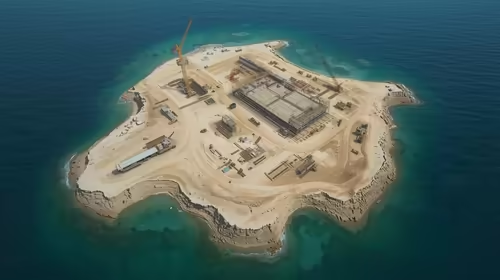
In one of the most audacious engineering feats of the 21st century, **China artificial islands** have risen from the turquoise waters of the South China Sea like modern-day Atlantis—but with runways, radar domes, and missile silos. What began as scattered coral outcrops are now fully militarized territories, built not by nature, but by state-backed dredging fleets dumping millions of cubic meters of sand into the ocean. This transformation, completed in just ten years, has redrawn maps, alarmed neighbors, and triggered a global debate over sovereignty, security, and environmental destruction.
Table of Contents
- The Scale of China’s Artificial Islands Project
- How China Built Artificial Islands: Technology and Tactics
- Key Artificial Islands in the South China Sea
- Why It Matters: Geopolitical and Military Implications
- Environmental Cost of Land Reclamation
- International Response and Legal Challenges
- Conclusion: A New Era of Maritime Power
- Sources
The Scale of China’s Artificial Islands Project
Between 2013 and 2023, China created over **3,200 acres (1,300 hectares)** of new land across seven key features in the Spratly Islands alone. To put that in perspective, it’s larger than New York City’s Central Park—and it was all built on contested reefs claimed by multiple nations, including the Philippines, Vietnam, and Malaysia .
This wasn’t gradual development. It was a rapid, centrally coordinated campaign using an armada of specialized vessels. Satellite imagery from organizations like the Asia Maritime Transparency Initiative (AMTI) shows barren reefs turning into bustling mini-cities in under two years .
How China Built Artificial Islands: Technology and Tactics
The secret weapon? Massive **cutter suction dredgers**—floating factories that suck up seabed sand and blast it through pipelines onto target reefs. The most famous, the Tianjing Hao, can move 4,500 cubic meters of sand per hour—enough to fill an Olympic swimming pool in under 90 minutes.
The process followed a clear blueprint:
- Site Selection: Choose strategically located reefs within China’s disputed “nine-dash line.”
- Dredging & Filling: Use dredgers to pump sand from nearby seabeds, creating stable platforms above sea level.
- Reinforcement: Surround the perimeter with concrete seawalls to prevent erosion.
- Infrastructure Buildout: Add airstrips, ports, radar installations, and military barracks.
This industrialized approach turned what once took centuries of natural accretion into a matter of months .
Key Artificial Islands in the South China Sea
Not all artificial islands are equal. Some have become linchpins of China’s maritime strategy:
- Mischief Reef (Meji Island): Now hosts a 2.7-km runway, deep-water port, and anti-aircraft systems.
- Fiery Cross Reef (Yongshu Island): Features a hospital, lighthouse, and satellite communication hub.
- Subi Reef (Zhubi Island): Equipped with advanced radar and missile defense capabilities.
These aren’t just outposts—they’re forward-operating bases capable of projecting power across vital shipping lanes used by $5 trillion in global trade annually .
Why It Matters: Geopolitical and Military Implications
The **China artificial islands** project is far more than an engineering marvel—it’s a geopolitical chess move. By building on disputed features, China effectively enforces its expansive territorial claims under the so-called “nine-dash line,” which covers nearly 90% of the South China Sea.
From these islands, Chinese coast guard and naval vessels can monitor and intercept foreign ships, enforce fishing bans, and restrict access to energy-rich zones. The U.S. Department of Defense has repeatedly labeled these structures as “unsinkable aircraft carriers” that extend Beijing’s military reach deep into Southeast Asia .
Environmental Cost of Land Reclamation
Beneath the political drama lies an ecological catastrophe. Scientists estimate that China’s dredging operations have destroyed over **10,000 acres of pristine coral reefs**—some of the most biodiverse marine ecosystems on Earth.
Coral reefs don’t just support fish; they protect coastlines from storms and sustain local fisheries worth billions. A 2020 study published in Nature Communications found that sediment plumes from dredging smothered corals up to 15 kilometers away, causing long-term habitat collapse .
Ironically, many of these new islands may be vulnerable to rising sea levels—a cruel twist for structures built to assert permanence.
International Response and Legal Challenges
In 2016, an international tribunal at The Hague ruled unanimously that China’s claims had “no legal basis” under the UN Convention on the Law of the Sea (UNCLOS). China rejected the ruling outright, calling it “null and void” .
Since then, ASEAN nations have struggled to form a unified front, while the U.S., Australia, and Japan have increased freedom-of-navigation operations (FONOPs) near the islands. Yet, no country has been willing to risk direct confrontation.
[INTERNAL_LINK:south-china-sea-dispute-explained] provides deeper context on the legal and historical roots of this conflict.
Conclusion: A New Era of Maritime Power
The rise of **China artificial islands** marks a turning point in 21st-century statecraft—where sand, steel, and satellite imagery are as potent as treaties and diplomacy. While China frames the project as necessary for search-and-rescue and weather monitoring, the world sees a calculated effort to control one of the planet’s most strategic waterways. As tensions simmer, these man-made specks of land will remain flashpoints in the struggle between national ambition and international law.
Sources
- [1] Asia Maritime Transparency Initiative (AMTI) – https://amti.csis.org/
- [2] U.S. Department of Defense Annual Report on China’s Military Power – 2023 China Military Power Report
- [3] BBC News – “How China is building islands in the South China Sea” – https://www.bbc.com/news/world-asia-33228970
- [4] Council on Foreign Relations – “China’s Maritime Claims in the South China Sea” – https://www.cfr.org/backgrounder/chinas-maritime-claims-south-china-sea
- [5] Permanent Court of Arbitration – Philippines v. China Award (2016) – https://pca-cpa.org/en/cases/7/
- [6] Nature Communications – “Environmental impacts of China’s island-building” (2020) – https://www.nature.com/articles/s41467-020-17437-3
- [7] Original Article: Times of India – How China created artificial islands by dumping sand into the sea in just one decade