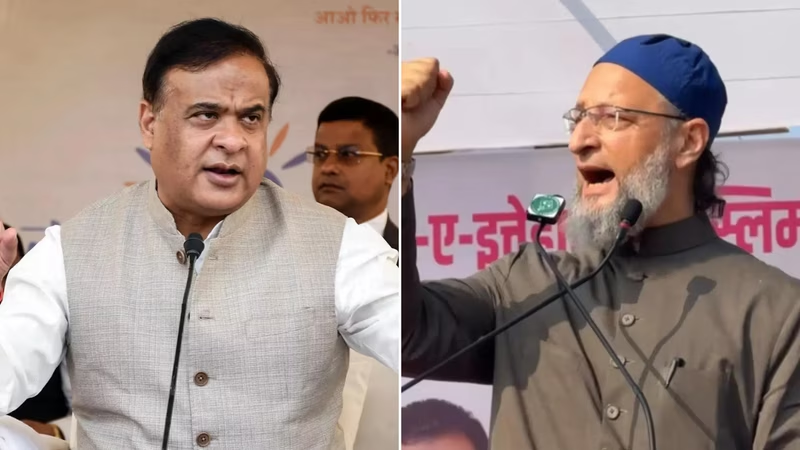
A political storm has swept across India following a sharp exchange between Assam Chief Minister **Himanta Biswa Sarma** and All India Majlis-e-Ittehadul Muslimeen (AIMIM) president **Asaduddin Owaisi**—centered on one explosive question: *Can a Muslim become Prime Minister of India?*
The controversy began when Owaisi, during a public address, remarked that just as a woman wearing a hijab can aspire to be a judge or an IAS officer, a Muslim should also be able to dream of becoming Prime Minister. In response, Sarma delivered a blunt and unambiguous retort: “The Prime Minister of this country will always be a Hindu.” This statement, made at a BJP event in Assam, has since triggered intense debate across media, political circles, and social platforms .
Table of Contents
- The Origin: What Did Owaisi Actually Say?
- Hindu PM India: Sarma’s Full Statement and Context
- What Does the Indian Constitution Say?
- Political Reactions: From BJP to Opposition
- Public Discourse: Secularism vs. Majoritarian Identity
- Conclusion
- Sources
The Origin: What Did Owaisi Actually Say?
Owaisi’s comments were part of a broader argument about representation and dignity for marginalized Muslim communities, particularly the Pasmanda (backward Muslim) groups. Speaking in support of affirmative action, he stated: “If a girl in a hijab can become a judge, why can’t a Muslim become the Prime Minister of India?” .
His intent appeared rhetorical—highlighting systemic barriers rather than claiming an immediate path to power. However, in India’s current socio-political climate, any suggestion about religious identity in top offices is instantly polarizing.
Hindu PM India: Sarma’s Full Statement and Context
At a BJP rally in Nagaon, Assam, Sarma directly countered Owaisi: “He talks about a Muslim Prime Minister. Let me make it clear—the Prime Minister of this country will always be a Hindu” . He went further, challenging AIMIM to first appoint a Pasmanda Muslim as its own party president before lecturing others on representation.
Sarma’s remarks were met with loud cheers from the crowd, underscoring their resonance with the BJP’s core base. But beyond electoral optics, the statement reflects a deeper ideological shift—one that frames national leadership through a civilizational, rather than purely constitutional, lens.
What Does the Indian Constitution Say?
Legally, there is **no religious qualification** for the office of Prime Minister in India. Article 75 of the Constitution only requires the PM to be a member of either House of Parliament. India’s first Law Minister, Dr. B.R. Ambedkar, explicitly rejected religious tests for public office, calling them antithetical to democracy .
Historically, India has had leaders from diverse faiths in top roles: Sikh Prime Ministers (Manmohan Singh), Christian Presidents (Pranab Mukherjee’s cabinet included several), and Muslim Presidents (Zakir Hussain, Fakhruddin Ali Ahmed). Yet, the PM’s office has remained with Hindu leaders—a fact Sarma now declares as permanent destiny, not historical coincidence.
Political Reactions: From BJP to Opposition
The fallout has been swift and divided along party lines:
- BJP Leaders: Backed Sarma, calling his statement a “reflection of ground reality” and accusing Owaisi of “divisive politics.”
- Congress & TMC: Condemned Sarma’s remarks as “unconstitutional” and “anti-secular,” urging the Centre to clarify its stance.
- AUDF & SP: Warned that such rhetoric deepens communal fault lines and alienates minority citizens [INTERNAL_LINK:minority-representation-in-indian-politics].
Public Discourse: Secularism vs. Majoritarian Identity
This clash isn’t just about two politicians—it’s a microcosm of India’s evolving national identity. On one side stands the constitutional ideal of secularism, where religion is irrelevant to civic eligibility. On the other is a rising narrative that equates Indianness with Hindu civilizational continuity.
Academics note that while India has never had a non-Hindu PM, the *principle* of eligibility has long been sacrosanct. By declaring it “always” impossible, critics argue, Sarma isn’t stating a fact—he’s foreclosing a democratic possibility. As historian Ramachandra Guha tweeted, “To say ‘always’ is to deny the future—and the Constitution.”
Conclusion
The “Hindu PM India” controversy reveals a profound tension at the heart of modern Indian democracy. While the Constitution guarantees equal opportunity regardless of faith, political rhetoric increasingly frames national leadership through a majoritarian lens. Whether this shift remains symbolic or translates into institutional change will be one of the defining battles of India’s next decade. For now, the debate rages—not just in Parliament, but in every home, classroom, and digital feed across the nation.