Table of Contents
- The Controversial Statement That Shook Assam
- Who Are the Miyas? Understanding the Community
- Political Fallout and National Backlash
- CM Sarma’s Defense: Citing the Supreme Court
- Implications for the 2026 Assam Assembly Elections
- Conclusion: A Dangerous Precedent?
- Sources
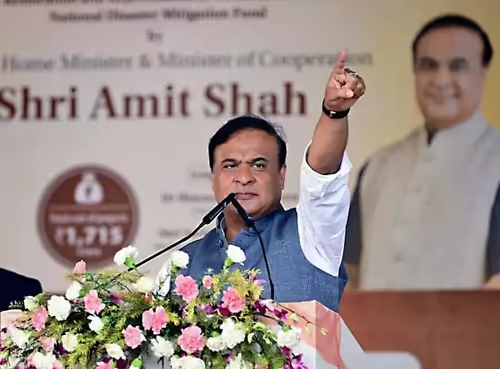
In a statement that has sent shockwaves across India, Assam Chief Minister Himanta Biswa Sarma has doubled down on his controversial remarks about the state’s Miya community. His blunt declaration—”Miyas will face trouble as long as I am CM”—has not only drawn fierce criticism from opposition parties and civil society but has also thrust the complex identity politics of Assam back into the national spotlight [[12]].
This isn’t just another political gaffe; it’s a calculated move that speaks to the heart of Assam’s most sensitive socio-political fault lines. As we head towards the 2026 state elections, understanding the Himanta Sarma Miyas controversy is crucial to grasping the future of the region.
The Controversial Statement That Shook Assam
The latest iteration of this ongoing saga saw CM Sarma, unmoved by the growing backlash, reiterate his stance with chilling clarity. He framed his government’s actions—which include a special revision of electoral rolls and other administrative measures—as a necessary step to address what he perceives as a demographic threat [[12]].
His comments have been widely interpreted as a direct incitement against a specific community, painting an entire population with the broad brush of being “illegal infiltrators.” This narrative, long championed by his party, the BJP, has now been given the full-throated endorsement of the state’s highest executive office [[25]].
Who Are the Miyas? Understanding the Community
To fully comprehend the gravity of the CM’s words, one must first understand who the Miyas are. The term refers to a large community of Bengali-origin Muslims whose ancestors migrated to Assam over generations, primarily during the British colonial period and after the partition of India [[23]].
Historically, many settled on the riverine islands known as chars and in low-lying areas called chaporis, developing a distinct cultural identity often referred to as char-chapori culture [[23]]. While the term “Miya” was once used pejoratively, a significant section of the community has recently reclaimed it as a symbol of pride and identity, notably through the powerful medium of Miya poetry [[28]].
For decades, their citizenship status has been a contentious political issue in Assam, culminating in the creation of the National Register of Citizens (NRC). The community lives under a constant shadow of uncertainty, making the CM’s public call for them to “face trouble” not just a political statement but a deeply personal and threatening one for millions of residents [[19]].
Political Fallout and National Backlash
The reaction to Sarma’s remarks has been swift and severe:
- Opposition Fury: The Congress and AIUDF have slammed the CM for stooping to an “unprecedented low” and accused him of playing divisive “hate politics” that undermines the Indian Constitution itself [[7]].
- Civil Society Outrage: A coalition of activists, lawyers, and academics has condemned the remarks as “prejudicial and alarmingly hateful,” arguing that a Chief Minister openly advocating for the harassment of a voter bloc is a dangerous red line [[8]].
- National Condemnation: Bodies like the All India Muslim Personal Law Board (AIMPLB) have labeled his comments as blatantly “anti-Muslim” [[10]].
CM Sarma’s Defense: Citing the Supreme Court
Facing intense criticism, Himanta Sarma has not backed down. Instead, he has attempted to lend legal and constitutional weight to his position by citing observations made by the Supreme Court of India in a 2005 judgment [[2], [13]].
He argues that his government’s actions are merely a response to legitimate concerns about “demographic pressure” and threats to the cultural identity of indigenous Assamese people, concerns that he claims were acknowledged by the highest court in the land [[15]]. This defense, however, has been widely disputed by legal experts who argue that a Chief Minister cannot use selective judicial observations to justify what appears to be state-sponsored discrimination against a specific community [[18]].
Implications for the 2026 Assam Assembly Elections
With the 2026 Assembly elections on the horizon, this controversy is far from academic. It is a central plank of the BJP’s political strategy in the state. By hardening his stance, CM Sarma is clearly aiming to consolidate his core voter base by positioning himself as the ultimate protector of “indigenous” Assamese interests [[1]].
However, this strategy carries immense risk. It could further alienate minority communities and potentially galvanize a strong anti-BJP vote. The outcome of this high-stakes political gamble will likely define not just Sarma’s legacy but the social fabric of Assam for years to come [[6]].
Conclusion: A Dangerous Precedent?
The Himanta Sarma Miyas controversy is more than a headline; it’s a critical juncture for Indian democracy. When a Chief Minister publicly states that a segment of his own citizens will be deliberately troubled under his rule, it sets a perilous precedent. This move, while politically expedient for some, threatens to deepen social divisions and erode the foundational principles of equality and justice for all. The nation is watching to see how Assam, and India, will respond to this challenge.
Sources
- Times of India: ‘Miyas will face trouble as long as I am CM’: Himanta Sarma unmoved by backlash
- The Hindu: Assam CM cites Supreme Court observations to defend ‘Miya’ remarks
- Indian Express: The Miyas of Assam, and their char-chapori culture
- Scroll.in: Himanta Sarma’s remarks about ‘Miyas’ make a mockery of Constitution
- [INTERNAL_LINK:assam-politics-2026-elections]
- [INTERNAL_LINK:history-of-muslims-in-assam]