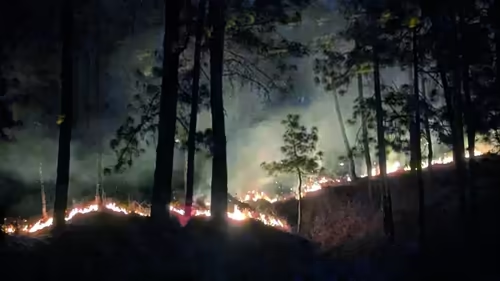
Winter is supposed to be a season of snow, silence, and stillness in the Himalayas. But this year, something is deeply wrong. From the pine-clad slopes of Uttarakhand to the cedar forests of Kashmir, plumes of smoke are rising where frost should be forming. Himalayan forest fires—once a summer phenomenon—are now erupting in the heart of winter, shattering decades of ecological predictability .
This isn’t just a local anomaly. It’s a national red flag. Since November 1, 2025, Uttarakhand alone has recorded the highest number of forest fire alerts in the entire country. And December—the month that should bring relief—has instead become one of the most active fire months on record . Experts aren’t just concerned; they’re alarmed.
Table of Contents
- Why Winter Forest Fires Are Unprecedented
- Uttarakhand on the Frontlines of the Crisis
- The Climate Change Connection
- Ecological and Human Consequences
- What Can Be Done? Next Steps
- Conclusion: A Winter That Burns
- Sources
Why Winter Forest Fires Are Unprecedented
Historically, forest fires in the Indian Himalayas followed a clear seasonal rhythm. They peaked between March and June, fueled by dry leaf litter, high temperatures, and strong winds. By November, the arrival of winter rains and dropping temperatures would naturally suppress fire risk .
But this cycle is breaking down. The emergence of intense fire activity in December and January—months when humidity is typically high and vegetation moist—is a stark deviation from the norm. This shift indicates that the natural fire regime is being overridden by new, human-driven forces, primarily climate variability .
Uttarakhand on the Frontlines of the Crisis
Among all Indian states, Uttarakhand has borne the brunt of this new reality. According to data from the Forest Survey of India (FSI), the state has logged more than 40% of the nation’s total fire alerts since early November 2025 . Districts like Pauri Garhwal, Tehri, and Almora have seen repeated outbreaks, often in remote, hard-to-reach terrain.
Local forest officials report that the usual winter moisture is absent. “The ground is bone-dry,” said one range officer on condition of anonymity. “Pine needles, which are highly flammable, haven’t decomposed because there’s been no rain. One spark is all it takes.”
The Climate Change Connection
Scientists point to a confluence of climate-driven factors behind these out-of-season Himalayan forest fires:
- Erratic Rainfall Patterns: The post-monsoon period (October–November) saw significantly below-average rainfall across North India, leaving forest floors parched.
- Rising Winter Temperatures: Average winter temperatures in the Himalayas have increased by over 1.5°C in the last three decades, according to the Indian Institute of Tropical Meteorology . Warmer winters mean faster evaporation and drier fuels.
- Increased Frequency of Western Disturbances: While these systems usually bring snow, recent years have seen them arrive weaker or later, failing to provide the critical winter moisture needed to dampen fire risk .
“This is not just ‘bad weather’—it’s a systemic shift,” explains Dr. Anjali Sharma, a climate ecologist at TERI. “The Himalayas are warming at twice the global average rate. What we’re seeing is the ecosystem responding to that stress through more frequent and intense fire events—even in winter.”
Ecological and Human Consequences
The impacts of these winter fires are far-reaching:
- Biodiversity Loss: Winter fires disrupt hibernation cycles, destroy seed banks, and kill saplings that wouldn’t normally face fire stress at this time of year.
- Soil Degradation: Repeated burning in the same areas reduces soil fertility and increases erosion, especially on steep Himalayan slopes.
- Air Quality Crisis: Smoke from these fires contributes to hazardous air quality in northern cities, compounding the winter smog problem.
- Water Security Threat: Healthy Himalayan forests act as water towers for millions. Their degradation directly threatens river flows and groundwater recharge .
For communities living in these regions, the fires also pose direct health and economic risks, damaging grazing lands and threatening livelihoods tied to forest resources.
What Can Be Done? Next Steps
Addressing this crisis requires a multi-pronged strategy:
- Early Warning Systems: Expand satellite-based fire detection (like MODIS and SNPP-VIIRS) with real-time ground verification networks.
- Community-Led Fire Management: Empower local Van Panchayats with training and resources for controlled burning and fuel load reduction before the fire season begins.
- Climate-Resilient Reforestation: Shift from monoculture pine plantations to mixed native species that are less flammable and more drought-resistant.
- National Policy Integration: Mainstream forest fire management into India’s National Action Plan on Climate Change (NAPCC) and State Adaptation Plans.
Readers interested in sustainable solutions can explore our guide on [INTERNAL_LINK:community-based-forest-conservation-in-india] for actionable insights.
Conclusion: A Winter That Burns
The sight of smoke rising over snow-capped peaks in January is more than just a paradox—it’s a warning. These out-of-season Himalayan forest fires are a visible symptom of a planet in distress. If current trends continue, what we’re witnessing may not be an anomaly, but the new normal. The time for reactive firefighting is over. India must now invest in proactive, science-based, and community-driven forest resilience to protect its most vital mountain ecosystem.
Sources
- Times of India: When winter burns: Uttarakhand to Kashmir, Himalayan forests are catching fire out of season
- Forest Survey of India (FSI): Forest Fire Monitoring Portal
- Indian Institute of Tropical Meteorology (IITM): Climate Change Research Reports
- Intergovernmental Panel on Climate Change (IPCC): AR6 Working Group II Report – Impacts on Mountain Regions