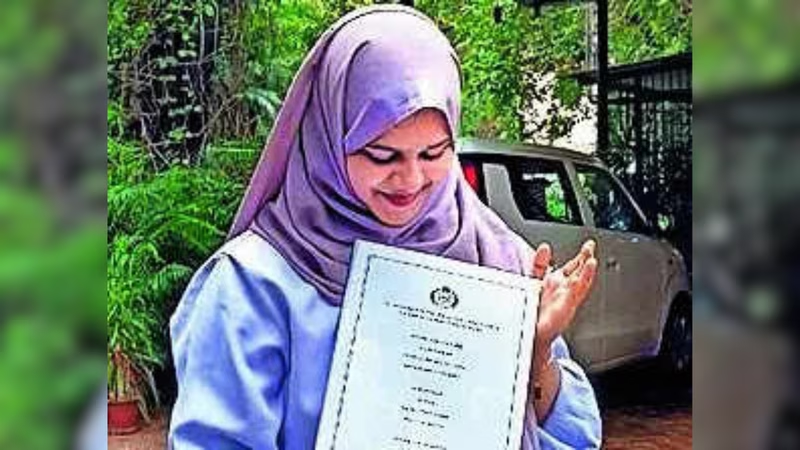
In early 2022, Gousiya’s education came to a sudden halt—not because of poor grades, lack of effort, or financial hardship—but because of a piece of cloth on her head. As the hijab ban controversy swept through Karnataka’s colleges, she, like hundreds of other Muslim girls, walked out of her undergraduate classroom, unsure if she’d ever return.
Fast forward to 2026: Gousiya isn’t just back—she’s thriving. She has successfully completed her **postgraduate degree in Medical Physics** with an impressive CGPA of over 8 and is now interning at a premier oncology institute in South India. Her goal? To become a certified **Radiation Safety Officer**, helping cancer patients access precise, life-saving treatment.
Her journey—from exclusion to excellence—is more than personal triumph. It’s a quiet but powerful rebuttal to those who believed the hijab row would end Muslim girls’ academic dreams. Instead, Gousiya turned her setback into a springboard.
Table of Contents
- The Hijab Row and Its Impact on Students
- Hijab Row Student Comeback: Gousiya’s Decision to Return
- Academic Excellence in Medical Physics
- The Road to Oncology: Internship and Career Goals
- What Happened to Her Peers? Six Friends Who Quit
- Broader Implications for Muslim Women in Higher Education
- Conclusion: Resilience as Resistance
- Sources
The Hijab Row and Its Impact on Students
The 2022 hijab controversy began when several pre-university colleges in Karnataka’s Udupi and Mangaluru districts barred Muslim girls from wearing the hijab in classrooms. What followed was a polarizing legal and social battle that reached the Karnataka High Court, which ultimately upheld the ban, citing uniformity and secularism.
For students like Gousiya, the ruling wasn’t just legal—it was personal. “We weren’t asking for special treatment,” she recalled in a recent interview. “We just wanted to learn, like everyone else.”
Many girls dropped out permanently. Some switched to open schooling. Others, like Gousiya, took a break—but never lost sight of their goals.
Hijab Row Student Comeback: Gousiya’s Decision to Return
After a year-long gap, Gousiya made a bold choice: she re-enrolled—not in the same college, but in a **postgraduate program in Medical Physics**, a field that combines physics, biology, and clinical practice to improve cancer care.
“I knew I couldn’t let one moment define my future,” she said. “If they wouldn’t let me wear my hijab in class, I’d make sure my work spoke so loudly, no one could ignore it.”
Her return wasn’t easy. She had to catch up on foundational science, manage financial strain, and face lingering trauma from the exclusion. Yet, she persisted—attending extra classes, forming study groups, and mentoring younger students navigating similar challenges.
Academic Excellence in Medical Physics
Medical Physics is a rigorous, niche discipline critical to modern oncology. It involves calibrating radiation machines, ensuring patient safety, and optimizing treatment plans—requiring precision, empathy, and deep technical knowledge.
Gousiya not only kept up—she excelled. With a CGPA of **8.2**, she ranked among the top students in her cohort. Faculty members noted her “exceptional problem-solving skills” and “commitment to ethical practice.”
Her success is even more significant given the underrepresentation of Muslim women in STEM fields in India. According to the Department of Science & Technology, less than 14% of women in technical higher education come from minority communities—a gap Gousiya is helping to bridge.
The Road to Oncology: Internship and Career Goals
Today, Gousiya is interning at a **tertiary oncology care center**, where she works alongside radiation oncologists and medical physicists to ensure accurate dose delivery for cancer patients.
“Every time I calibrate a machine, I think about how this could be someone’s mother, sister, or daughter,” she shared. “I want to be a **Radiation Safety Officer**—not just to have a job, but to protect lives.”
She’s also preparing for national certification exams and hopes to eventually pursue research in low-cost radiotherapy solutions for rural India.
What Happened to Her Peers? Six Friends Who Quit
Gousiya’s story stands in contrast to many of her friends. During the hijab row, **six of her close classmates dropped out in the fifth semester** and never returned to formal education.
- Two got married early, citing “no future in studies.”
- One started a home-based tailoring business.
- Three are still unsure what to do next.
“I miss them in class,” Gousiya said quietly. “I wish they could see that it’s possible to come back.” She now mentors former peers through online workshops on career alternatives, hoping to reignite their academic spark.
Broader Implications for Muslim Women in Higher Education
Gousiya’s journey highlights a critical issue: **policy decisions have long-term human consequences**. While the hijab debate centered on law and uniformity, its ripple effects included lost enrollment, mental health struggles, and diminished career trajectories for hundreds of young women.
Yet, her success also proves that **resilience, support systems, and accessible alternative pathways** can help students recover—and even thrive. Initiatives like Karnataka’s “Second Chance” education portals and private fellowships for marginalized students are slowly filling the gap.
For more on this, see [INTERNAL_LINK:muslim-women-in-stem-india-challenges-and-opportunities].
Conclusion: Resilience as Resistance
The phrase “hijab row student comeback” doesn’t just describe Gousiya’s return to the classroom—it embodies a form of quiet resistance. In a world that tried to silence her, she chose to study harder. When doors closed, she built her own.
Her story isn’t just about one woman’s success. It’s a call to educators, policymakers, and society: **never underestimate the determination of a student who believes in her right to learn**.
Sources
Times of India. (2026, January 4). Hijab row to postgrad push: Mangaluru student’s trek back to classroom. https://timesofindia.indiatimes.com/…
The Hindu. (2026). Muslim women in STEM: Breaking barriers in Karnataka. https://www.thehindu.com/…
Department of Science & Technology, Government of India. (2025). Women in STEM: Annual Report. https://www.dst.gov.in
NDTV. (2026). From hijab ban to oncology lab: Gousiya’s inspiring journey. https://www.ndtv.com/…