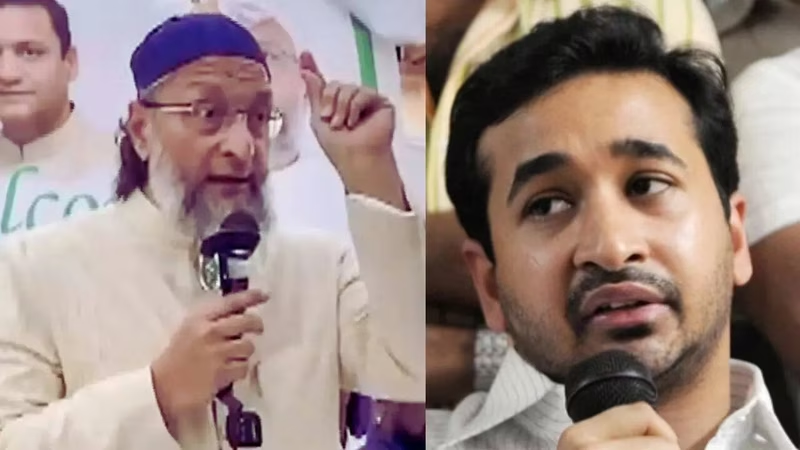
What does the face of India’s future leadership look like? For AIMIM chief Asaduddin Owaisi, it could very well be a woman in a hijab. In a statement that has sent shockwaves across the political spectrum, Owaisi declared, “One day, a hijab-clad woman will be Prime Minister of India.” His words weren’t just aspirational—they were a direct invocation of the secular ideals enshrined in the Indian Constitution. But his vision was met with immediate and scathing opposition from Maharashtra minister Nitish Rane, who retorted, “In a Hindu nation, a woman in a hijab or burqa will never become PM.”
This clash isn’t merely about one hypothetical future—it’s a microcosm of a much larger, ongoing battle over India’s soul: Is it a pluralistic democracy where every citizen has an equal shot at the highest office, or is it a nation defined by a singular religious identity? The hijab-clad PM debate has become the latest flashpoint in this defining struggle.
Table of Contents
- Owaisi’s Constitutional Vision
- Hijab-clad PM: Nitish Rane’s “Hindu Nation” Rebuttal
- What Does the Indian Constitution Really Say?
- Global Perspectives on Religious Garb in Politics
- The Politics of the Hijab in India
- Conclusion: A Battle for India’s Future
- Sources
Owaisi’s Constitutional Vision
Owaisi’s prediction wasn’t made in a vacuum. He framed it as a celebration of India’s foundational document. “Our Constitution allows it,” he asserted, drawing a stark contrast with countries like Pakistan, where he claims such religious expression in high office is restricted . His point was clear: India’s strength lies in its diversity and its legal guarantee of equality, regardless of religion, gender, or attire.
By imagining a Muslim woman in a hijab as Prime Minister, Owaisi was doing more than making a political statement—he was challenging societal norms and pushing back against rising Islamophobia. It was a call for inclusion, echoing the spirit of Article 14 (Right to Equality) and Article 25 (Freedom of Conscience and Free Profession, Practice and Propagation of Religion) of the Indian Constitution .
Hijab-clad PM: Nitish Rane’s “Hindu Nation” Rebuttal
Nitish Rane’s response was swift and unambiguous. Dismissing Owaisi’s vision as unrealistic, he doubled down on a majoritarian narrative. “India is a Hindu nation,” he stated, implying that national identity is intrinsically tied to Hinduism . His most controversial remark—suggesting that women who wear the hijab or burqa should “go to Islamic countries”—was widely condemned as xenophobic and exclusionary.
Rane’s comments reflect a growing political discourse that seeks to redefine India not as a secular republic, but as a civilizational state rooted in Hindu ethos. This perspective directly contradicts the Preamble of the Constitution, which explicitly declares India to be a “sovereign socialist secular democratic republic” . The tension between these two visions is at the heart of today’s political polarization.
What Does the Indian Constitution Really Say?
Let’s cut through the rhetoric. The Indian Constitution is unequivocal:
- Article 15: Prohibits discrimination on grounds of religion, race, caste, sex, or place of birth.
- Article 16: Guarantees equality of opportunity in matters of public employment.
- Article 25: Grants all persons the freedom to profess, practice, and propagate their religion.
Nowhere does it prescribe a dress code for public office. In fact, the Supreme Court of India has consistently upheld the right to religious expression as a fundamental freedom, provided it doesn’t infringe on public order or health . The idea that a citizen’s eligibility for the highest office could be contingent on their religious attire has no basis in law.
Global Perspectives on Religious Garb in Politics
India wouldn’t be alone if it elected a leader in religious attire. Around the world, democracies have embraced diverse symbols of faith in their leadership:
- In the United Kingdom, Muslim women MPs like Rushanara Ali wear the hijab in Parliament.
- In Indonesia, the world’s largest Muslim-majority democracy, female leaders often appear in public with headscarves.
- Even in the United States, Congress now includes members who wear religious garments, from kippahs to hijabs.
As noted by the Universal Declaration of Human Rights, “Everyone has the right to freedom of thought, conscience and religion” . The ability to hold public office while maintaining one’s religious identity is a hallmark of a mature democracy.
The Politics of the Hijab in India
The hijab has become a potent political symbol in India, far beyond its religious significance. From the Karnataka hijab ban in educational institutions to debates over its presence in government offices, the garment has been weaponized in culture wars. Critics frame it as a symbol of oppression, while its wearers see it as an act of personal faith and autonomy.
Owaisi’s comment forces a critical question: Should a woman’s choice of clothing disqualify her from leadership? [INTERNAL_LINK:religious-freedom-in-india] explores how courts have navigated these complex issues. The answer, according to constitutional experts, is a resounding no. A democracy that excludes citizens based on their religious expression is a democracy in name only.
Conclusion: A Battle for India’s Future
The debate over a hijab-clad PM is not really about one woman’s potential future. It’s about the kind of country India wants to be. Owaisi’s vision champions the inclusive, pluralistic democracy promised in 1947. Rane’s rebuttal reflects a more exclusionary, majoritarian ideal. This isn’t just political disagreement—it’s a fundamental contest over national identity. As India moves forward, the resolution of this conflict will determine whether its democracy deepens its commitment to equality or retreats into division. The world is watching.
Sources
- Times of India: ‘One day hijab-clad woman will be PM’: Owaisi’s prediction stirs row; BJP responds
- Constitution of India: Official Portal of the Government of India
- Supreme Court of India Judgments: On Religious Freedom and Expression
- United Nations: Universal Declaration of Human Rights