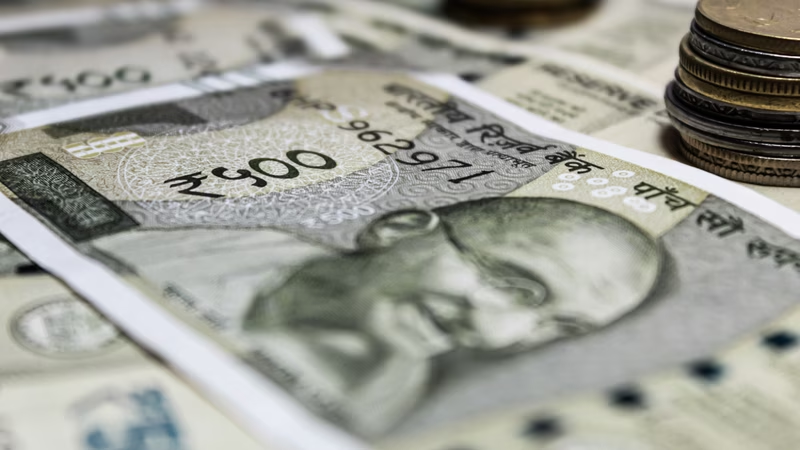
India is taking a giant leap forward in its fight against counterfeiting and document fraud. The Union Cabinet has given its nod to a colossal **Rs 1,800 crore** project to establish a brand-new high-security printing line. This state-of-the-art facility, to be operated by the Security Printing and Minting Corporation of India Limited (SPMCIL), will be dedicated to producing the nation’s most critical identity and value documents: banknotes and passports .
This isn’t just a routine infrastructure upgrade. It’s a strategic, future-proofing investment that signals a serious commitment to safeguarding the integrity of India’s financial and national security systems. In a world where sophisticated forgers are an ever-present threat, this move is both timely and essential.
Table of Contents
- The Big Announcement: What the Govt Approved
- Why India Needed This High-Security Printing Upgrade
- State-of-the-Art Technology to Combat Counterfeiting
- The Role of SPMCIL: India’s Security Printing Arm
- Beyond Banknotes: How Passport Security Will Benefit
- Economic and Strategic Implications
- Conclusion: A Secure Foundation for India’s Future
- Sources
The Big Announcement: What the Govt Approved
The Cabinet Committee on Economic Affairs (CCEA), chaired by the Prime Minister, has formally sanctioned a project worth **Rs 1,800 crore** (approximately $215 million USD) for SPMCIL . The primary objective is to set up a new, integrated high-security printing line at one of SPMCIL’s existing facilities.
This new line will be a one-stop shop for producing both Indian banknotes and machine-readable passports (MRPs). By centralizing and modernizing this production, the government aims to achieve several key goals: drastically enhance security features, improve production capacity to meet future demand, and ensure a more resilient and self-reliant supply chain for these critical national assets [INTERNAL_LINK:make-in-india-security-sector].
Why India Needed This High-Security Printing Upgrade
The existing printing infrastructure, while robust, is aging. As printing technology has advanced globally, so have the tools available to counterfeiters. The threat is twofold:
- Counterfeit Currency: The presence of fake Indian rupee notes in the economy not only causes direct financial losses but also undermines public trust in the currency and can be used to finance illicit activities.
- Fraudulent Documents: Fake or tampered passports pose a severe national security risk, enabling illegal immigration, human trafficking, and even potential terrorist activities.
This new investment is a direct and powerful response to these evolving threats, ensuring that India’s security documents are always several steps ahead of the criminals.
State-of-the-Art Technology to Combat Counterfeiting
While the government hasn’t disclosed the specific supplier of the new line, experts anticipate it will incorporate the latest generation of security printing technologies. This will likely include advanced features such as:
- Dynamic Security Threads: Threads that change appearance when tilted, making them extremely hard to replicate.
- Nano-Optic and 3D Elements: Sophisticated visual features that are virtually impossible to forge with standard printing equipment.
- Enhanced Polycarbonate Data Pages for Passports: Moving to more durable and secure materials for the bio-data page, which is the most critical part of a passport.
- Integrated Production Workflow: A seamless digital process from design to print that minimizes human handling and the risk of tampering.
These features will make new Indian banknotes and passports among the most secure in the world.
The Role of SPMCIL: India’s Security Printing Arm
The Security Printing and Minting Corporation of India Limited (SPMCIL) is a “Mini-Ratna” Category-I Central Public Sector Enterprise wholly owned by the Government of India, under the administrative control of the Department of Economic Affairs, Ministry of Finance .
SPMCIL is the sole entity authorized to print India’s currency notes, mint coins, and produce a wide array of other security products, including non-judicial stamp papers, cheques for public sector banks, and now, passports. This new project is a testament to the government’s trust in this public sector behemoth and its commitment to keeping this critical function in Indian hands. For more on India’s public sector enterprises, see the Department of Public Enterprises.
Beyond Banknotes: How Passport Security Will Benefit
While much of the focus is on banknotes, the upgrade for passport printing is equally, if not more, significant. India issues millions of passports every year, and their integrity is a direct reflection of the nation’s security posture on the global stage.
The new high-security printing line will enable the integration of more advanced biometric and anti-tamper features into Indian passports. This will not only enhance their security but also streamline international travel by ensuring they meet and exceed the International Civil Aviation Organization (ICAO) standards, leading to smoother immigration checks worldwide [INTERNAL_LINK:indian-passport-global-rankings].
Economic and Strategic Implications
The Rs 1,800 crore outlay is a significant capital expenditure, but its long-term benefits far outweigh the cost. It will create high-skilled jobs, boost the security printing and technology sector in India, and most importantly, protect the nation from the massive economic and security costs associated with fraud and counterfeiting.
Strategically, this move reduces India’s potential reliance on foreign printing technologies for its most sensitive documents, aligning perfectly with the ‘Atmanirbhar Bharat’ (Self-Reliant India) vision. It ensures that the very fabric of the nation’s identity and economy is produced on home soil with the highest possible security.
Conclusion: A Secure Foundation for India’s Future
The government’s approval of the Rs 1,800 crore project for a new high-security printing line is far more than a financial decision; it’s a foundational investment in India’s future security and economic integrity. By equipping SPMCIL with cutting-edge technology, the nation is taking a decisive stand against the evolving threats of counterfeiting and document fraud. This move promises to deliver banknotes that the public can trust implicitly and passports that command respect on the global stage, creating a more secure and resilient India for generations to come.
Sources
- Times of India: Govt approves Rs 1,800 cr for new high-security printing line for banknotes, passports
- Security Printing and Minting Corporation of India Ltd. (SPMCIL): Official Website
- Department of Public Enterprises, Government of India: Official Website
- International Civil Aviation Organization (ICAO): Machine Readable Travel Documents