Table of Contents
- The Cosmic Shield Beneath Alien Worlds
- What Are Magma Oceans and How Do They Form?
- The Magnetic Field Generator
- Why Super-Earths Are the Perfect Candidates
- Implications for Alien Life and Habitability
- Conclusion: Rethinking Planetary Protection
- Sources
The Cosmic Shield Beneath Alien Worlds
Imagine a planet with a secret weapon—a hidden, churning ocean of molten rock deep beneath its surface, acting as a planetary force field against the harsh realities of space. This isn’t science fiction; it’s a groundbreaking discovery in astrophysics. Scientists have found that buried magma oceans could be the key factor keeping many alien planets, especially massive ones known as super-Earths, from being stripped bare by their host stars’ intense radiation .
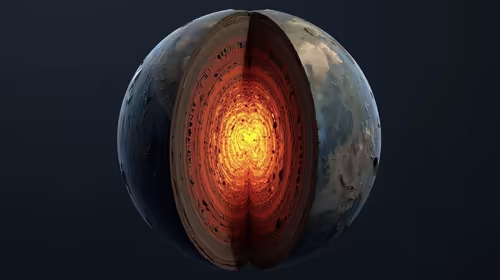
This revelation flips our understanding of planetary evolution on its head. Instead of being a sign of a young, chaotic world, a persistent magma layer might be a sign of a mature planet with a sophisticated internal defense system. The focus of this new research is a specific structure called a basal magma ocean, which sits at the boundary between a planet’s rocky mantle and its metallic core .
What Are Magma Oceans and How Do They Form?
Magma oceans are not a new concept. In the early days of our own solar system, the violent collisions that formed the planets generated so much heat that their surfaces were likely covered in seas of molten rock. Traditionally, scientists believed these oceans would eventually cool and solidify, forming the crust and mantle we see today.
However, the new theory suggests that on larger, more massive planets—those several times the size of Earth—the immense pressure and heat can keep a layer of this magma liquid for billions of years. This isn’t a surface feature but a deep, buried reservoir, a relic of the planet’s violent birth that never fully cooled .
The Magnetic Field Generator
So, how does a hidden ocean of molten rock protect a planet? The answer lies in its ability to generate a powerful magnetic field. On Earth, our protective magnetosphere is created by the dynamo effect: the movement of molten iron in our outer core. This magnetic field acts like an invisible shield, deflecting the solar wind—a stream of charged particles from the Sun—that would otherwise erode our atmosphere over time.
The new research proposes that a basal magma ocean can perform a similar function. Because this magma is a hot, electrically conductive fluid under extreme pressure, its movement can also generate a long-lasting magnetic field . This self-generated shield would be crucial for planets orbiting close to their stars, where stellar winds and radiation are most intense. Without such a shield, a planet’s atmosphere could be slowly stripped away, leaving it barren and lifeless .
Key Protective Mechanisms of Magma Oceans:
- Magnetic Dynamo: The churning, conductive magma creates a global magnetic field.
- Atmospheric Preservation: This magnetic field deflects stellar winds, preventing atmospheric erosion.
Unlike a cooling core, a basal magma ocean can remain active for the planet’s entire lifespan, offering sustained protection .
Why Super-Earths Are the Perfect Candidates
Super-Earths—rocky exoplanets with masses greater than Earth’s but less than ice giants like Neptune—are prime candidates for hosting these protective magma oceans. Their greater mass means stronger gravitational compression, which in turn generates the intense internal heat and pressure needed to keep a basal layer molten for eons .
It’s important to note that “super-Earth” refers only to a planet’s size and mass, not its actual conditions. Many could be scorching hot or frozen wastelands. But this new finding suggests that some of them might have a hidden advantage that makes them more resilient and potentially more habitable than previously thought .
Implications for Alien Life and Habitability
This discovery has profound implications for the search for extraterrestrial life. A stable atmosphere is a non-negotiable requirement for life as we know it. If a planet can maintain its atmosphere thanks to a magnetic shield from a buried magma ocean, its chances of developing and sustaining life increase dramatically.
Furthermore, this research shifts our focus. Instead of just looking for Earth twins, astrobiologists might now prioritize studying super-Earths, knowing they could possess this unique, built-in defense mechanism. It adds a new layer of complexity to our models of [INTERNAL_LINK:exoplanet-habitability] and forces us to reconsider what makes a planet truly “alive.” For a deeper dive into planetary formation, you can explore NASA’s extensive resources on exoplanet science.
Conclusion: Rethinking Planetary Protection
The idea that a planet’s greatest defense might lie not in its surface features but in its deep, molten interior is both fascinating and humbling. These hidden magma oceans represent a remarkable example of nature’s ingenuity, turning what was once seen as a destructive phase of planetary formation into a long-term survival strategy. As we continue to discover thousands of new alien worlds, this insight will be crucial in our quest to understand which of them might harbor the secrets of life.