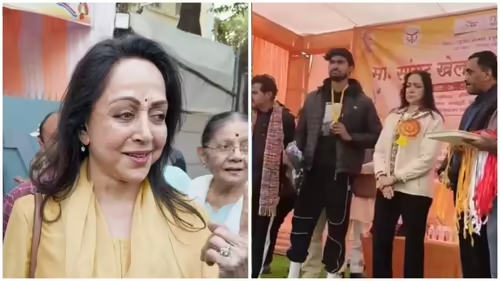
She’s been called the ‘Dream Girl’ of Indian cinema, served as a two-term Member of Parliament, and remains one of Bollywood’s most respected icons. Yet even at 77, Hema Malini isn’t spared from the relentless scrutiny of online trolls. Recently, a short video from a sports event in Mathura—where she was distributing medals—went viral for all the wrong reasons. Netizens slammed her for appearing “cold,” “unapproachable,” and worst of all, “not smiling.” But instead of staying silent, Malini delivered a quiet yet cutting response that has reignited conversations about gender, ageism, and the double standards faced by women in the public eye .
Table of Contents
- The ‘Not Smiling’ Video That Sparked a Storm
- Hema Malini Hits Back with a Pointed Remark
- Why Women Are Always Expected to Smile
- From Dream Girl to Politician: The Evolution of Hema Malini
- The BMC Elections Context
- Celebrity Trolling in India: A Growing Crisis
- Conclusion: Grace Under Fire
- Sources
The ‘Not Smiling’ Video That Sparked a Storm
The controversy began when a clip from a school-level athletics meet in Mathura surfaced online. In it, Hema Malini—dressed in a crisp white sari with a blue border—is seen handing out medals to young athletes. Her expression is neutral, focused, perhaps even tired after a long day of public duties. But to social media critics, that was enough.
Comments flooded in: “Why so serious?” “Smile, didi!” “Even at events, she looks annoyed.” Some even speculated she was “disrespecting” the children—a claim quickly debunked by attendees who praised her warmth backstage.
Hema Malini Hits Back with a Pointed Remark
Never one to engage in public spats, Malini chose an elegant form of clapback. While posing for photographers ahead of the Brihanmumbai Municipal Corporation (BMC) elections, she smiled broadly and said with a knowing glance: “Now don’t complain while I’m posing for paps.” The remark, shared widely on Instagram and X (formerly Twitter), was met with applause from fans and fellow celebrities alike .
It wasn’t just a quip—it was a statement. By contrasting her “on-duty” solemnity with her willingness to perform for cameras when expected, she highlighted the absurdity of demanding constant cheerfulness from women, especially older ones in positions of authority.
Why Women Are Always Expected to Smile
This incident taps into a deep-rooted cultural bias. Studies show that women are far more likely than men to be told to “smile” in professional and public settings—a phenomenon psychologists call “emotional labor policing.” According to a 2023 report by the Observer Research Foundation, 68% of Indian women in public life have faced criticism over their facial expressions, tone, or demeanor .
For male politicians or actors, a stern look conveys “strength” or “gravitas.” For women? It’s “rude” or “bitter.” Malini’s experience is not unique—but her platform allows her to challenge the narrative.
From Dream Girl to Politician: The Evolution of Hema Malini
Hema Malini’s career spans over five decades. She debuted in 1963 and rose to fame in the 1970s with films like Seeta Aur Geeta and Sholay. Known for her grace and classical dance background, she transitioned into politics in 2004, joining the BJP and winning the Mathura Lok Sabha seat twice.
Today, she balances film appearances, dance workshops, parliamentary duties, and social advocacy. Her public persona is no longer just that of an actress—it’s that of a stateswoman. And like any leader, she deserves the right to be serious when the moment calls for it.
The BMC Elections Context
Her recent public appearances—including the photo-op where she made her remark—are tied to the upcoming BMC elections, where she’s actively campaigning for BJP candidates. In this high-stakes environment, every image is curated, every word weighed. Her decision to address the trolling during such a politically sensitive time shows strategic awareness: she’s reclaiming her narrative while staying on message.
Celebrity Trolling in India: A Growing Crisis
Malini is far from alone. From Kangana Ranaut to Taapsee Pannu, female celebrities regularly face vitriolic online abuse for everything from their fashion choices to their political views. A 2025 study by the Internet Freedom Foundation found that 74% of abusive comments targeting women online contain gendered slurs or demands for emotional compliance—like “smile more” .
Platforms remain slow to act, and victims are often told to “ignore it.” But as Malini’s case shows, sometimes the best response is to expose the hypocrisy with wit and dignity.
Conclusion: Grace Under Fire
Hema Malini hits back not with anger, but with irony—a reminder that women shouldn’t have to perform perpetual happiness to be deemed worthy of respect. In a digital age that rewards outrage, her restraint is revolutionary. Whether on screen, on stage, or in Parliament, she continues to redefine what it means to be a woman of substance in India. And if that means not smiling for a camera while handing a medal to a child? So be it. For more on how public figures navigate online hate, see our feature on [INTERNAL_LINK:celebrity-mental-health-india].
Sources
- The Times of India. “Hema Malini hits back at trolls over ‘not smiling’ video.” January 15, 2026.
- Observer Research Foundation. “Gender and Emotional Labor in Indian Public Life.” orfonline.org, 2023.
- Internet Freedom Foundation. “Online Harassment of Women in India: Patterns and Policy Gaps.” iff.in, 2025.
- Parliament of India. “Member Profile: Smt. Hema Malini.” sansad.in.