Table of Contents
- A Deceptive Blue Hue
- HD 189733 b: The Anatomy of a Nightmare World
- The Glass Rain Phenomenon Explained
- How NASA Discovered This Alien Hellscape
- Is HD 189733 b Really Earth-Like?
- Why Studying Extreme Exoplanets Matters
- Conclusion: A Sobering Perspective on Our Own Blue Planet
- Sources
A Deceptive Blue Hue
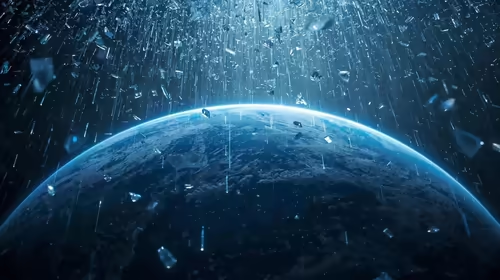
From a distance, it’s a stunning sight: a deep, cobalt blue sphere hanging in the void of space. At first glance, HD 189733 b might even be mistaken for a cousin of our own Earth, another beautiful blue marble in the cosmos. But this is where the similarity ends—and the horror begins. That serene blue color isn’t from oceans or a life-sustaining atmosphere. It’s the signature of a world where the very sky is a weapon .
NASA’s observations have revealed that this exoplanet is a place of unimaginable extremes, a cosmic pressure cooker where the weather makes our worst hurricanes look like a gentle breeze. The most infamous feature? A perpetual storm system that hurls droplets of molten glass at speeds that defy comprehension.
HD 189733 b: The Anatomy of a Nightmare World
Discovered in 2005, HD 189733 b is a “hot Jupiter”—a gas giant that orbits incredibly close to its parent star. Located about 63 light-years away in the constellation Vulpecula, its year is a mere 2.2 Earth days long. This proximity means its atmosphere is superheated to a scorching 1,700 degrees Fahrenheit (over 900 degrees Celsius) .
At these temperatures, silicate particles in the atmosphere melt into droplets of glass. But the real terror comes from the planet’s insane wind speeds. Scientists have clocked the jet streams on HD 189733 b at a mind-blowing **5,400 miles per hour**—that’s seven times the speed of sound and over 20 times faster than the strongest tornado ever recorded on Earth. These supersonic winds don’t just blow the glass rain down; they blast it sideways, creating a horizontal blizzard of razor-sharp, molten shards.
The Glass Rain Phenomenon Explained
So, how does it actually rain glass? The process is a brutal cycle of heat and violence:
- Evaporation: Intense stellar radiation heats the upper atmosphere, vaporizing silicate rock.
- Condensation: As these vapors rise and cool slightly in the upper cloud decks, they condense into tiny droplets of molten glass.
- Precipitation & Propulsion: Instead of falling gently, these droplets are immediately caught in the planet’s hyper-sonic jet streams, which fling them horizontally across the sky at 5,400 mph.
This isn’t a gentle shower; it’s a relentless, planet-wide sandblasting event with liquid glass.
How NASA Discovered This Alien Hellscape
The secrets of HD 189733 b were unlocked using some of the most sophisticated tools in astronomy. NASA’s Hubble Space Telescope played a pivotal role. By observing the planet as it passed in front of its star (a transit), scientists could analyze the starlight filtering through its atmosphere. This technique, called transmission spectroscopy, revealed the chemical fingerprints of sodium, water vapor, and, most tellingly, the silicate particles responsible for the blue color and the glass rain .
Further observations, including measurements of the planet’s temperature map, showed a massive hot spot offset from the point directly facing the star. This offset was the smoking gun for the existence of those supersonic winds, which carry the intense heat around the planet’s globe at an incredible pace.
Is HD 189733 b Really Earth-Like?
The original summary mentions the planet “possibly resembling Earth,” but this is a dangerous oversimplification that needs clarification. While both are blue, that’s where the comparison ends. Earth is a rocky, temperate world with liquid water oceans and a life-sustaining atmosphere. HD 189733 b is a bloated gas giant with no solid surface, a toxic atmosphere, and weather that would instantly vaporize any known form of life.
Calling it “Earth-like” based solely on its color is a classic case of cosmic deception. It serves as a powerful reminder that in the universe, appearances can be profoundly misleading. Its value lies not in its habitability, but in its extremity—a natural laboratory for studying atmospheric physics under conditions we can never replicate on Earth.
Why Studying Extreme Exoplanets Matters
Studying hellish worlds like HD 189733 b isn’t just about satisfying scientific curiosity. It’s crucial for our broader understanding of planetary science. By pushing our models to their limits with these extreme cases, we refine our ability to interpret data from more temperate, potentially habitable worlds. [INTERNAL_LINK:exoplanet-habitability] Understanding the full spectrum of planetary possibilities—from frozen ice balls to glass-rain infernos—helps us better define the narrow band of conditions that make a planet truly Earth-like and capable of supporting life.
Conclusion: A Sobering Perspective on Our Own Blue Planet
HD 189733 b stands as a stark and terrifying monument to the violent beauty of the universe. Its deep blue color, once a symbol of potential, is now a warning label. It reminds us that our own pale blue dot is a rare and precious anomaly—a haven of calm in a cosmos filled with chaos. The next time you see a rainstorm, be grateful it’s just water. On HD 189733 b, the sky itself is trying to kill you.
Sources
[1] Times of India: This blue planet, possibly resembling Earth, experiences rain of glass at 5400 mph
[4] NASA Exoplanet Archive: HD 189733 b Fact Sheet (https://exoplanets.nasa.gov/exoplanet-catalog/2826/hd-189733-b/)