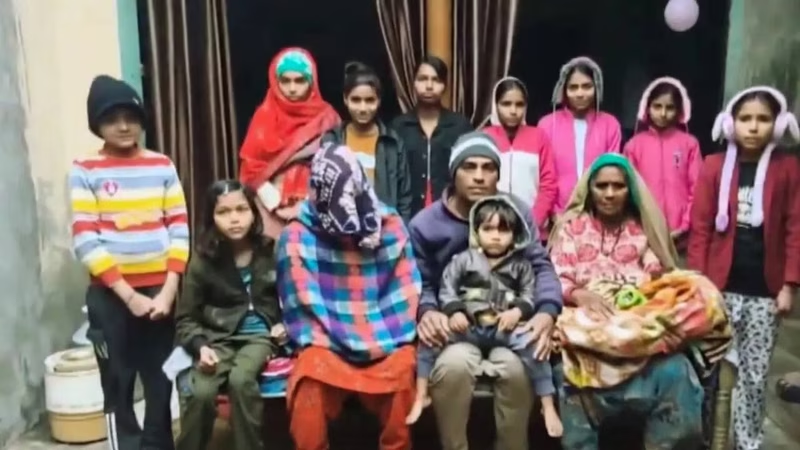
In a small village in Haryana, a father’s offhand remark—“Sometimes I forget their names”—has sparked national conversation. The man, who welcomed his 11th child and first son after ten daughters, casually admitted he struggles to recall all his daughters’ names . On the surface, it’s a humorous quip. But beneath it lies a painful truth about deep-rooted son preference that continues to shape family dynamics across parts of India—even as the country celebrates girls with grand rituals elsewhere in the same state .
This paradox—of both celebrating daughters and yearning for sons—captures the complex, often contradictory, journey of gender equity in Haryana, a state historically known for its skewed sex ratio. The story of this father isn’t just anecdotal; it’s a mirror reflecting the slow, uneven pace of social change.
Table of Contents
- Haryana Father 10 Daughters 1 Son: The Story Behind the Headlines
- The Gender Paradox in Haryana: Celebrating Daughters While Craving Sons
- Why Son Preference Persists: Cultural, Economic, and Social Factors
- Government Efforts and Ground Reality
- What Needs to Change: Mindsets and Measurement
- Conclusion: A Single Father’s Words, a Nation’s Challenge
- Sources
Haryana Father 10 Daughters 1 Son: The Story Behind the Headlines
The now-viral quote comes from a 42-year-old farmer in Haryana’s Jind district, who, after more than two decades of marriage and ten daughters, finally had a son. In an interview with the Times of India, he chuckled and said, “Sometimes I forget their names,” referring to his daughters .
His tone wasn’t malicious—it was matter-of-fact, almost resigned. But that’s what makes it so telling. The comment reveals an unconscious hierarchy: the son, long awaited, is unforgettable; the daughters, though numerous and present, blur together in memory. This isn’t about malice—it’s about internalized bias so normalized it goes unquestioned.
Meanwhile, in another part of Haryana, families are now hosting “laadli” ceremonies—traditionally reserved for sons—to celebrate the birth of daughters with equal fanfare . These contrasting images—one of erasure, one of celebration—define the state’s current struggle with gender identity.
The Gender Paradox in Haryana: Celebrating Daughters While Craving Sons
Haryana has long battled one of India’s worst child sex ratios. In 2011, the state recorded just 834 girls per 1,000 boys (0–6 years)—far below the national average of 918 . Aggressive government campaigns like Beti Bachao, Beti Padhao (Save the Girl Child, Educate the Girl Child) have helped improve the ratio to around 921 by 2023 .
Yet numbers alone don’t tell the full story. Symbolic gestures—like celebrating daughters with cradles, sweets, and public announcements—are growing. But as the “I forget” father shows, symbolic change hasn’t fully penetrated private attitudes. The desire for a male heir remains powerful, tied to notions of lineage, old-age security, and social status.
Why Son Preference Persists: Cultural, Economic, and Social Factors
Several interconnected factors keep son preference alive:
- Cultural Continuity: Sons are seen as carriers of the family name and essential for performing last rites—a belief rooted in Hindu tradition .
- Economic Burden: Despite progress, daughters are still often viewed as financial liabilities due to dowry practices and wedding expenses.
- Social Security: In rural areas with weak pension systems, parents rely on sons for care in old age.
- Community Pressure: A man without a son may face ridicule or be seen as “incomplete” in traditional settings.
These pressures create immense psychological strain on women to produce male children—leading to repeated pregnancies, health risks, and, in extreme cases, sex-selective abortions, which remain illegal but persist underground.
Government Efforts and Ground Reality
Programs like Beti Bachao, Beti Padhao, launched in 2015, have invested billions in awareness, education, and enforcement of laws against sex determination . Haryana’s government has also offered cash incentives (up to ₹2.5 lakh) for families with daughters who remain unmarried until 21 and complete their education.
While these efforts have shifted public discourse, they haven’t fully altered private beliefs. As one sociologist noted, “You can change policy overnight, but changing a 300-year-old mindset takes generations” . The “I forget” comment is proof that legal and financial incentives must be paired with deeper emotional and cultural education.
For more on India’s evolving gender landscape, see our feature on [INTERNAL_LINK:india-gender-equality-progress]. You can also explore official data on child sex ratios from the Government of India’s Census portal.
What Needs to Change: Mindsets and Measurement
True progress won’t just be measured in improved sex ratios, but in moments like this:
- A father proudly listing all his daughters’ names before mentioning his son.
- A mother saying, “I just want healthy children,” without specifying gender.
- Communities valuing daughters not as “gifts to be given away” but as permanent members of the family legacy.
This requires engaging men and boys in the conversation, integrating gender equality into school curricula, and amplifying stories of families who cherish their daughters unconditionally—not as a response to campaigns, but as a natural norm.
Conclusion: A Single Father’s Words, a Nation’s Challenge
The phrase “Sometimes I forget” might seem small. But in it lies the weight of centuries of bias. The story of the Haryana father 10 daughters 1 son is not just his—it’s a reflection of a society in transition, caught between old habits and new hopes. Celebrating daughters with rituals is a start. But until every child—girl or boy—is remembered, valued, and named with equal pride, the journey toward true gender equality remains unfinished.
Sources
[1] Times of India. (2026, January 7). ‘Sometimes I forget’: Son after 10 daughters, father struggles to recall all daughters’ names. https://timesofindia.indiatimes.com/…
[2] Reports on ‘laadli’ ceremonies for daughters in Haryana villages.
[4] Census of India 2011 – Child Sex Ratio data.
[5] Ministry of Women and Child Development – Beti Bachao, Beti Padhao progress reports.
[6] Sociological studies on son preference in North India.
[7] Expert commentary from gender studies researchers at Jawaharlal Nehru University.