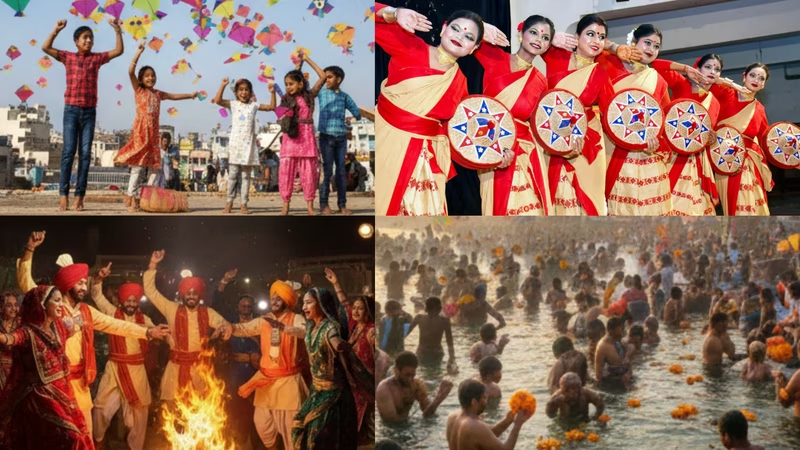
As winter’s chill gives way to the first whispers of spring, India erupts in color, song, and celebration—not for a royal wedding or a national holiday, but for something far more primal: the harvest. Across the country, from the snow-dusted fields of Punjab to the lush paddy plains of Assam, communities gather to give thanks for nature’s bounty. These aren’t just parties—they’re ancient rituals woven into the fabric of agrarian life, passed down through generations.
Welcome to the world of the harvest festivals of India—a dazzling mosaic of regional traditions that share a common heartbeat: gratitude for the earth’s generosity.
Table of Contents
- What Are the Major Harvest Festivals of India?
- Makar Sankranti: A Solar Celebration of Renewal
- Lohri: Punjab’s Bonfire of Gratitude and Youth
- Bihu: Assam’s Trilogy of Seasons and Songs
- Pongal / Thai Pongal: Tamil Nadu’s Four-Day Thanksgiving
- Why These Festivals Matter in Modern India
- Conclusion: A United “Thank You” from a Diverse Land
- Sources
What Are the Major Harvest Festivals of India?
India celebrates multiple harvest festivals of India in January, each aligned with the solar calendar and marking the end of the winter cropping season. Though names and customs vary wildly by region, their essence is universal: honoring farmers, thanking nature, and sharing joy with family and community.
The four most prominent include:
- Makar Sankranti (North, West, and South India)
- Lohri (Punjab, Haryana, Himachal Pradesh)
- Bihu (Assam and Northeast)
- Pongal (Tamil Nadu and parts of South India)
Each festival carries its own folklore, food, and flair—but all orbit around the same sun: agricultural abundance.
Makar Sankranti: A Solar Celebration of Renewal
Unlike most Indian festivals based on the lunar calendar, Makar Sankranti follows the solar cycle, falling on January 14 (or 15 in leap years). It marks the sun’s northward journey—Uttarayan—a time considered highly auspicious in Hindu cosmology.
In Gujarat and Rajasthan, skies fill with colorful kites as families shout “Kai po che!” (Cut it!). In Maharashtra, people exchange til-gul (sesame-jaggery sweets) with the saying, “Til gul ghya, god god bola”—eat this sweet and speak sweetly. Meanwhile, in Karnataka, it’s Suggi, where girls carry decorated baskets of sugarcane and bananas to newly married couples .
This festival isn’t just about fun—it’s a spiritual reset, symbolizing the shedding of darkness and the embrace of light and growth.
Lohri: Punjab’s Bonfire of Gratitude and Youth
Celebrated a day before Makar Sankranti, Lohri is Punjab’s fiery ode to winter’s end. At dusk, communities gather around a massive bonfire, tossing popcorn, rewari (sesame candy), and puffed rice into the flames as offerings to Agni, the fire god.
Children go door-to-door singing folk songs about Dulla Bhatti—a legendary Robin Hood figure who rescued girls from slavery—and collect treats. The night crescendos with bhangra and gidda, energetic dances that pulse with the rhythm of the land.
Lohri also holds special significance for newborns and newlyweds, who are celebrated as symbols of new beginnings—a beautiful blend of agrarian joy and social renewal .
Bihu: Assam’s Trilogy of Seasons and Songs
While most regions celebrate one harvest festival, Assam honors three Bihus throughout the year. But it’s Magh Bihu (or Bhogali Bihu) in mid-January that aligns with the pan-Indian winter harvest.
For Magh Bihu, villagers build temporary huts called bhelaghars from bamboo and thatch, cook feasts of chira (flattened rice), pitha (rice cakes), and roasted meat, and spend the night around a meji (bonfire). At dawn, the hut is burned—a ritual symbolizing sacrifice and renewal.
Traditional games like buffalo fights and egg fights add playful energy, while Bihu geet (folk songs) echo themes of love, labor, and the land . It’s a festival where agriculture, art, and community fuse seamlessly.
Pongal / Thai Pongal: Tamil Nadu’s Four-Day Thanksgiving
In Tamil Nadu, the harvest is honored over four days during Thai Pongal. The centerpiece? A clay pot of milk and rice boiled until it overflows—shouting “Pongalo Pongal!” as it does, symbolizing abundance.
Each day has meaning:
- Bhogi: Old items are burned; homes are cleaned and decorated.
- Surya Pongal: The main day—offering the Pongal dish to the Sun God.
- Mattu Pongal: Cattle are bathed, painted, and worshipped for their role in farming.
- Kaanum Pongal: Families reunite; people visit beaches or parks.
It’s a holistic celebration that ties human life, animal labor, and cosmic cycles into one grateful narrative .
Why These Festivals Matter in Modern India
In an age of urbanization and digital distraction, these festivals serve as vital anchors to India’s agrarian roots. They remind us that food doesn’t come from apps—it comes from soil, sweat, and seasons.
Moreover, they foster intergenerational bonding. Grandparents teach kite-flying techniques; mothers pass down pitha recipes; uncles lead bonfire chants. These aren’t just customs—they’re living libraries of cultural knowledge.
For travelers and culture seekers, experiencing a local harvest festival offers an authentic window into India’s soul—far beyond monuments and malls. [INTERNAL_LINK:best-time-to-visit-india-for-festivals]
As UNESCO notes, intangible cultural heritage like these festivals “transmits knowledge and skills from one generation to the next” and strengthens community identity .
Conclusion: A United “Thank You” from a Diverse Land
Whether it’s flying a kite in Ahmedabad, dancing around a bonfire in Amritsar, or boiling Pongal in Chennai, India’s harvest festivals of India are a collective sigh of relief and joy after months of hard work. They prove that despite our linguistic, culinary, and ritual differences, we share a profound respect for the land that feeds us.
In a world racing toward the future, these festivals gently pull us back—to the soil, to our elders, and to the simple, sacred act of saying thank you.
Sources
- [1] Times of India: Sankranti, Lohri, Bihu and beyond: Tracing the harvest celebrations of India
- [2] Ministry of Culture, Government of India: Festivals of India Portal
- [3] Assam Tourism: Official Bihu Festival Guide
- [4] Tamil Nadu Tourism: Thai Pongal Celebrations
- [5] UNESCO Intangible Cultural Heritage: UNESCO ICH