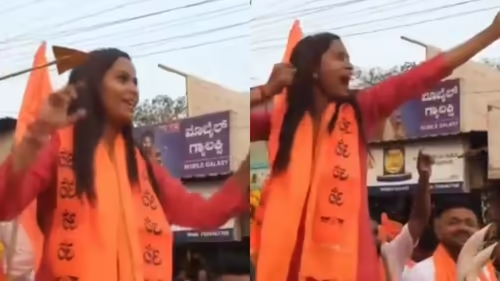
A simple hand gesture has ignited a firestorm in Karnataka. Harshita Thakur, a prominent Hindu leader from Maharashtra, now finds herself at the center of a national controversy after being accused of making a provocative ‘arrow-shooting’ gesture towards the historic Ansari Dargah in Belagavi. The incident, which occurred during a procession linked to an ‘Akhanda Hindu Sammelana,’ has led to a police case, widespread condemnation, and a heated debate on the boundaries of free speech and religious respect [[4], [22]].
Table of Contents
- The Incident: What Happened in Belagavi?
- Who is Harshita Thakur? A Profile of the Accused
- Legal Ramifications: The IPC Sections Invoked
- The Ansari Dargah: A Symbol of Sufi Heritage
- Political and Social Fallout
- Conclusion: Walking the Tightrope Between Faith and Law
- Sources
The Incident: What Happened in Belagavi?
On January 19, 2026, during a Hindu procession in Machhe village, Belagavi taluk, Harshita Thakur was travelling in an open vehicle as it passed the Syed Ansari Dargah near Peeranawadi . According to multiple eyewitness accounts and a viral video clip, Thakur allegedly made repeated gestures mimicking the act of shooting an arrow directly towards the sacred shrine [[3], [9]]. The act was reportedly accompanied by supporters chanting religious slogans like ‘Jai Shri Ram’ . This sequence of events prompted a formal complaint, leading the Belagavi Rural Police to register a case against Thakur and six other individuals associated with the event [[2], [7]].
Who is Harshita Thakur? A Profile of the Accused
Harshita Thakur is a known Hindutva activist from Maharashtra, often associated with hardline nationalist groups. Her public appearances are typically marked by strong rhetoric and a focus on Hindu identity politics. While she has a significant following on social media, this incident marks her most serious legal trouble to date, placing her under intense public scrutiny .
Legal Ramifications: The IPC Sections Invoked
The police case against Thakur is not a minor one. It invokes some of the most serious sections of the Indian Penal Code (IPC) related to religious offenses. These include:
- Section 295A: This section criminalizes “deliberate and malicious acts intended to outrage religious feelings of any class by insulting its religion or religious beliefs” [[12], [17]]. It is the primary charge in cases of this nature.
- Section 298: This deals with “uttering words, or making sounds or gestures, with deliberate intent to wound the religious feelings of any person” .
- Section 153A: This section penalizes acts that promote “enmity between different groups on grounds of religion” and is often used in cases where an action is seen as inciting communal discord .
These charges carry significant prison terms, reflecting the gravity with which the Indian legal system views acts that threaten communal harmony .
The Ansari Dargah: A Symbol of Sufi Heritage
The target of the alleged gesture, the Ansari Dargah, is more than just a building; it’s a centuries-old spiritual landmark for the local Muslim community. Dargahs across India, like the famous one in Ajmer, are memorials to Sufi saints and serve as centers for peace, devotion, and interfaith dialogue . An attack—real or symbolic—on such a place is perceived as a direct assault on the community’s faith and heritage, which explains the depth of the hurt and anger expressed in the complaint .
Political and Social Fallout
The incident has sent shockwaves through Belagavi’s social fabric, a region already sensitive to communal dynamics. Local leaders from various communities have called for calm, while others have demanded strict legal action to prevent further escalation . The case has also become a flashpoint in the national political discourse, with opposition parties criticizing the government for failing to maintain law and order, while some ruling party figures have called for a fair investigation without jumping to conclusions. The situation remains tense, and authorities are on high alert to prevent any retaliatory actions.
Conclusion: Walking the Tightrope Between Faith and Law
The Harshita Thakur case is a stark reminder of how quickly a single moment can unravel social cohesion. It forces us to confront difficult questions about the limits of expression in a diverse society. While the courts will ultimately decide the legal culpability, the social damage has already been done. The path forward requires a commitment from all sides—leaders, citizens, and institutions—to prioritize mutual respect and the rule of law over inflammatory symbolism. For more on the legal framework surrounding religious freedom and hate speech in India, you can refer to resources from the Indian Ministry of Law and Justice.
Sources
- Times of India: Maharashtra-based Hindu leader Harshita Thakur, 6 others booked for provocative gesture against Ansari dargah in Belagavi
- Indian Penal Code (IPC) Sections: Section 295A, 298, 153A
- SuperSport & Other News Reports: Various reports on the incident details and legal proceedings.