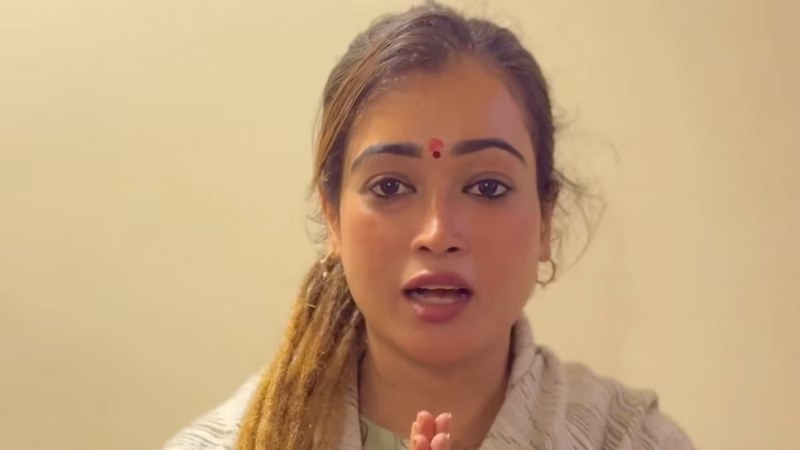
On the sacred banks of the Narmada River in Jabalpur, a striking figure emerged from the waters on Makar Sankranti. Clad in simple white, her head shaved, stood Harsha Richharia—a woman whose life has been a study in contrasts. Just a few years ago, she was known as a glamorous model and television anchor. Today, she identifies as a sadhvi, a female ascetic dedicated to spreading dharma. Her public act of devotion, however, has reignited a complex national conversation about faith, femininity, and who gets to claim the mantle of spirituality in modern India.
In a heartfelt statement following the ritual, Richharia expressed her deep connection to Maa Narmada and her hometown of Jabalpur . She didn’t shy away from her past, stating she is “proud” of her career in media but is now fully committed to her spiritual path. Yet, her very public presence as a spiritual figure has drawn fire, not from secular critics, but from within religious circles themselves—a pain she openly acknowledged . This tension between her old world and her new one makes Harsha Richharia a fascinating and controversial symbol of contemporary spiritual seeking.
Table of Contents
- Who is Harsha Richharia? A Journey from Entertainment to Enlightenment
- The Narmada Dip: A Symbolic Rebirth on Makar Sankranti
- Harsha Richharia Defends Her Spiritual Path
- The Backlash: Criticism from Within the Faith
- The Evolving Face of Female Asceticism in India
- Conclusion: A Modern Quest for Meaning
- Sources
Who is Harsha Richharia? A Journey from Entertainment to Enlightenment
Before her name became synonymous with spiritual discourse, Harsha Richharia was a fixture in the world of Indian television and modeling. Her career spanned anchoring popular shows and appearing in various media projects, a path that offered fame, financial security, and a public platform . For many, this would have been the pinnacle of success. But for Richharia, it appears to have been merely a chapter.
Her transition from the entertainment industry to a life of renunciation is not an isolated phenomenon. In recent decades, India has seen a growing number of individuals, particularly women, leaving behind conventional careers to pursue spiritual paths. What makes Richharia’s story stand out is the visibility she brings to this choice. Unlike traditional ascetics who often retreat from public view, she uses her existing platform to share her journey, making her a bridge between ancient traditions and a digital-age audience.
The Narmada Dip: A Symbolic Rebirth on Makar Sankranti
Makar Sankranti is a major Hindu festival marking the sun’s transition into Capricorn and the end of winter solstice. It’s considered an auspicious time for ritual baths, especially in sacred rivers like the Ganga, Yamuna, and Narmada. The Narmada, in particular, holds immense spiritual significance in central India and is personified as a goddess—Maa Narmada.
By choosing to take her holy dip in the Narmada on this specific day, Richharia was engaging in a deeply symbolic act. It represented a cleansing, a renewal, and a reaffirmation of her commitment to her chosen path. Her choice of Jabalpur, her hometown, adds a layer of personal homecoming to the spiritual ritual, grounding her divine connection in a very human sense of place and belonging .
Harsha Richharia Defends Her Spiritual Path
Faced with skepticism, Richharia has been remarkably candid. She doesn’t reject her past; instead, she integrates it into her present narrative. “I am proud of my work as an anchor and actor,” she stated, framing her previous career not as a contradiction to her current life, but as a different phase of her evolution .
Her mission now, she explains, is to “spread dharma.” This term, which can be loosely translated as righteousness, duty, or cosmic law, is central to her new identity. She sees her role not just as a personal quest for liberation (moksha), but as a public service—to guide others on a righteous path. This outward-facing aspect of her spirituality is key to understanding both her appeal and the controversy surrounding her.
The Backlash: Criticism from Within the Faith
Perhaps the most poignant part of Richharia’s statement was her admission of pain over criticism from fellow members of the religious community. This is a crucial detail. The resistance isn’t coming from outsiders questioning the validity of faith, but from insiders who appear to have a rigid, traditional blueprint for what a sadhvi should look like and how she should behave.
Their objections likely stem from several unspoken rules:
- The Rule of Anonymity: Traditional ascetics often shun publicity, believing that fame is antithetical to spiritual progress.
- The Rule of Provenance: There’s often an expectation of a long, documented lineage or initiation under a well-known guru, which may be absent or less visible in Richharia’s case.
- The Rule of Appearance: Her past as a public figure in the entertainment industry may be seen by some as incompatible with the perceived purity required of a spiritual leader.
This internal gatekeeping highlights a significant tension within modern Hinduism: the struggle to reconcile ancient monastic ideals with the realities of a connected, celebrity-driven world.
The Evolving Face of Female Asceticism in India
Historically, the path of the sadhvi has been a powerful, albeit often marginalized, avenue for women seeking autonomy and spiritual authority outside the confines of marriage and family. Figures like Anandamayi Ma and Mata Amritanandamayi have shown that female spiritual leadership is not only possible but can command vast followings .
Richharia represents a new generation of this tradition—one that is comfortable using social media, giving interviews, and engaging directly with the public. She is not hiding in an ashram; she is building her spiritual practice in the full glare of the public eye. Whether this is a dilution of the tradition or a necessary evolution for it to remain relevant in the 21st century is the central question her life poses.
Conclusion: A Modern Quest for Meaning
Harsha Richharia’s story is more than just a personal transformation; it’s a mirror reflecting the complexities of modern Indian identity. In a society grappling with rapid change, her journey from model to sadhvi speaks to a deep, universal human desire for meaning that transcends material success. Her public rituals and her defense against critics are acts of courage that challenge us to expand our definitions of faith and who is allowed to embody it.
Love her or question her, you cannot ignore her. Her presence forces a conversation about authenticity, tradition, and the right of every individual, regardless of their past, to seek their own spiritual truth. For more on the lives of influential women in Indian spirituality, explore our feature on [INTERNAL_LINK:pioneering-female-gurus-of-india].