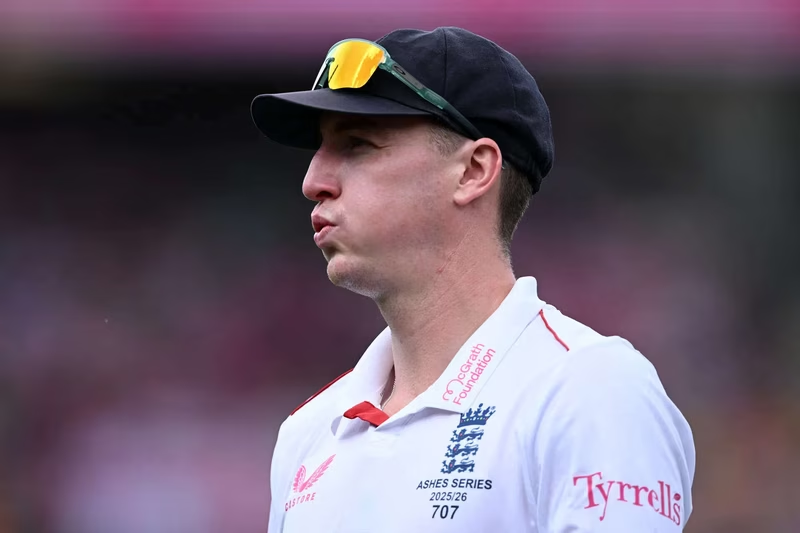
“I am deeply sorry.” These four words from Harry Brook have sent shockwaves through English cricket, reopening a wound many hoped had healed after a demoralizing England Ashes tour. The white-ball captain’s public apology for a now-infamous nightclub incident in New Zealand isn’t just about one man’s mistake—it’s the spark that’s reigniting a crucial conversation about professionalism, culture, and accountability in the national team.
With the England and Wales Cricket Board (ECB) already deep in its post-mortem of the Ashes disaster, Brook’s admission has turned the microscope firmly onto the team’s off-field conduct. Was this a single lapse in judgment, or a symptom of a deeper, systemic issue?
Table of Contents
- The Nightclub Incident and Brook’s Apology
- England Ashes: A Campaign Defined by Chaos?
- The ECB’s Response and the Final Warning
- A History of Off-Field Controversies
- What This Means for the Future of English Cricket
- Conclusion: Accountability Is the First Step
- Sources
The Nightclub Incident and Brook’s Apology
The incident in question occurred in late 2025, just weeks before the England squad was scheduled to depart for the Ashes tour in Australia. According to reports, a physical altercation broke out at a nightclub in Auckland involving Brook and another individual . While details remain sparse, the fallout was immediate and severe.
Brook, who has been one of England’s most exciting batting talents in recent years, has now broken his silence. In a carefully worded statement, he said, “I am deeply sorry for my actions. My behaviour was wrong and I accept that it caused embarrassment to my team, my family, and the sport I love” . His apology is a rare moment of public contrition from a current England player, acknowledging the gravity of his actions beyond just a private reprimand.
England Ashes: A Campaign Defined by Chaos?
The timing of this apology is critical. It comes on the heels of what many are calling the worst England Ashes performance in a generation. The team was not only outplayed on the field but was also dogged by persistent rumors of internal discord and unprofessional behavior off it .
While on-field failures can often be attributed to skill or strategy, off-field controversies strike at the heart of a team’s culture and discipline. Brook’s incident, happening so close to the tour’s start, raises serious questions about the pre-tour environment and the level of oversight from team management. Did this event set a negative tone for the entire campaign? The ECB’s ongoing review is almost certainly exploring this very connection.
The ECB’s Response and the Final Warning
In the immediate aftermath of the New Zealand incident, the ECB acted swiftly. Brook was handed a significant fine and, more importantly, a final warning about his future conduct . This is not a slap on the wrist. In disciplinary terms, a final warning is the last step before more severe sanctions, including potential suspension from international duty.
This suggests the ECB views the matter as extremely serious. The fact that they allowed Brook to tour with the Ashes squad was likely a calculated risk, betting on his immense talent to outweigh the disciplinary concerns. However, with the tour ending in failure, that decision is now under intense scrutiny. The public apology may be Brook’s attempt to get ahead of the narrative before the ECB’s full review report is published.
A History of Off-Field Controversies
English cricket has a long and complicated relationship with off-field discipline. From the 2010 “Textgate” scandal to various incidents involving alcohol and altercations, the team has often struggled to project an image of professionalism. Brook’s incident is the latest in a recurring pattern that threatens to undermine the sport’s credibility.
Here’s a quick look at past incidents that have plagued the England setup:
- 2010 Ashes Tour: Players involved in late-night drinking sessions and a now-infamous “ding dong” incident.
- 2013-14 Ashes Tour: A major team culture review was launched after a 5-0 whitewash in Australia, citing poor team dynamics.
- 2018: Multiple players reprimanded for breaching team protocols during a tour.
The recurring nature of these problems points to a need for a cultural reset, not just a series of one-off punishments. [INTERNAL_LINK:england-cricket-team-culture-history] could provide more context on this long-standing issue.
What This Means for the Future of English Cricket
The ECB’s forthcoming review is more than just an Ashes post-mortem; it’s a potential blueprint for the future of the entire England program. The spotlight on off-field conduct, amplified by Brook’s apology, means the board will likely be forced to address several key areas:
- Player Education: Implementing more robust programs on professionalism, media handling, and personal responsibility.
- Leadership Accountability: Clarifying the role of the captain and senior players in setting and enforcing team standards.
- Clear Disciplinary Framework: Moving beyond vague warnings to a transparent system with consistent consequences.
For Harry Brook, his future as a leader in the England setup now hangs in the balance. His apology is a necessary first step, but his actions in the coming months will be the true test of his character and his commitment to the team.
As the BBC’s chief sports correspondent has noted, “A team’s culture is its most valuable asset. When that’s damaged, even world-class talent can’t compensate for the loss of unity and trust” .
Conclusion: Accountability Is the First Step
Harry Brook’s “I am sorry” is more than just a personal mea culpa. It’s a public acknowledgment that the off-field actions of England’s players have consequences far beyond a single night out. In the context of a disastrous England Ashes campaign, his apology has become a catalyst for a much-needed and long-overdue conversation about the soul of the national team.
The ECB now has a clear choice: continue to paper over the cracks with fines and warnings, or use this moment to drive a fundamental and lasting change in the team’s culture. For the sake of English cricket’s future, let’s hope they choose the latter.
Sources
- Times of India: ‘I am deeply sorry’ – Harry Brook’s apology puts spotlight on England’s off-field conduct
- BBC Sport: ECB confirms fine and final warning for Harry Brook over New Zealand incident
- The Guardian: ECB to launch ‘root-and-branch’ review of Ashes failures
- ESPNCricinfo: Harry Brook apologises for ‘wrong’ behaviour in New Zealand altercation
- Sky Sports: Brook given final warning by ECB after pre-Ashes incident