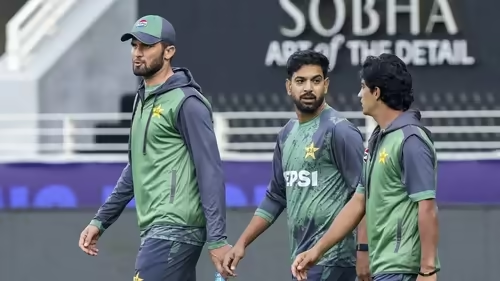
The countdown to the ICC Men’s T20 World Cup 2026 is on, and Pakistan just made its most controversial call yet. According to multiple reports, pace sensation Haris Rauf—one of the fastest and most lethal bowlers in T20 cricket—may not be boarding the plane to the Caribbean and USA .
The decision, driven by head coach Mike Hesson and backed by the Pakistan Cricket Board (PCB), marks a dramatic shift in strategy. Despite delivering standout performances in Australia’s Big Bash League (BBL), Rauf’s prolonged absence from Pakistan’s T20I setup since the 2025 Asia Cup appears to have sealed his fate. The message is clear: current form abroad won’t override team cohesion and tactical alignment at home.
Table of Contents
- Why Haris Rauf Might Miss the T20 World Cup
- Mike Hesson’s New Vision for Pakistan Bowling
- The Big Bash Form Paradox
- Who Could Replace Rauf in the Squad?
- Fan and Expert Reactions to the Decision
- Conclusion: A Risky but Calculated Move
- Sources
Why Haris Rauf Might Miss the T20 World Cup
On paper, excluding Haris Rauf seems unthinkable. He’s consistently ranked among the top T20 bowlers globally, with a slingy action, searing yorkers, and death-over mastery that has troubled even the best batters. In the 2025–26 BBL season, he was among the leading wicket-takers for Melbourne Stars, clocking speeds over 145 km/h and maintaining an economy under 8.
Yet, his last appearance for Pakistan in T20Is was during the 2025 Asia Cup. Since then, he’s been absent—officially due to “rest and recovery,” though rumors of disagreements over workload management have swirled. The PCB, under Hesson’s guidance, now appears to prioritize players who are fully integrated into the current system, both physically and philosophically.
As one selector anonymously told a local outlet: “It’s not just about skill. It’s about availability, attitude, and alignment with the team’s evolving identity.”
Mike Hesson’s New Vision for Pakistan Bowling
New Zealand’s former head coach Mike Hesson, brought in to overhaul Pakistan’s white-ball approach, is steering the ship toward a more disciplined, data-driven model. Gone are the days of relying solely on raw pace and aggression. Hesson wants bowlers who can execute specific plans under pressure, vary lengths intelligently, and contribute in the field.
This shift favors bowlers like Naseem Shah, who has shown improved control, and emerging talents like Mohammad Wasim Jr. and Abbas Afridi, who offer seam movement and lower-economy options. The focus is on versatility over brute speed—a philosophy that, while effective in New Zealand, is untested in Pakistan’s high-stakes, high-emotion cricket culture.
The Big Bash Form Paradox
Rauf’s case highlights a growing tension in modern cricket: should overseas franchise performance guarantee national selection?
While leagues like the BBL, IPL, and SA20 showcase talent, national teams operate under different pressures—team chemistry, specific opposition strategies, and long-term planning. The PCB’s stance suggests they believe consistent participation in Pakistan’s setup trumps sporadic brilliance abroad.
But critics argue this is short-sighted. “Ignoring a player in peak form because he wasn’t available for a few bilateral series is like refusing a Ferrari because it missed a test drive,” said a former Pakistan captain on social media.
Who Could Replace Rauf in the Squad?
If Rauf is indeed axed, Pakistan’s T20 World Cup pace attack will likely feature:
- Naseem Shah: The frontline leader, now more mature and consistent.
- Shaheen Shah Afridi: Returning from injury, expected to spearhead the attack.
- Abbas Afridi: Offers bounce and aggression, with improving death skills.
- Mohammad Wasim Jr.: A left-arm option with clever variations.
- Haris Rauf’s absence opens the door for a wildcard—perhaps a young gun like Akif Javed or a spin-bowling all-rounder to add balance.
Notably, the squad may lean heavier on spin, with Usama Mir and Mohammad Nawaz expected to play crucial roles in subcontinental-style conditions—even in the Americas.
Fan and Expert Reactions to the Decision
Pakistani fans are divided. On one side, supporters applaud the PCB for enforcing discipline and building a cohesive unit. “No player is bigger than the team,” reads a popular tweet.
On the other, many see it as a massive gamble. “Rauf is our X-factor in death overs. Without him, we’re predictable,” argued a prominent sports analyst on Geo Super.
International observers note that similar decisions have backfired before—like South Africa omitting Dale Steyn in 2019 or England dropping Ben Stokes in 2018. The stakes are high, and the margin for error at a T20 World Cup is razor-thin.
Conclusion: A Risky but Calculated Move
The potential exclusion of Haris Rauf from Pakistan’s T20 World Cup squad is more than a selection headache—it’s a statement of intent. Under Mike Hesson, Pakistan is betting on structure over stardom, process over personality, and long-term vision over short-term fireworks.
Whether this gamble pays off in June 2026 remains to be seen. But one thing is certain: if Pakistan lifts the trophy without their fastest bowler, it will be hailed as a masterstroke. If they falter in the knockout stages, this decision will be remembered as the moment they gambled—and lost—their biggest weapon. For ongoing updates on Pakistan’s World Cup preparations, check out our [INTERNAL_LINK:t20-world-cup-2026-preview] coverage.
Sources
- Times of India: Key Pakistan bowler to miss T20 World Cup: PCB decides to go in different direction
- ESPNcricinfo: ICC Men’s T20 World Cup 2026
- PCB Official Website: Pakistan Cricket Board
- Big Bash League Stats: BBL 2025-26 Player Statistics