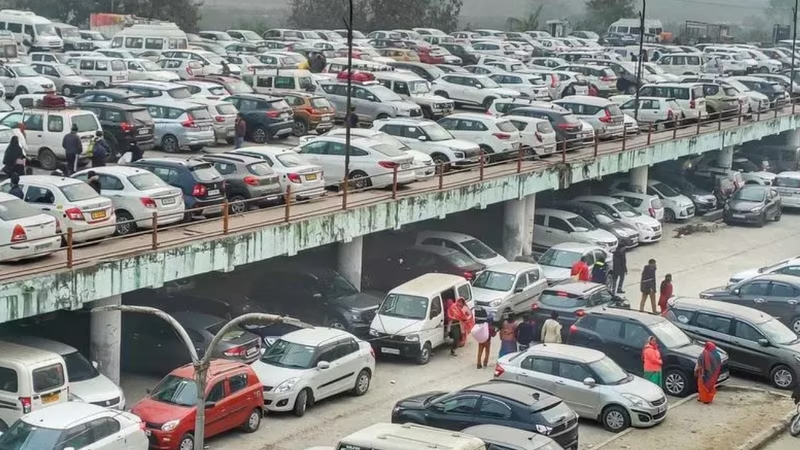
In a horrifying act of violence that has left Haridwar reeling, a parking lot manager was fatally run over by two tourists from Haryana following a petty dispute over a ₹20 parking fee. The brutal incident—captured in part by bystanders and CCTV—occurred at the Deen Dayal Upadhyay parking facility near Har Ki Pauri, one of Hinduism’s holiest sites. What began as a minor argument escalated within seconds into a deliberate vehicular assault, claiming the life of a man simply doing his job.
Table of Contents
- The Fatal Incident in Haridwar
- Haridwar Parking Manager Killed: Police Response and Arrests
- Road Rage or Premeditated Violence?
- Legal Consequences Under Indian Law
- Broader Implications for Tourism and Public Safety
- Conclusion: A Call for Accountability and Respect
- Sources
The Fatal Incident in Haridwar
The victim, identified as 42-year-old Rajesh Kumar (name changed for privacy in some reports), was managing vehicle entry at the Deen Dayal Upadhyay parking complex on January 9, 2026, during peak evening hours . According to eyewitnesses, two men in a white SUV refused to pay the standard ₹20 parking fee, claiming they were only stopping “for a minute.”
When Rajesh insisted on payment—as per municipal guidelines—the argument grew heated. Within moments, the driver allegedly reversed aggressively, then accelerated forward, deliberately striking Rajesh and pinning him under the vehicle before speeding away . Bystanders rushed to help, and Rajesh was immediately shifted to a nearby hospital with critical injuries. He succumbed to his injuries the following day, leaving behind a wife and two young children.
Haridwar Parking Manager Killed: Police Response and Arrests
Following public outcry and viral video footage, the Haridwar police launched a swift manhunt. Using vehicle registration records and highway toll data, they traced the SUV to Rohtak, Haryana. Within 36 hours, both accused—identified as Vikas Yadav and Ankit Malik, both in their early 30s—were arrested and brought back to Uttarakhand .
Police have filed a stringent FIR under multiple sections of the Indian Penal Code, including:
- Section 302: Murder
- Section 201: Destruction of evidence (for fleeing the scene)
- Section 34: Common intention
Both men are currently in judicial custody, and the court has denied them bail, citing the “brutal and callous” nature of the crime .
Road Rage or Premeditated Violence?
While initial reports labeled this as “road rage,” investigators now believe the act was intentional. Forensic analysis of skid marks and vehicle trajectory suggests the driver didn’t swerve accidentally—he aimed. “This wasn’t a momentary loss of temper; it was an execution-style act of intimidation that went horribly wrong,” said a senior police official who requested anonymity .
The incident reflects a disturbing trend of entitlement among some tourists, particularly in religious towns like Haridwar, Rishikesh, and Varanasi, where local staff are often treated as invisible service providers rather than citizens deserving dignity and respect.
Legal Consequences Under Indian Law
If convicted under Section 302 IPC, the accused face either life imprisonment or the death penalty, especially given the brutality and public nature of the crime. The Supreme Court of India has repeatedly emphasized that crimes committed in public spaces—particularly those involving vehicles as weapons—warrant the harshest penalties to deter copycat behavior [[INTERNAL_LINK:indian-road-rage-laws]].
Additionally, the victim’s family is entitled to compensation under the Uttarakhand Victim Compensation Scheme, which provides up to ₹5 lakh for families of homicide victims. Civil society groups are also pushing for stricter penalties for hit-and-run cases involving intent.
Broader Implications for Tourism and Public Safety
Haridwar, a key pilgrimage site on the banks of the Ganges, welcomes millions of visitors annually. Yet incidents like this expose systemic vulnerabilities:
- Lack of standardized parking enforcement: Many lots operate through informal contractors with little oversight.
- Inadequate security: Few public parking areas have panic buttons or direct police connectivity.
- Cultural disconnect: Out-of-state tourists sometimes display disregard for local norms and workers.
Local authorities have announced plans to install AI-enabled CCTV cameras at all major parking zones and mandate digital payment systems to reduce cash-based disputes—a move long overdue but now tragically catalyzed by death.
Conclusion: A Call for Accountability and Respect
The Haridwar parking manager killed case is more than a crime—it’s a mirror held up to societal attitudes toward service workers and public decorum. A ₹20 fee should never cost a life. As India’s spiritual towns modernize, they must also humanize. Justice for Rajesh isn’t just about punishing two men; it’s about ensuring no parking attendant, street vendor, or sanitation worker lives in fear while serving the public. In the land of dharma, respect must be non-negotiable.