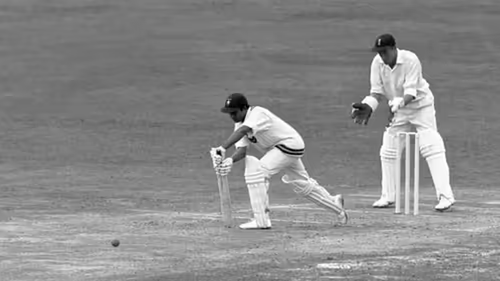
Picture this: You’re playing against one of the most fearsome bowling attacks in cricket history—Wes Hall, Charlie Griffith, and Sonny Ramadhin haven’t even been born yet, but you’re already facing legends like Garry Sobers, Wes Hall’s predecessors, and Clyde Walcott. Your team has been forced to follow on. Defeat seems inevitable. And then, one man decides to stand tall—not for an hour, not for a day—but for **four straight days**.
That man was Hanif Mohammad. And his innings of 337 in Bridgetown, Barbados, in January 1958 remains not just a Pakistani treasure, but a global monument to patience, resilience, and sheer willpower in Test cricket. At **970 minutes at the crease**, it’s still the longest individual innings in Test history by time—and arguably the greatest escape act ever witnessed on the field .
Table of Contents
- The Context: Pakistan on the Brink
- Hanif Mohammad 337: A Masterclass in Defence
- Why This Innings Changed Cricket History
- Records and Legacy of the Bridgetown Epic
- How Modern Batters Compare to Hanif’s Marathon
- Conclusion: More Than Runs—A Test of Human Spirit
- Sources
The Context: Pakistan on the Brink
The third Test of Pakistan’s 1958 tour of the West Indies was a disaster in the making. After being bowled out for just **106** in their first innings, Pakistan conceded a massive **473-run lead** to the hosts. Forced to follow on—a rare and humiliating position—they were staring at an innings defeat.
Enter Hanif Mohammad, the “Little Master” (a title later borrowed by Sunil Gavaskar). Already known for his grit, Hanif walked in at No. 3 with the scoreboard reading 1/1. What followed wasn’t just batting—it was a siege defense with a willow.
Hanif Mohammad 337: A Masterclass in Defence
Hanif’s innings spanned **16 hours and 10 minutes** over four days (January 17–20, 1958). He faced an estimated **600+ deliveries**—though exact ball counts weren’t recorded then—and struck only **33 boundaries**. His strike rate? Around 55 per 100 balls. In today’s T20 era, that might seem glacial. But in 1958, against a hostile Caribbean pace-spin combo, it was revolutionary.
Key highlights of the innings:
- Batted with a broken finger for part of the knock
- Shared a crucial 109-run stand with brother Wazir Mohammad
- Was the last man out—declaring himself retired hurt only after ensuring safety
- Scored more than **triple** the next-highest individual score in the match
His concentration was so intense that he reportedly didn’t speak to anyone during breaks. He ate sparingly, avoided distractions, and treated every ball like a life-or-death decision. As former teammate Intikhab Alam later said, “He didn’t just bat—he meditated with a bat in hand.”
Why This Innings Changed Cricket History
Before Hanif’s 337, no team had ever avoided defeat after being forced to follow on with such a massive deficit. His knock didn’t just save the match—it redefined what was possible in Test cricket. It proved that **mental fortitude could overcome physical odds**, and that a single player could alter the fate of a five-day contest through sheer endurance.
Moreover, it gave Pakistan—a nation barely 11 years old—its first moral victory on the world stage. In a post-colonial era where identity was fragile, Hanif’s heroics became a symbol of national pride and resilience.
Records and Legacy of the Bridgetown Epic
Over six decades later, Hanif’s 337 still holds legendary status:
| Record | Status |
|---|---|
| Longest innings by time in Test cricket | 970 minutes – STILL STANDING |
| Highest individual score by a Pakistani in West Indies | Unbroken for 40+ years |
| First triple-century in a follow-on situation | Only one of three in history (with VVS Laxman & Michael Clarke) |
While Brian Lara (400*) and Matthew Hayden (380) have since scored bigger numbers, none matched Hanif’s **time investment** or **match context**. His innings remains the gold standard for crisis management in Test cricket.
How Modern Batters Compare to Hanif’s Marathon
In today’s game, where strike rates dominate and sessions are often sacrificed for aggression, Hanif’s approach feels almost alien. Even elite defensive batters like Cheteshwar Pujara or Kane Williamson rarely face 500+ balls in a single innings.
[INTERNAL_LINK:greatest-test-innings-of-all-time] analysts argue that the modern pitch conditions, lighter bats, and protective gear make long innings easier—but the mental toll of batting for 16 hours under scoreboard pressure is unmatched. As ESPNcricinfo notes, “Hanif’s 337 wasn’t just about runs; it was a psychological fortress built ball by ball” .
Conclusion: More Than Runs—A Test of Human Spirit
Hanif Mohammad 337 transcends statistics. It’s a testament to what humans can achieve when pushed to the edge. In an age of instant gratification, his innings reminds us that greatness sometimes demands silence, solitude, and relentless focus. For cricket fans, historians, and dreamers alike, the Bridgetown epic isn’t just a chapter in a record book—it’s a timeless lesson in courage.
Sources
- Times of India: The great escape: When Pakistan’s Hanif Mohammad batted four days to save Test
- ESPNcricinfo: Hanif Mohammad’s 337: The innings that redefined resilience
- International Cricket Council (ICC): Hanif Mohammad – ICC Hall of Fame Profile