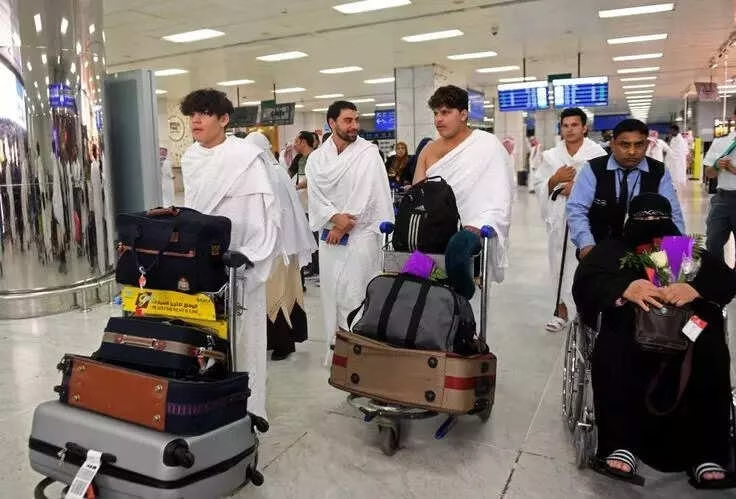
For decades, the Egyptian government covered the cost of Hajj for thousands of citizens each year—a gesture of religious solidarity and social support that thousands counted on to fulfill one of Islam’s Five Pillars. But in a move that has stunned the nation and the wider Muslim world, Egypt has officially ended its free Hajj program for Hajj 2026 .
Starting this year, the roughly 12,000 Egyptians who will make the sacred journey to Mecca must either enter a new digital lottery system or book through licensed, paid Hajj packages. This seismic shift isn’t just administrative—it’s deeply personal for millions of devout Egyptians who viewed the state-sponsored pilgrimage as both a spiritual lifeline and a social entitlement. So, what’s behind this controversial decision, and how will it reshape the experience of Hajj for ordinary citizens?
Table of Contents
- Why Egypt Ended Free Hajj 2026
- The New Hajj 2026 System: Digital Lottery and Paid Packages
- Impact on Ordinary Egyptian Pilgrims
- Transparency and Economic Reforms Behind the Change
- How to Apply for Hajj 2026 Under the New Rules
- Conclusion
- Sources
Why Egypt Ended Free Hajj 2026
The decision to terminate the free Hajj program is not happening in a vacuum. It’s part of Egypt’s broader economic restructuring efforts under pressure from international financial institutions like the International Monetary Fund (IMF). With inflation hovering near double digits and foreign reserves under strain, the government is aggressively trimming subsidies across multiple sectors—from fuel and bread to now, religious travel .
According to officials from Egypt’s Ministry of Religious Affairs, maintaining the free Hajj program had become financially unsustainable. The cost per pilgrim—covering flights, visas, accommodation, and ground logistics in Saudi Arabia—ranged between $3,000 to $5,000. With up to 18,000 pilgrims in some years, that’s an annual expenditure of nearly $90 million .
The New Hajj 2026 System: Digital Lottery and Paid Packages
Under the revamped framework for Hajj 2026, the government has introduced a two-tier system designed to ensure fairness and curb corruption:
- Digital Lottery for Limited Free Slots: Approximately 12,000 spots will be allocated via a transparent, online lottery managed by the Ministry of Religious Affairs. This is not a return to full subsidies but a highly restricted allocation aimed at low-income applicants who meet strict eligibility criteria.
- Licensed Paid Packages: All other pilgrims must book through one of the 120 government-approved travel agencies. These packages will be standardized, with prices published on an official portal to prevent price gouging .
New visa and health documentation rules have also been aligned with Saudi Arabia’s updated Hajj regulations, including mandatory digital health passports and biometric registration.
Impact on Ordinary Egyptian Pilgrims
For many Egyptians, especially those in rural areas or from working-class backgrounds, the dream of Hajj was only possible because of state support. With its removal, that dream is now out of reach for countless families.
“My father saved for 20 years, but it was still not enough,” says Amina Hassan, a schoolteacher from Assiut. “The free Hajj was his only hope. Now, even the lottery feels like a long shot.”
Religious scholars and community leaders have expressed concern that the policy shift could deepen social inequality, turning a spiritual obligation into a luxury accessible only to the wealthy. Some fear it may also push desperate pilgrims toward unlicensed, illegal operators—a major safety and legal risk.
Transparency and Economic Reforms Behind the Change
Despite the public outcry, government officials insist the new system promotes transparency and efficiency. In past years, the free Hajj list was often criticized for being manipulated by local officials or reserved for political loyalists . The digital lottery, they argue, removes human bias and ensures a fairer distribution.
Moreover, by licensing only reputable travel agencies, the state aims to protect pilgrims from fraud and ensure they receive quality services. This move mirrors similar reforms in countries like Indonesia and Pakistan, which have also transitioned to regulated, market-based Hajj systems in recent years.
Still, critics question whether economic pragmatism should override religious accessibility—especially in a country where over 90% of the population is Muslim and views Hajj as a sacred duty.
How to Apply for Hajj 2026 Under the New Rules
If you’re an Egyptian citizen planning for Hajj 2026, here’s what you need to know:
- Step 1: Monitor the official Ministry of Religious Affairs portal ([www.egypt.gov.eg/hajj](https://www.egypt.gov.eg/hajj)) for the lottery registration window, expected to open in March 2026.
- Step 2: If not selected, browse the list of licensed Hajj operators on the same portal. All packages must be displayed with clear pricing and inclusions.
- Step 3: Ensure your passport is valid for at least six months beyond Hajj dates and that you meet Saudi health requirements (including vaccination proof).
- Step 4: Submit biometric data and complete the Saudi e-visa application through the approved agency or the National E-Government Portal.
[INTERNAL_LINK:hajj-requirements-saudi-arabia-2026] For a detailed guide on Saudi Arabia’s Hajj entry rules for 2026, click here.
Conclusion
Egypt’s decision to end free Hajj for Hajj 2026 marks a profound shift in the relationship between state and citizen in matters of faith. While driven by economic necessity and a push for reform, the move carries deep emotional and social consequences. For millions of devout Egyptians, the path to Mecca has just become longer, more uncertain, and significantly more expensive. As the new system rolls out, its true test will be whether it can balance fiscal responsibility with the spiritual needs of a nation for whom Hajj is not just a journey—but a lifelong calling.
Sources
- Times of India: Hajj 2026 shock: Why has Egypt ended free pilgrimage trips?
- Al-Ahram: Egypt introduces digital lottery for Hajj 2026
- IMF Country Report: Egypt: Economic Reform and Subsidy Restructuring
- Saudi Ministry of Hajj and Umrah: Official Hajj Regulations 2026
- [INTERNAL_LINK:global-hajj-policies-comparison] How Other Countries Manage Hajj Pilgrimage