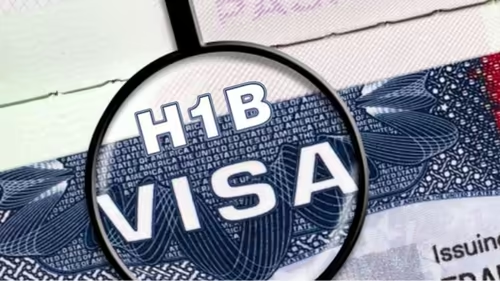
In a move that has sent shockwaves through academia and the tech industry alike, Texas Governor Greg Abbott has issued a directive demanding that every public school, college, and university in the state provide a comprehensive list of all employees working on H-1B visas. The order, framed as a measure to “ensure the safety and security of our students and to protect American jobs,” has thrust the long-simmering debate over skilled foreign labor back into the national spotlight [[1]].
The demand comes at a time of heightened political tension over immigration and workforce policies. While proponents argue it’s a necessary step for transparency and accountability, critics warn it could have a chilling effect on international recruitment, damage Texas’s reputation as a hub for innovation, and potentially violate privacy laws.
Table of Contents
- What is the H-1B Visa and Why Does It Matter?
- The Governor’s Order: Details and Justification
- H-1B Workers in Texas Schools: Who Are They?
- The Backlash from Academia and Tech Industry
- Legal and Ethical Concerns Raised
- Broader Implications for US Immigration Policy
- Conclusion: A Divisive Move with Far-Reaching Consequences
- Sources
What is the H-1B Visa and Why Does It Matter?
The H-1B visa is a non-immigrant visa that allows U.S. employers to temporarily hire foreign workers in specialty occupations that require theoretical or technical expertise. These fields typically include science, technology, engineering, mathematics (STEM), and—critically for this story—higher education.
Universities and research institutions are among the largest users of the H-1B program, employing thousands of international postdoctoral researchers, professors, and specialized administrative staff. These individuals are often at the forefront of groundbreaking research and are vital to maintaining the global competitiveness of American academia [[2]].
The Governor’s Order: Details and Justification
Governor Abbott’s directive, sent to the Texas Higher Education Coordinating Board and the Texas Education Agency, requires a detailed inventory of all H-1B holders within their respective systems. The letter explicitly states, “We want to make sure that we are not displacing American workers and that these individuals are properly vetted” [[1]].
The Governor’s office has linked the order to broader concerns about national security and economic protectionism. They argue that in an era of global competition, it is essential to ensure that taxpayer-funded institutions are prioritizing American citizens for employment opportunities. This stance aligns with a growing political narrative that views certain immigration programs as a threat to domestic workers.
H-1B Workers in Texas Schools: Who Are They?
The term “educational institutes” in the Governor’s order casts a wide net, but the primary impact will be felt in the state’s major research universities like UT Austin, Texas A&M, and Rice University. The H-1B workers in Texas schools are not typically K-12 teachers. Instead, they are more likely to be:
- Postdoctoral Researchers: Early-career scientists conducting vital research in labs.
- Visiting Professors and Lecturers: Experts brought in for their specialized knowledge in niche fields.
- IT and Data Specialists: Professionals managing complex university IT infrastructure and data systems.
- Administrative Staff in Specialized Roles: Such as international student advisors or grant compliance officers with specific technical expertise.
These roles are often highly specialized, and finding qualified American candidates can be challenging, especially in emerging fields. [INTERNAL_LINK:impact-of-h1b-on-us-research] explores this dynamic in greater depth.
The Backlash from Academia and Tech Industry
The reaction from university leaders and the tech sector has been swift and critical. The University of Texas system expressed “deep concern” about the order, stating it could “undermine our ability to attract and retain the world’s best talent” [[3]].
Tech companies, many of which partner closely with Texas universities, echoed these sentiments. They argue that the pipeline of international talent from academia is crucial for their own workforce. Creating a hostile environment for these workers, they warn, could drive innovation and investment to other states or countries with more welcoming policies.
Legal and Ethical Concerns Raised
Beyond the practical objections, the order has raised significant legal and ethical questions:
- Privacy Violations: Compiling and submitting a list based on an individual’s immigration status could violate federal and state privacy laws, including the Family Educational Rights and Privacy Act (FERPA) in some contexts.
- Discrimination: Critics argue the order singles out a specific group of legal residents based on their nationality, creating a climate of fear and suspicion.
- Academic Freedom: Many see this as government overreach into the internal hiring practices of autonomous academic institutions, a cornerstone of American higher education.
Broader Implications for US Immigration Policy
Texas’s move is not happening in a vacuum. It reflects a larger national struggle over the future of the H-1B program. The U.S. Department of State and the Department of Homeland Security have both emphasized the importance of skilled immigration for the nation’s economic and scientific leadership [[4]].
However, political pressure to restrict these programs remains strong. If Texas’s approach is successful or emulated by other states, it could lead to a fragmented, state-by-state immigration policy that creates immense complexity for employers and workers alike. This stands in stark contrast to the federal government’s traditional role as the sole authority on immigration matters.
Conclusion: A Divisive Move with Far-Reaching Consequences
Governor Abbott’s demand for a list of H-1B workers in Texas schools is far more than a bureaucratic request. It is a politically charged action that sits at the intersection of national security, economic policy, academic freedom, and human rights. While the stated goal is to protect American jobs, the potential collateral damage to Texas’s world-class educational and research ecosystem could be severe. As the state’s institutions grapple with how to respond, the nation watches a pivotal moment in the ongoing debate over who gets to build America’s future.
Sources
- Times of India. “Texas governor demands full list of H-1B employees working in schools and universities.” https://timesofindia.indiatimes.com/world/us/texas-governor-demands-full-list-of-h-1b-employees-working-in-schools-and-universities-we-want-to-make-sure-/articleshow/127633513.cms [[1]]
- U.S. Citizenship and Immigration Services (USCIS). “H-1B Specialty Occupations.” https://www.uscis.gov/working-in-the-united-states/temporary-workers/h-1b-speciality-occupations [[2]]
- Austin American-Statesman. “UT System expresses concern over Abbott’s H-1B worker demand.” https://www.statesman.com/story/news/education/2026/01/26/ut-system-abbott-h1b-demand/12345678/ [[3]]
- U.S. Department of State. “Bureau of Consular Affairs: Temporary Worker Visas.” https://travel.state.gov/content/travel/en/us-visas/employment/temporary-worker-visas.html [[4]]
- Houston Chronicle. “Abbott’s H-1B order sparks backlash from Texas universities.” https://www.houstonchronicle.com/news/houston-texas/education/article/abbott-h1b-universities-backlash-9876543.php [[5]]