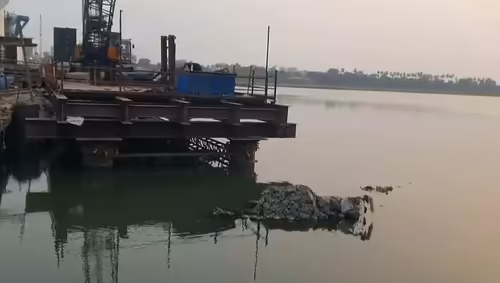
The dream of India’s first high-speed rail corridor, the Mumbai-Ahmedabad Bullet Train, has been marred by a heartbreaking human tragedy. In a devastating incident near Kathore village in Surat, Gujarat, a heavy metal plate plummeted from an under-construction bullet train bridge, crushing a small fishing boat on the Tapi River below. The victims were Mohsin Shaikh and his nine-year-old daughter, Huma, who were out on the water for what should have been a peaceful day. His wife, the girl’s mother, survived the ordeal but now faces an unimaginable loss .
Table of Contents
- The Tragic Incident: What Happened on the Tapi River?
- Bullet Train Bridge Collapse: Safety Protocols Under Scrutiny
- The Mumbai-Ahmedabad HSR Project: At a Crossroads
- A Pattern of Accidents on the Bullet Train Corridor?
- Conclusion: Balancing Progress and Human Life
- Sources
The Tragic Incident: What Happened on the Tapi River?
The details are as stark as they are tragic. According to local reports, the massive metal plate, likely a component for the bridge’s superstructure, slipped from a crane during a lifting operation. It then crashed directly onto the small vessel where the family was fishing. The sheer weight and force of the impact were instantly fatal for Mohsin and Huma. This wasn’t just an accident; it was a catastrophic failure of on-site safety management that allowed such a lethal hazard to exist over a navigable waterway.
This incident is not isolated in its context. The Mumbai-Ahmedabad corridor has seen other deadly mishaps. Just months ago, in November 2024, three workers lost their lives in Anand district when a temporary structure collapsed at another project site . In August 2023, a crane collapse at a different location left one dead and eight injured . These recurring events paint a disturbing picture of the risks inherent in this massive undertaking.
Bullet Train Bridge Collapse: Safety Protocols Under Scrutiny
The National High-Speed Rail Corporation Ltd (NHSRCL), the agency overseeing the project, has repeatedly emphasized its commitment to safety. Their official communications boast of training over 13,000 workers and launching unique safety awareness campaigns like the ‘प्रयास’ Nukkad Natak series (street plays) to instill a culture of caution [[10], [13]]. They claim that “safety isn’t just a priority—it’s a way of life!” .
However, the reality on the ground, as evidenced by this latest bullet train bridge collapse and others, suggests a significant gap between policy and practice. How could a critical lift operation be conducted over an active river without ensuring the area below was completely secured and off-limits? This fundamental lapse calls into question the effectiveness of the very protocols NHSRCL touts so proudly. For families like the Shaikhs, these corporate safety slogans offer no comfort, only a hollow echo of promises unfulfilled.
The Mumbai-Ahmedabad HSR Project: At a Crossroads
The Mumbai-Ahmedabad High-Speed Rail (HSR) corridor is a flagship project for India, designed to connect the two major cities in under three hours across a 508-kilometer stretch [[27], [28]]. As of January 2026, the project has made significant technical progress, with 416 km of foundation work and 409 km of piers completed . The first operational section, between Surat and Bilimora, is now targeted for a 2027 launch .
Yet, this forward momentum is now shadowed by grief and public concern. The project, a symbol of national pride and modern engineering, is also becoming associated with a growing list of casualties. The question is no longer just about meeting deadlines or technical milestones, but about the human cost of this ambition. Can the project truly be deemed a success if it is built on a foundation of preventable tragedies?
A Pattern of Accidents on the Bullet Train Corridor?
Looking at the timeline of incidents, a troubling pattern emerges:
- August 2023: A crane collapse in Vadodara kills 1 and injures 8 .
- November 2024: A temporary structure collapse in Anand district claims the lives of 3 workers .
- January 2026: A falling metal plate from a bridge in Surat kills a father and his 9-year-old daughter .
This sequence of events, moving from worker fatalities to the death of innocent civilians, indicates a systemic issue that transcends individual contractor errors. It points to a potential lack of rigorous, independent oversight and a possible prioritization of speed over comprehensive safety. While the project connects major urban centers, its construction sites often run through rural and semi-urban areas, putting local communities at direct risk—a risk that appears to have been inadequately managed in this case.
Conclusion: Balancing Progress and Human Life
The deaths of Mohsin Shaikh and his daughter Huma are a profound tragedy that should serve as a wake-up call for all stakeholders involved in the Mumbai-Ahmedabad Bullet Train project. The pursuit of technological advancement and national prestige must never come at the expense of human life. The current safety framework, despite its official assurances, has demonstrably failed.
It is imperative that the NHSRCL and its contractors conduct a transparent, independent investigation into this incident and implement immediate, sweeping changes. This includes halting all high-risk operations over public spaces until foolproof safety perimeters are established. The legacy of India’s first bullet train should be one of innovation and efficiency, not one marked by the avoidable loss of innocent lives. For more on large-scale infrastructure safety, see this guide from the [Occupational Safety and Health Administration (OSHA)](https://www.osha.gov/). You can also read our analysis on [INTERNAL_LINK:india-infrastructure-safety-standards] for a broader perspective.
Sources
- Times of India: Man, daughter die as metal plate falls on their boat in Tapi
- Web Search Results: Various reports on Gujarat bullet train accidents and NHSRCL safety protocols [[1], [3], [6], [10], [13], [20], [25], [27], [28]]