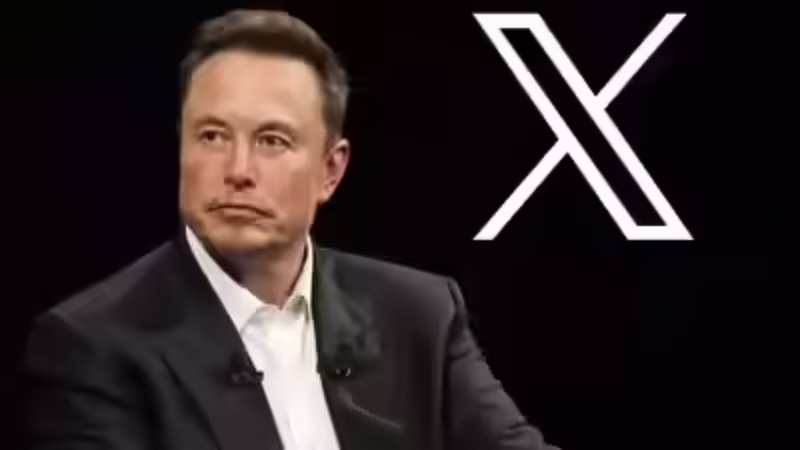
In a significant escalation of tensions between New Delhi and Silicon Valley, the Indian government has declared it is “not satisfied” with X’s (formerly Twitter) official response regarding the Grok misuse crisis. The standoff centers on allegations that Elon Musk’s AI-powered chatbot—integrated into the X platform—is being exploited to spread false information, incite communal hatred, and bypass content moderation safeguards across India.
This development marks one of the first major regulatory confrontations involving Grok outside the United States and signals India’s growing assertiveness in holding global tech giants accountable for AI-driven harms on their platforms.
Table of Contents
- What Is Grok and How Is It Being Misused?
- Indian Government’s Official Objections
- X’s Response—and Why It Fell Short
- The Broader Battle Over AI Accountability in India
- Global Precedents and Comparative Regulation
- What Happens Next for X in India?
What Is Grok and How Is It Being Misused?
Launched by xAI—the AI division of X Corp—Grok is a large language model designed to answer user queries with real-time data pulled from the X platform. Marketed as “witty,” “rebellious,” and less censored than competitors like ChatGPT, Grok has gained popularity among X Premium+ subscribers.
However, in India, users have reportedly manipulated Grok to generate:
- Fake news about religious minorities during sensitive festivals.
- Deepfake-style text narratives accusing political opponents of corruption.
- Instructions for circumventing local laws on hate speech and defamation.
- Automated replies that amplify divisive hashtags in regional languages.
Because Grok draws from X’s live feed—which includes unverified posts—it can inadvertently (or intentionally) reinforce viral falsehoods, creating dangerous feedback loops in a country with a history of social media-fueled violence .
Indian Government’s Official Objections
According to sources in the Ministry of Electronics and Information Technology (MeitY), officials summoned X’s India leadership after receiving multiple complaints from law enforcement agencies and civil society groups about Grok misuse.
The government’s core demands include:
- Immediate suspension of Grok for Indian users until safety protocols are implemented.
- Transparency reports detailing how Grok processes queries related to religion, caste, and politics.
- Deployment of localized AI filters trained on Indian legal and cultural contexts.
“A generic global policy is not sufficient for a diverse democracy like India,” a senior MeitY official told reporters on condition of anonymity .
X’s Response—and Why It Fell Short
X reportedly submitted a formal reply stating that Grok operates under “user discretion” and that the company cannot be held liable for how individuals choose to use the AI tool. The platform also emphasized that Grok is only available to paying subscribers and includes disclaimers about potential inaccuracies.
But Indian regulators found this response inadequate. “Saying ‘users are responsible’ is not a compliance strategy—it’s an abdication of responsibility,” said a legal expert familiar with India’s upcoming Digital India Act .
Critically, X failed to address whether Grok’s training data includes flagged or banned content from X’s own platform—a key concern given India’s strict intermediary liability rules under Section 79 of the IT Act.
The Broader Battle Over AI Accountability in India
This clash is not just about one chatbot. It’s a proxy war over who controls AI governance in the world’s most populous democracy.
India is finalizing its AI regulatory framework, which is expected to classify high-risk AI systems—like those influencing public opinion—and mandate rigorous audits, human oversight, and redress mechanisms. Platforms like X, which position Grok as both a product and a platform feature, sit squarely in this gray zone.
For more on India’s evolving digital laws, see our analysis on [INTERNAL_LINK:digital-india-act-explained].
Why India’s Stance Matters Globally
- Over 50 million X users reside in India—the platform’s largest market after the U.S.
- India’s AI rules could become a model for other Global South nations.
- Non-compliance could lead to fines, blocking orders, or even criminal liability for executives.
Global Precedents and Comparative Regulation
India isn’t alone in scrutinizing Grok. The European Union has already flagged concerns under the AI Act, while Brazil’s electoral court warned X about Grok’s potential to interfere in elections .
However, India’s approach is distinct: rather than waiting for harm to occur, regulators are demanding ex-ante (preventive) safeguards—a shift from the reactive moderation model that dominated the social media era.
This proactive stance aligns with recommendations from UNESCO and the OECD, which urge countries to embed human rights principles into AI design from day one .
What Happens Next for X in India?
If X fails to submit a revised, satisfactory plan within the stipulated timeframe, the government could invoke emergency powers under the IT Rules 2021 to restrict Grok’s functionality—or even block the feature entirely for Indian IP addresses.
More broadly, this episode may accelerate the enforcement of India’s new compliance requirements for “significant social media intermediaries,” pushing platforms to localize AI governance or risk losing access to a critical market.
Conclusion
The Indian government’s dissatisfaction with X’s handling of Grok misuse is a watershed moment in the global debate over AI accountability. It underscores a fundamental truth: in democracies with complex social fabrics, AI cannot operate in a legal vacuum. As India moves toward stricter oversight, X—and every other tech giant—must decide whether to adapt to local democratic norms or face escalating consequences. The world is watching to see if “move fast and break things” can survive in an era of responsible innovation.