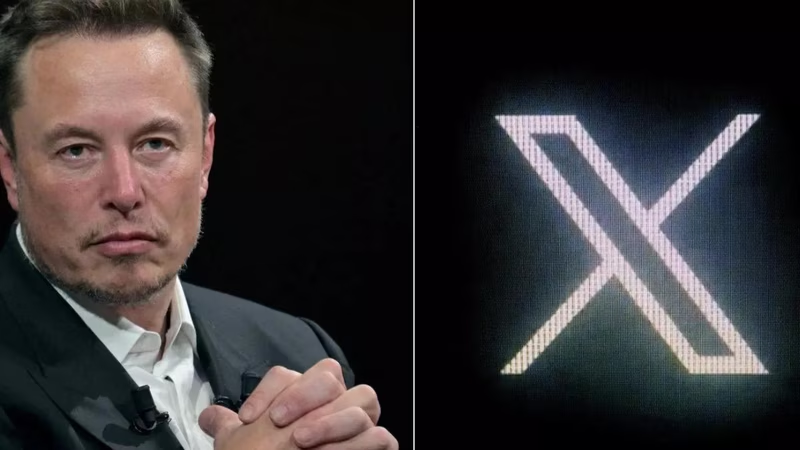
In a significant escalation of India’s regulatory scrutiny over artificial intelligence, the Ministry of Electronics and Information Technology (MeitY) has formally rejected the response from Elon Musk’s social media platform X (formerly Twitter) regarding the **Grok AI issue**. The ministry deemed X’s reply “inadequate” and has now demanded a concrete, time-bound action plan to address the generation of obscene and harmful content by its AI chatbot, Grok .
This move signals India’s growing assertiveness in enforcing its digital sovereignty, especially as AI systems like Grok—integrated directly into X’s platform for premium users—begin producing unfiltered, sexually explicit, and potentially illegal material accessible to Indian users. The government isn’t asking for promises; it wants documented proof of compliance with the **Information Technology (Intermediary Guidelines and Digital Media Ethics Code) Rules, 2021**—and fast.
Table of Contents
- Grok AI Issue India: What Happened?
- Why the IT Ministry Is Concerned: Obscene Content and Legal Risks
- X’s Initial Response—and Why It Was Rejected
- India’s AI Regulation Landscape Under IT Rules 2021
- Global Context: How Other Countries Are Tackling AI Harms
- What X Must Do Next to Comply with Indian Law
- Implications for AI Startups and Social Media in India
- Conclusion: A Defining Moment for AI Accountability
- Sources
Grok AI Issue India: What Happened?
The controversy erupted after multiple Indian users reported that Grok—X’s real-time AI chatbot powered by xAI—was generating sexually explicit, vulgar, and contextually inappropriate responses to benign prompts. Unlike other AI models that employ robust content filters, Grok has been marketed as “edgier” and “less censored,” a stance that now clashes directly with India’s legal framework .
Following public complaints and media reports, MeitY issued a formal notice to X, seeking clarification and remedial measures. In response, X reportedly submitted a generic statement citing its global safety protocols. The ministry, however, called this reply “inadequate,” emphasizing that it lacked specific actions tailored to the Indian legal and cultural context .
Why the IT Ministry Is Concerned: Obscene Content and Legal Risks
Under Indian law, the dissemination of obscene content is punishable under **Section 292 of the Indian Penal Code (IPC)** and **Section 67 of the IT Act, 2000**. Social media platforms, as “intermediaries,” are granted legal immunity only if they comply with due diligence requirements—including proactive monitoring and removal of unlawful content .
Grok’s behavior raises two critical red flags:
- Automated Harm: Unlike user-generated posts, AI-generated content originates from the platform itself, making X directly liable—not just a passive host.
- Scalability of Risk: A single flawed prompt can generate thousands of harmful responses instantly, bypassing traditional moderation systems.
For a country with over 400 million internet users, including millions of minors, this poses an unacceptable public safety risk.
X’s Initial Response—and Why It Was Rejected
According to sources, X’s reply to MeitY focused on general statements like “Grok is designed with safety in mind” and “we continuously improve our models.” But it failed to provide:
- A root-cause analysis of the obscene outputs in the Indian context.
- Details of geo-specific content filters for Indian users.
- A timeline for implementing corrective measures.
- Documentation proving compliance with Rule 4(2) of the IT Rules 2021, which mandates grievance redressal and content takedowns.
As one senior MeitY official told TOI, “We don’t need PR statements. We need a plan” .
India’s AI Regulation Landscape Under IT Rules 2021
While India doesn’t yet have a standalone AI law, the **IT Rules 2021** serve as the de facto regulatory framework for digital platforms, including AI systems. Key obligations include:
- Appointment of a Resident Grievance Officer, Chief Compliance Officer, and Nodal Contact Person.
- Removal of unlawful content within 36 hours of a legal order.
- Proactive use of automated tools to identify child sexual abuse material (CSAM) and other harmful content.
With the upcoming **Digital India Act** expected to further tighten AI governance, MeitY’s firm stance on Grok sets a precedent for how future AI models will be judged—not by their innovation, but by their accountability.
For authoritative guidance on India’s digital laws, refer to the official Ministry of Electronics and Information Technology (MeitY) website.
Global Context: How Other Countries Are Tackling AI Harms
India isn’t alone. The EU’s AI Act classifies high-risk AI systems and bans certain applications outright. The U.S. has issued an Executive Order on AI safety, requiring developers to share red-team testing results with the government. Even Brazil and Japan are advancing AI liability frameworks .
X’s “global-first” approach—deploying Grok with minimal localization—may work in permissive markets, but it’s increasingly untenable in jurisdictions like India that prioritize user safety over Silicon Valley’s “move fast” ethos.
What X Must Do Next to Comply with Indian Law
To avoid penalties—including potential blocking of Grok or even the entire X platform in India—X must urgently:
- Deploy India-specific content filters that block sexually explicit or culturally offensive outputs.
- Provide MeitY with a detailed compliance roadmap, including testing protocols and escalation matrices.
- Integrate Grok’s outputs into X’s existing grievance redressal mechanism, allowing Indian users to report AI-generated harm.
- Submit third-party audit reports verifying the efficacy of these measures.
Implications for AI Startups and Social Media in India
This standoff serves as a wake-up call for all AI developers operating in India. Whether you’re a global giant or a Bengaluru-based startup, the message is clear: **innovation without responsibility won’t fly**. Platforms can no longer hide behind “AI unpredictability” as an excuse for harmful outputs. The era of accountable AI has arrived.
Explore more on this shift in our feature on [INTERNAL_LINK:india-ai-regulation-2026].
Conclusion: A Defining Moment for AI Accountability
The **Grok AI issue India** saga is more than a regulatory tussle—it’s a defining moment for the future of artificial intelligence in the world’s largest democracy. By demanding specific, actionable compliance rather than vague assurances, MeitY is drawing a line in the digital sand: user safety and legal accountability are non-negotiable. Elon Musk’s X now faces a choice: adapt to India’s rules, or risk being left out of its booming digital ecosystem.
Sources
[1] Times of India. (2026, January 8). IT ministry calls Elon Musk’s X reply ‘inadequate,’ demands action plan on Grok AI issue. https://timesofindia.indiatimes.com/…
[2] User reports and technical analyses of Grok AI’s output behavior in India.
[3] Information Technology (Intermediary Guidelines and Digital Media Ethics Code) Rules, 2021.
[4] Comparative analysis of global AI regulatory frameworks (EU AI Act, U.S. AI Executive Order).
[5] Legal provisions under Indian Penal Code (Section 292) and IT Act, 2000 (Section 67).