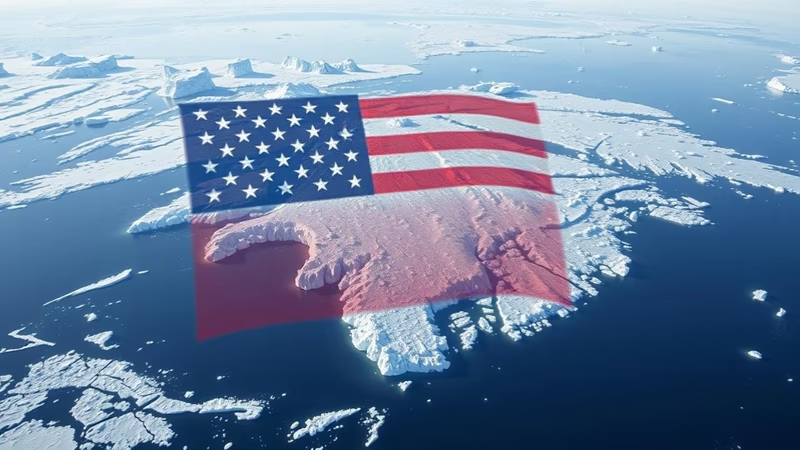
Forget oil, rare earths, or shipping lanes—when it comes to 21st-century national security, the ultimate prize might just be a 2.1-million-square-kilometer ice sheet sitting between the Atlantic and Arctic Oceans. That’s Greenland, and according to former President Donald Trump, it’s the cornerstone of his proposed $175 billion Golden Dome missile shield .
While Trump’s 2019 offer to “buy” Greenland was widely mocked, his latest push reveals a far more serious strategic calculus. The island’s geographic position—closer to Moscow than to Washington—makes it the perfect early-warning sentinel against intercontinental ballistic missiles (ICBMs) from Russia or beyond. And with the U.S. already operating the Thule Air Base there since the Cold War, the foundation is already laid.
Table of Contents
- What Is the Golden Dome Missile Shield?
- Why Greenland Is Irreplaceable for U.S. Defense
- Thule Air Base: The Northernmost Eyes of America
- Geopolitical Tensions: Denmark, Greenland, and U.S. Interests
- Critics and Challenges to the $175B Plan
- Conclusion
- Sources
What Is the Golden Dome Missile Shield?
Unveiled as part of Trump’s broader national security vision, the Golden Dome missile shield aims to create an impenetrable, space-ground integrated defense network capable of detecting, tracking, and neutralizing incoming missiles at every phase of flight—from launch to re-entry .
Unlike older systems like the Ground-Based Midcourse Defense (GMD), which relies on fixed silos in Alaska and California, the Golden Dome leverages:
- Next-gen radar arrays in the Arctic and Pacific
- Hypersonic glide-phase interceptors
- Low-orbit satellite constellations for real-time tracking
- AI-driven command systems for split-second decisions
The total projected cost? A staggering $175 billion over 15 years—a figure that has drawn sharp criticism from fiscal hawks and arms-control advocates alike.
Why Greenland Is Irreplaceable for U.S. Defense
Greenland’s value isn’t hypothetical—it’s geometric. Located just **3,000 miles from Moscow**, it offers the earliest possible radar line-of-sight for missiles launched over the North Pole, the shortest route to the continental U.S.
“Missiles from Russia would fly directly over Greenland,” explains Dr. Laura Thompson, a defense analyst at the Center for Strategic and International Studies (CSIS). “Having sensors there cuts detection time by 4–6 minutes—enough to launch interceptors before the threat enters U.S. airspace” .
Beyond missile tracking, Greenland’s high latitude is ideal for monitoring satellite launches and space-based threats—a growing priority as China and Russia develop anti-satellite weapons.
Thule Air Base: The Northernmost Eyes of America
Operational since 1951, Thule Air Base is the U.S. military’s northernmost installation. Home to the **12th Space Warning Squadron**, it hosts the Upgraded Early Warning Radar (UEWR)—a phased-array system capable of tracking objects over 3,000 miles away .
Under the Golden Dome plan, Thule would be upgraded with:
- Quantum-enhanced radar for hypersonic missile detection
- New interceptor silos for midcourse defense
- Expanded satellite downlink capabilities
- Year-round logistical support (currently limited by extreme weather)
These enhancements would transform Thule from a Cold War relic into the nerve center of America’s 21st-century missile shield.
Geopolitical Tensions: Denmark, Greenland, and U.S. Interests
But here’s the catch: Greenland isn’t U.S. territory. It’s a self-governing part of the Kingdom of Denmark, and both Copenhagen and Nuuk have repeatedly rejected American attempts to increase sovereignty or control.
After Trump’s 2019 purchase proposal, Danish Prime Minister Mette Frederiksen called it “absurd.” Now, with renewed focus on Thule’s expansion, tensions are simmering again. Greenlandic leaders insist any upgrades must respect local autonomy and environmental protections—a stance backed by Denmark .
Still, the U.S. holds a 1951 defense agreement granting it exclusive military use of Thule. The question isn’t legality—it’s political will.
For deeper analysis on Arctic power plays, see our feature on [INTERNAL_LINK:arctic-militarization-us-russia-china].
Critics and Challenges to the $175B Plan
Not everyone is sold on the Golden Dome. Critics argue:
- It violates the spirit of the 1972 Anti-Ballistic Missile Treaty (though the U.S. withdrew in 2002)
- $175B could be better spent on cyber defense or nuclear modernization
- Hypersonic missiles may render ground-based interceptors obsolete
- Climate change is making Arctic infrastructure increasingly unstable
“This is Cold War thinking wrapped in futuristic packaging,” says arms-control expert Mark Rosen of the Arms Control Association . “Deterrence, not defense, remains the bedrock of strategic stability.”
Conclusion
Love it or loathe it, Trump’s Golden Dome missile shield has thrust Greenland into the global spotlight—not as a real estate deal, but as a linchpin of planetary defense. Whether the plan survives budget battles or diplomatic friction remains to be seen. But one thing is clear: in the new age of great-power competition, the frozen north is anything but peripheral.
Sources
- Times of India. “Explained: How Greenland fits into Trump’s $175 bn Golden Dome missile shield.” https://timesofindia.indiatimes.com/…
- U.S. Space Force. “Thule Air Base – Mission Overview.” https://www.spaceforce.mil/…
- Center for Strategic and International Studies (CSIS). “Arctic Security and U.S. Defense Strategy.” https://www.csis.org/…
- Arms Control Association. “The Risks of Next-Gen Missile Defense.” https://www.armscontrol.org/…