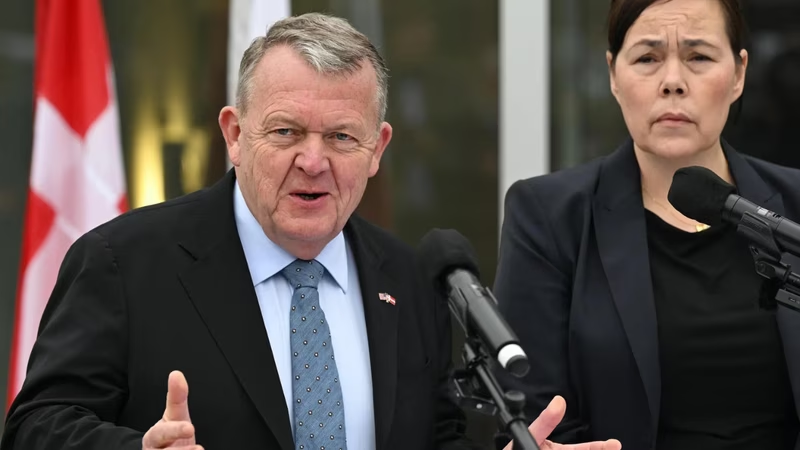
It’s a story that sounds like geopolitical fiction—but it’s very real. In early 2026, former U.S. President Donald Trump reignited his controversial push for American control over Greenland, urging NATO allies to back a plan that would effectively transfer sovereignty of the Danish territory to Washington. The response? A swift and unambiguous “no” from both Denmark and Greenland itself.
“There is a fundamental disagreement,” Danish officials told White House representatives during recent talks, according to reports . This diplomatic clash isn’t just about real estate—it’s about sovereignty, Arctic strategy, and the future of Western alliances in an increasingly contested polar region.
Table of Contents
- Trump’s Greenland Obsession: A Recap
- Denmark’s Firm Stance on Greenland Sovereignty
- Greenlandic Voices: Local Opposition to U.S. Annexation
- Why Greenland Matters: The Geopolitical Stakes
- Denmark’s Arctic Military Buildup
- Conclusion
- Sources
Trump’s Greenland Obsession: A Recap
This isn’t the first time Trump has fixated on Greenland. Back in 2019, he floated the idea of purchasing the island—calling it a “large real estate deal”—only to be rebuffed by then-Prime Minister Mette Frederiksen, who called the notion “absurd.” Now, with renewed influence in Republican circles, Trump is pushing again, this time framing it as a national security imperative and suggesting NATO should facilitate U.S. control .
His argument hinges on strategic access: Greenland sits at the crossroads of North America and Europe, hosts the critical Thule Air Base (operated by the U.S. since 1951), and holds vast mineral reserves—including rare earth elements essential for defense tech .
Denmark’s Firm Stance on Greenland Sovereignty
Denmark’s position hasn’t wavered. Despite being a close NATO ally, Copenhagen has drawn a red line: Greenland is not for sale, lease, or transfer. “We are in fundamental disagreement with the idea that any part of our kingdom can be subject to foreign acquisition,” a senior Danish diplomat stated during closed-door talks with U.S. officials .
Importantly, Denmark recognizes Greenland’s right to self-determination. Since 2009, the island has operated under “self-rule,” managing its own judiciary, police, and natural resources—though defense and foreign policy remain under Copenhagen’s purview. Any change in status would require Greenlandic consent, which is nowhere in sight.
Greenlandic Voices: Local Opposition to U.S. Annexation
Perhaps most damning to Trump’s proposal is the near-universal rejection from Greenlanders themselves. In public statements, Greenlandic representatives emphasized that there is “very low support” for joining the United States .
“We are not a commodity,” said Múte Bourup Egede, Premier of Greenland. “Our future will be decided by Greenlanders—not by foreign powers bargaining over our land.” Many locals view the U.S. presence at Thule Air Base with ambivalence; while it brings economic benefits, it also recalls Cold War-era displacement of Indigenous communities—a wound that hasn’t fully healed .
Why Greenland Matters: The Geopolitical Stakes
Beyond symbolism, Greenland’s strategic value is immense:
- Arctic Gateway: As polar ice melts, new shipping lanes are opening, making Greenland a key node in trans-Arctic trade.
- Resource Wealth: The island holds deposits of uranium, zinc, iron ore, and rare earth minerals—critical for green tech and defense systems.
- Military Positioning: Thule Air Base is the northernmost U.S. military installation, vital for missile detection and space surveillance.
Russia and China have also shown interest in the region, heightening Western concerns. But as the Arctic Council notes, cooperation—not conquest—is the agreed-upon path forward among Arctic states .
Denmark’s Arctic Military Buildup
In response to what it calls an “unpredictable security environment,” Denmark announced plans to significantly bolster its military presence across the Arctic—including in Greenland . This includes:
- Deploying additional naval patrol vessels.
- Upgrading radar and surveillance infrastructure.
- Strengthening joint exercises with the U.S., Canada, and Norway under NATO’s Arctic defense framework.
Notably, this buildup is framed as defensive and collaborative—not confrontational. Denmark seeks to protect its realm while reinforcing transatlantic unity, even as it pushes back against unilateral U.S. ambitions.
For deeper insights into Arctic geopolitics, explore our feature on [INTERNAL_LINK:arctic-race-for-resources-and-influence].
Conclusion
The renewed debate over Greenland reveals a growing tension between old-school territorial ambition and modern norms of sovereignty and self-determination. While the U.S. sees strategic opportunity, Denmark and Greenland see a threat to their shared democratic values. As climate change accelerates Arctic accessibility, how the West navigates these disputes will set a precedent for global order in the 21st century. One thing is clear: Greenland belongs to Greenlanders—and they’re not selling.
Sources
- Times of India. “‘Fundamental disagreement’: Denmark discusses Greenland with US.” https://timesofindia.indiatimes.com/…
- U.S. Department of State. “U.S.-Denmark Relations and the Arctic.” https://www.state.gov/…
- Government of Greenland. “Self-Government Act of 2009.” https://naalakkersuisut.gl/…
- Arctic Council. “Founding Declaration & Principles.” https://arctic-council.org/…