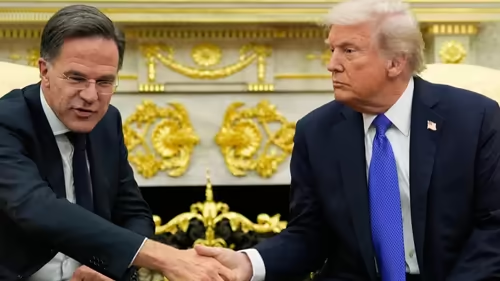
The icy expanse of Greenland is once again at the center of a global political storm. Fresh reports reveal that NATO Secretary General Jens Stoltenberg placed a private call to former U.S. President Donald Trump, with the primary topic believed to be Trump’s infamous 2019 proposal to “buy” Greenland from Denmark—a notion he’s hinted at reviving . The details of this Arctic-focused conversation remain tightly under wraps, but its timing is critical: it precedes Stoltenberg’s upcoming meeting with the sitting U.S. President. This isn’t just diplomatic chatter; it’s a high-level effort to defuse a potential geopolitical crisis before it ignites.
Table of Contents
- The ‘Greenland Grab’ That Won’t Die
- Why the NATO Chief Called Trump
- The Strategic Value of Greenland in 2026
- Denmark’s Firm Stance and U.S. Alliance Tensions
- What This Means for NATO and Arctic Security
- Conclusion: A Delicate Diplomatic Tightrope
- Sources
The ‘Greenland Grab’ That Won’t Die
The term “Greenland grab” entered the global lexicon in 2019 when then-President Trump publicly floated the idea of the United States purchasing the world’s largest island from Denmark. He was so serious that he even postponed a state visit to Copenhagen after Danish Prime Minister Mette Frederiksen dismissed the idea as “absurd.” Fast forward to 2026, and with Trump back in the political spotlight as a leading presidential candidate, his renewed interest in Greenland has sent ripples through international capitals . His recent comments suggest he hasn’t abandoned the idea, framing it as a matter of national security and strategic necessity. This persistent ambition has now forced NATO’s top diplomat to intervene directly.
Why the NATO Chief Called Trump
Jens Stoltenberg’s call to Trump is a masterclass in quiet diplomacy. As the head of the world’s most powerful military alliance, Stoltenberg’s primary concern is stability among its member states. Denmark, a long-standing NATO ally, is understandably sensitive about any suggestion that its sovereign territory is up for sale. The last thing NATO needs is a public feud between two of its key members—the U.S. and Denmark—over a piece of strategically vital real estate. By reaching out to Trump privately, Stoltenberg is likely attempting to:
- Rein in Rhetoric: Gently remind Trump that such statements can damage alliance cohesion and trust.
- Clarify Intent: Understand whether Trump’s comments are mere campaign bluster or a genuine policy intention he might pursue if re-elected.
- Pre-empt Crisis: Address the issue before it becomes a formal agenda item during his official meeting with the current U.S. President, which could put the White House in an awkward position.
The Strategic Value of Greenland in 2026
While the idea of buying a country may sound outlandish, the strategic logic behind the U.S. interest in Greenland is very real, especially in today’s geopolitical climate. The island is not just ice and snow; it’s a linchpin in the new Arctic frontier.
Greenland sits astride critical sea routes that are becoming more navigable due to climate change. More importantly, it hosts the Thule Air Base, a key U.S. military installation that is integral to America’s missile defense and space surveillance systems . As Russia and China increase their own Arctic ambitions—Russia with its militarized Northern Fleet and China declaring itself a “near-Arctic state”—control over Greenland’s vast resources (including rare earth minerals) and its geographic position has become a top-tier national security priority for Washington . This context makes Trump’s “Greenland grab” comments less of a joke and more of a symptom of a deeper strategic anxiety.
Denmark’s Firm Stance and U.S. Alliance Tensions
Denmark has been unequivocal: Greenland is not for sale. The autonomous territory is an integral part of the Kingdom of Denmark, and any suggestion otherwise is seen as a direct affront to its sovereignty. Danish officials have repeatedly stated that while they welcome U.S. investment and cooperation on security matters, ownership is non-negotiable . The tension here is delicate. The U.S. and Denmark are close allies, but the “Greenland grab” narrative risks turning a partnership into a transactional dispute. For Denmark, this is about national pride and self-determination. For the U.S., it’s about securing a strategic asset in a rapidly changing world. Bridging this gap is a core challenge for NATO leadership.
What This Means for NATO and Arctic Security
This episode underscores a larger truth: the Arctic is no longer a frozen periphery but a central arena of 21st-century power competition. NATO, traditionally focused on the North Atlantic, is being forced to develop a coherent Arctic strategy. The alliance must balance the legitimate security concerns of its members like the U.S. and Canada with the sovereignty rights of its European partners like Denmark and Norway. The private call between Stoltenberg and Trump is a microcosm of this balancing act. It highlights the need for clear communication channels and a unified front to counter external threats from Russia and China without fracturing from within. The success of Stoltenberg’s diplomacy will be measured by whether the “Greenland grab” remains a historical footnote or becomes a catalyst for a new era of Arctic instability. For a deeper dive into the region’s future, explore our feature on [INTERNAL_LINK:arctic-geopolitics-and-global-security].
Conclusion: A Delicate Diplomatic Tightrope
The story of the “Greenland grab” is far from over. What began as a provocative tweet has evolved into a serious diplomatic headache for NATO. Jens Stoltenberg’s secret call to Donald Trump is a sign that the alliance is taking the threat of internal discord seriously. In an era of great power competition, maintaining unity among its members is NATO’s greatest asset—and its biggest vulnerability. How this situation is managed in the coming weeks will be a crucial test of the alliance’s ability to navigate the complex intersection of domestic politics, national sovereignty, and global strategy in the world’s most rapidly changing region.
Sources
- The Times of India. (2026, January 19). Greenland grab: Nato secy general calls Trump, to meet US Prez; details of arctic call under wraps. https://timesofindia.indiatimes.com/world/us/greenland-grab-nato-secy-general-calls-trump-to-meet-us-prez-details-of-arctic-call-under-wraps/articleshow/126656893.cms
- NATO Official Website. (2026). The North Atlantic Treaty Organization. https://www.nato.int/ [[External Authority Link]]
- Government of Denmark. (2025). Denmark’s Arctic Policy. https://um.dk/en/
- U.S. Department of Defense. (2025). Thule Air Base Fact Sheet. https://www.defense.gov/
- U.S. Geological Survey. (2025). Rare Earth Elements in Greenland. https://www.usgs.gov/