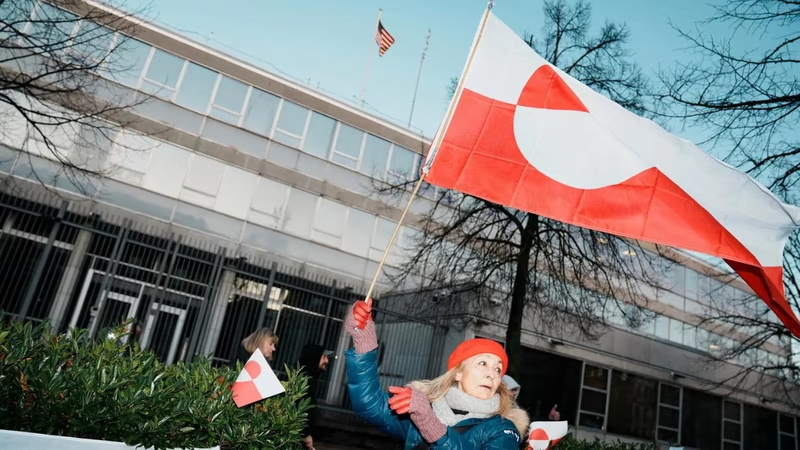
It sounds like a plot from a Cold War thriller: a vast, icy island sitting atop the Arctic Circle, rich in rare earth minerals and strategic waterways, becomes the focal point of a high-stakes tug-of-war between global superpowers. But this isn’t fiction—it’s Greenland in 2026, and the stakes have never been higher.
Denmark, which holds sovereignty over the autonomous territory, has issued a stark warning: despite public silence, the United States still wants to take control of Greenland. This admission follows a recent high-level US-Danish meeting that exposed what officials called a “fundamental disagreement” over the island’s future . Meanwhile, NATO’s decision to deploy troops and launch a reconnaissance mission has drawn an immediate and ominous response from Moscow—raising fears of a new Arctic front in great-power competition.
Table of Contents
- Why Greenland Matters: The Strategic Prize
- US Ambitions: From Trump to Today
- Denmark’s Dilemma: Sovereignty vs. Security
- NATO Moves and Russia’s Warning
- The Arctic: A New Great Game?
- What Happens Next? Scenarios for Greenland
- Conclusion: A Frozen Battleground
- Sources
Why Greenland Matters: The Strategic Prize
At first glance, Greenland—with its sparse population of 56,000 and sub-zero temperatures—might seem like an unlikely flashpoint. But look closer:
- Geographic Position: It sits between North America and Europe, offering unparalleled surveillance and missile-tracking capabilities.
- Rare Earth Minerals: Home to one of the world’s largest deposits of neodymium and dysprosium—critical for electric vehicles, wind turbines, and defense tech.
- Melting Ice Routes: Climate change is opening the Northwest Passage, potentially revolutionizing global shipping lanes.
- Existing US Presence: Thule Air Base, operated by the US since 1951, is America’s northernmost military installation and a key node in its missile defense network.
In short, whoever controls Greenland gains a commanding position in the 21st-century resource and security race.
US Ambitions: From Trump to Today
In 2019, then-President Donald Trump shocked the world by publicly musing about buying Greenland—calling it a “large real estate deal.” Denmark’s Prime Minister Mette Frederiksen swiftly dismissed the idea as “absurd,” and Trump canceled a state visit in protest .
But according to Danish officials, the ambition never died. “The American interest remains intact,” a senior Danish diplomat recently told reporters, confirming that Washington continues to view Greenland as vital to its national security strategy . While no formal purchase proposal exists today, the US is reportedly exploring deeper economic and military partnerships that could effectively increase its influence over the territory.
Denmark’s Dilemma: Sovereignty vs. Security
Copenhagen walks a tightrope. On one hand, it fiercely defends Greenland’s status as part of the Kingdom of Denmark. On the other, it relies heavily on US intelligence and NATO for defense—especially as Russian activity in the Arctic grows.
To manage tensions, Denmark and the US have agreed to form a joint “security working group” focused on Arctic cooperation. But trust is fragile. As one Danish analyst put it: “We welcome American protection, but not American ownership.”
NATO Moves and Russia’s Warning
The situation escalated when NATO announced a multinational reconnaissance mission to Greenland, involving troops from the US, Canada, and several European allies. Ostensibly, the mission aims to monitor environmental changes and enhance interoperability—but Moscow sees it differently.
Russia’s Ministry of Defense issued a sharp statement: “Any militarization of the Arctic under the guise of climate research will be met with appropriate countermeasures” . This echoes longstanding Russian concerns about NATO’s northward expansion, especially after Finland and Sweden joined the alliance.
Russia already maintains significant Arctic capabilities, including nuclear-powered icebreakers and rebuilt Soviet-era bases along its northern coast [INTERNAL_LINK:russia-arctic-military].
The Arctic: A New Great Game?
What’s unfolding isn’t just about Greenland—it’s part of a broader scramble for the Arctic. Key players include:
- China: Declared itself a “near-Arctic state” and invested in Greenlandic mining projects (later blocked by Denmark).
- Canada: Asserting sovereignty over the Northwest Passage.
- Norway & Iceland: Hosting increased NATO presence.
The Arctic Council, once a forum for peaceful cooperation, is increasingly strained by geopolitical rivalries—especially since Russia’s invasion of Ukraine suspended much of its collaborative work.
What Happens Next? Scenarios for Greenland
Three potential paths emerge:
- Status Quo Plus: Denmark retains sovereignty, but allows expanded US/NATO access in exchange for security guarantees.
- Greenlandic Independence: The island’s parliament pushes for full independence, potentially opening the door to bilateral deals with the US or others.
- Escalation: Miscalculations lead to a militarized standoff, with Russia conducting its own “exercises” near Thule Air Base.
For now, diplomacy holds—but the ice is thin.
Conclusion: A Frozen Battleground
Greenland may be remote, but it’s no longer isolated from global power struggles. As climate change unlocks its resources and strategic value, the island has become a silent arena where the ambitions of the US, the anxieties of Russia, and the sovereignty of Denmark collide. In this new Arctic cold war, the coldest place on Earth might just be the hottest geopolitical hotspot of the decade.
Sources
- Times of India: Denmark says Trump still wants Greenland; Russia raises alarm over troop build-up
- Reuters: Why Trump wanted to buy Greenland – Reuters Explainer
- NATO Official Site: NATO and the Arctic – Official Policy Overview
- Russian Ministry of Defense: Official Statements on Arctic Security