Introduction
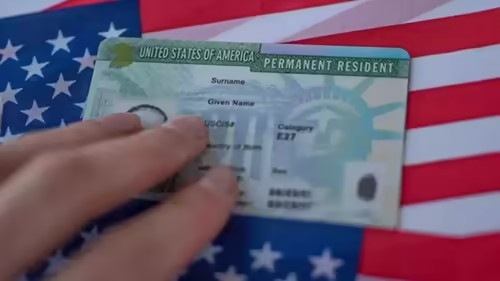
Your Green Card is more than just a plastic card; it’s your legal right to live and work permanently in the United States. But that right comes with serious responsibilities. One of the most common—and potentially devastating—green card mistakes is assuming you can live abroad indefinitely while keeping your U.S. status intact. An immigration lawyer has recently flagged this as a critical error, and for good reason. In today’s complex immigration landscape, a single misstep can put your entire future at risk.
Table of Contents
- The Danger of Staying Outside the US Too Long
- What is a Re-Entry Permit (and Do You Need One)?
- Other Critical Green Card Mistakes to Avoid
- How to Prove Your Ties to the United States
- Conclusion: Protect Your Permanent Residency
- Sources
The Danger of Staying Outside the US Too Long
The golden rule for any Green Card holder is simple: your primary residence must be in the United States. While short trips abroad are perfectly fine, extended absences can signal to U.S. Customs and Border Protection (CBP) and USCIS that you’ve abandoned your intent to live in the U.S. permanently.
Here’s the hard truth: if you stay outside the U.S. for more than one year continuously, you create a “rebuttable presumption” that you have abandoned your permanent resident status . This means your Green Card is no longer a valid document for re-entry . You could be denied entry at the border and forced to start the entire immigration process over—or worse, face removal proceedings.
Even trips lasting between six months and a year can raise red flags. Immigration officers may question your commitment to residing in the U.S., especially if you have weak ties to the country .
What is a Re-Entry Permit (and Do You Need One)?
If you know you’ll need to be outside the U.S. for more than a year—but less than two—you have a solution: the Re-Entry Permit.
A Re-Entry Permit is a travel document obtained by filing Form I-131 with USCIS. It serves a crucial purpose: it tells the U.S. government, “I am a lawful permanent resident, I am traveling abroad temporarily, and I fully intend to return to my home in the United States” .
Key facts about the Re-Entry Permit:
- You must apply for it while you are physically inside the United States .
- It allows you to remain outside the U.S. for up to 24 months without automatically abandoning your status .
- It is not a guarantee of readmission, but it is strong evidence of your non-abandonment intent .
For any planned absence longer than a year, securing a Re-Entry Permit is not just a good idea—it’s an essential step to protect your green card status. For more on international travel logistics, see our guide on [INTERNAL_LINK:travel-documents-for-us-residents].
Other Critical Green Card Mistakes to Avoid
While prolonged absence is the top concern, it’s far from the only pitfall. Here are other common green card mistakes that can jeopardize your residency:
- Not Maintaining Strong Ties to the U.S.: This includes not having a U.S. address, bank accounts, driver’s license, or tax filings. These are all proof that the U.S. is your true home.
- Failing to File U.S. Taxes: As a permanent resident, you are required to file U.S. income tax returns every year, reporting your worldwide income, regardless of where you live .
- Committing a Crime: Certain criminal convictions can make you deportable. Always consult an immigration attorney before pleading guilty to any charge.
- Making False Claims to Citizenship: Even a casual, mistaken claim can have severe, irreversible consequences for your immigration status .
- Not Updating Your Address with USCIS: You are legally required to report your change of address to USCIS within 10 days of moving.
How to Prove Your Ties to the United States
If you travel frequently, it’s wise to proactively gather documentation that proves your life is centered in the U.S. This evidence can be invaluable if you’re ever questioned by an immigration officer. Keep records of:
- U.S. federal and state tax returns.
- Ownership or a lease for a U.S. residence.
- Active U.S. bank accounts and credit cards.
- U.S. driver’s license or state ID.
- Employment in the United States.
- Family members (spouse, children) who reside in the U.S.
These aren’t just bureaucratic formalities; they are the tangible proof of your commitment to your American life.
Conclusion: Protect Your Permanent Residency
Your Green Card is a privilege that requires active maintenance. The most dangerous of all green card mistakes is complacency—believing that your status is permanent and unassailable. By understanding the rules around international travel, securing a Re-Entry Permit when necessary, and diligently maintaining your U.S. ties, you can safeguard your future in the country you now call home. Don’t wait for a problem at the border to learn this lesson the hard way.