Take a deep breath, Delhiites—you’ve earned it. After weeks of choking under a toxic haze, the city’s air quality has finally taken a dramatic turn for the better. In a major relief, the Commission for Air Quality Management (CAQM) has officially **revoked GRAP Stage III** across the entire National Capital Region (NCR) as of January 2, 2026 .
This decision comes after the 24-hour average Air Quality Index (AQI) dropped to 215—firmly in the ‘Poor’ category but a significant improvement from the ‘Severe’ levels (above 400) that had gripped the region just days ago . While this marks a major environmental win, authorities are quick to caution that the fight against pollution is far from over. Stage I and Stage II restrictions under the Graded Response Action Plan (GRAP) remain firmly in place, and residents must stay vigilant.
Table of Contents
- What Is GRAP and Why Was Stage III Imposed?
- Why GRAP Stage III Revoked Now?
- What’s Still Banned Under Stage I and II?
- What’s Now Allowed After Revocation?
- How to Check Real-Time AQI and Stay Safe
- The Road Ahead for Delhi Air Quality
- Conclusion: Relief, Not Victory
- Sources
What Is GRAP and Why Was Stage III Imposed?
The Graded Response Action Plan (GRAP) is a set of emergency measures approved by the Supreme Court of India and implemented by the CAQM to combat air pollution based on real-time AQI levels. It’s structured in four stages:
- Stage I (AQI 201–300: Poor): Mild restrictions like mechanized sweeping and strict action against garbage burning.
- Stage II (AQI 301–400: Very Poor): Bans on diesel generator sets (except for essential services), increased public transport frequency.
- Stage III (AQI 401–450: Severe): School closures, work-from-home for 50% of govt. staff, ban on construction activities.
- Stage IV (AQI >450: Severe+): Emergency measures like odd-even vehicle scheme and potential industrial shutdowns.
Stage III was activated in late December 2025 when Delhi’s AQI crossed 420, leading to school shutdowns, halted construction, and widespread disruption .
Why GRAP Stage III Revoked Now?
The revocation is directly tied to meteorological conditions. A fresh western disturbance brought in strong winds and light rainfall over the past 48 hours, which helped disperse the dense layer of pollutants that had settled over the city . This natural “air wash” has led to a steady decline in PM2.5 and PM10 concentrations.
According to CAQM data, the 24-hour average AQI in Delhi dropped from 427 on December 31 to 215 on January 2—a more than 50% improvement in just two days . While still unhealthy for sensitive groups, this level no longer warrants the harshest emergency measures under Stage III.
What’s Still Banned Under Stage I and II?
Don’t dust off your diesel generator just yet. Even though Stage III is lifted, **GRAP Stage I and II measures remain active** because the AQI is still above 200. Here’s what’s still prohibited:
- Use of diesel generator sets (except for hospitals, airports, railways, and other essential services).
- Open burning of waste, leaves, or garbage—strictly banned with heavy penalties.
- Unpaved construction sites must remain covered; dust control measures are mandatory.
- Entry of polluting trucks (except those carrying essential commodities) into Delhi is still restricted.
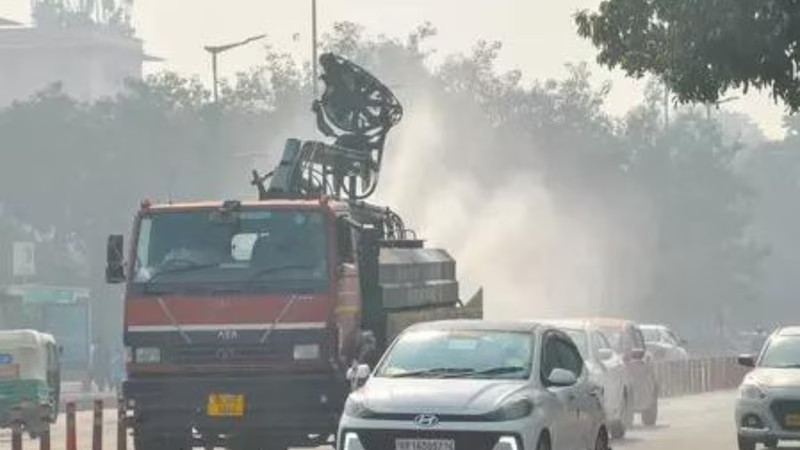
Additionally, the Delhi government continues its anti-smog measures, including increased anti-smog gun deployment and water sprinkling on major roads .
What’s Now Allowed After Revocation?
With Stage III lifted, several key restrictions have been eased:
- Schools and colleges can resume in-person classes (many had already reopened partially).
- Construction and demolition activities are permitted to restart, provided they follow dust mitigation norms.
- Government offices can operate at full capacity (the 50% work-from-home rule is lifted).
- Outdoor events and weddings can proceed with fewer limitations.
This easing brings much-needed normalcy back to daily life—but experts warn against complacency.
How to Check Real-Time AQI and Stay Safe
Air quality in Delhi can change rapidly. To stay informed and protect your health:
- Use the ‘Sameer’ app by the Central Pollution Control Board (CPCB) for real-time AQI updates.
- Monitor the CPCB website or aqicn.org for hourly data.
- If AQI exceeds 300, sensitive groups (children, elderly, those with respiratory issues) should avoid outdoor exertion.
- Keep N95 masks handy during high-pollution episodes.
The Road Ahead for Delhi Air Quality
While the current improvement is welcome, it’s largely weather-dependent—not the result of long-term policy success. Every winter, Delhi faces a similar crisis, and every year, emergency measures are rolled out too late. Sustainable solutions—like transitioning to electric public transport, ending stubble burning through farmer support, and expanding green cover—are still in early stages .
The CAQM has emphasized that the revocation is **not a green light for laxity**. Continued public cooperation is essential to prevent a rapid rebound in pollution levels once the favorable winds subside.
Conclusion: Relief, Not Victory
The **GRAP Stage III revoked** announcement is a sign of short-term relief, not long-term victory. Delhi’s air remains in the ‘Poor’ category—unsafe for prolonged exposure. The real test will be whether the city can maintain this improvement through proactive measures, not just favorable weather. For now, enjoy the clearer skies, but stay alert. To understand how pollution affects your health, explore our in-depth guide on [INTERNAL_LINK:health-impacts-of-air-pollution].