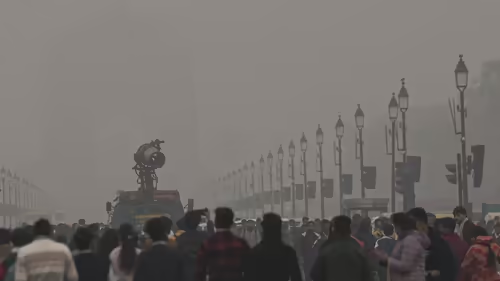
It’s that time of year again. The familiar, acrid haze has returned to blanket the skies of Delhi-NCR, turning day into a perpetual twilight and making every breath a conscious effort. As the Air Quality Index (AQI) nosedives towards the dreaded ‘severe’ zone, the Commission for Air Quality Management (CAQM) has pulled the emergency lever, reimposing the strict GRAP-III in Delhi .
This isn’t just another advisory; it’s a full-scale operational shutdown of major pollution sources. The move is a stark reminder of the city’s annual battle with its own air, a public health crisis that seems to repeat itself with alarming regularity despite years of warnings and action plans. For millions of residents, this means significant disruptions to daily life, from halted commutes to shuttered work sites.
Table of Contents
- What is GRAP-III? A Deep Dive into Stage 3
- Key Restrictions Under GRAP-III in Delhi
- Why Now? The Perfect Storm for Severe Pollution
- Exemptions and Essential Services
- Public Health Advisories and How to Stay Safe
- Sources
What is GRAP-III? A Deep Dive into Stage 3
The Graded Response Action Plan (GRAP) is a set of emergency measures designed to combat the escalating air pollution in the National Capital Region. It operates on a tiered system, with actions escalating in severity as the AQI worsens. GRAP-III is triggered when the AQI is in the ‘very poor’ (301-400) or ‘severe’ (401-500) categories for more than 48 hours .
Developed by the Environment Pollution (Prevention and Control) Authority (EPCA) and now enforced by the CAQM, GRAP is a legally binding framework that mandates specific actions from multiple government agencies. Stage 3 represents a critical intervention point, where the focus shifts from long-term mitigation to immediate, drastic source control to prevent a public health emergency.
Key Restrictions Under GRAP-III in Delhi
The reimposition of GRAP-III brings a wave of sweeping restrictions aimed at the biggest known contributors to the city’s winter smog:
- Construction & Demolition Ban: All non-essential construction, demolition, and mining activities are to be halted immediately across the NCR. This is one of the most impactful measures, as dust from these sites is a primary source of PM10 and PM2.5 particles.
- Vehicular Curbs: A complete ban is imposed on the entry of trucks into Delhi, except for those carrying essential commodities. Additionally, older, more polluting vehicles are targeted: all BS-III petrol and BS-IV diesel light motor vehicles are prohibited from plying on Delhi roads .
- Industrial Shutdown: Industries not running on clean fuels like PNG (Piped Natural Gas) are ordered to stop operations. This targets small and medium enterprises that often rely on dirtier alternatives like coal or furnace oil.
- Power Generation: The Badarpur thermal power plant, if operational, is to be shut down to eliminate a major point-source of emissions.
Exemptions and Essential Services
Recognizing the need for continuity in critical functions, the GRAP-III order includes several key exemptions. Construction projects related to national security, railways, metro rail, airports, and other vital infrastructure are allowed to continue. Similarly, essential services like healthcare, water supply, and waste management remain fully operational to ensure the basic needs of the population are met during this environmental crisis.
Why Now? The Perfect Storm for Severe Pollution
The return of GRAP-III is no surprise to experts. It’s the result of a predictable confluence of factors that hit the region every post-monsoon season:
- Stubble Burning: Despite years of efforts and subsidies, the practice of burning crop residue in Punjab and Haryana continues to be a major external source of particulate matter, which is carried by north-westerly winds into Delhi.
- Local Emissions: The city’s own cocktail of vehicular exhaust, industrial pollution, and construction dust provides a constant baseline of pollutants.
- Adverse Weather: As temperatures drop, a phenomenon known as temperature inversion occurs, where a layer of cool air gets trapped near the ground under a layer of warmer air, acting like a lid and preventing pollutants from dispersing.
This annual cycle has become a grim ritual, highlighting the gap between policy announcements and on-ground implementation.
Public Health Advisories and How to Stay Safe
Apart from the operational restrictions, the authorities have issued strong public health advisories. People are urged to avoid outdoor physical activity, especially children, the elderly, and those with pre-existing respiratory or cardiovascular conditions. Schools and colleges have been instructed to switch to a hybrid or online mode of learning to protect students .
Residents are advised to use N95 or P95 masks if they must venture outside and to keep windows and doors closed at home. Using air purifiers indoors can also help reduce exposure to harmful particulates. This is a critical time for personal vigilance, as the health impacts of prolonged exposure to ‘severe’ air quality can be serious and long-lasting. For more on staying healthy during pollution spikes, see our guide on [INTERNAL_LINK:how-to-protect-yourself-from-delhi-pollution] and [INTERNAL_LINK:best-air-purifiers-for-home].