You’re driving in an unfamiliar city, relying on your phone’s map to get you to your destination. Suddenly, the blue dot jumps a block away, or your turn-by-turn directions tell you to make a left where there’s only a wall. It’s frustrating, but what if it’s not just a glitch in your app? What if it’s the weather?
A new scientific study has confirmed a long-suspected link between one of nature’s most powerful forces—lightning—and the accuracy of our everyday GPS errors. This isn’t just about a minor inconvenience; it has serious implications for aviation, maritime navigation, and even emergency services. Let’s dive into the electrifying details.
Table of Contents
- The Science Behind the Spark: How Lightning Messes with GPS
- GPS Errors: What the New Study Actually Found
- Real-World Implications: When a Wrong Turn Isn’t Just Annoying
- Is Your Device at Risk? Understanding the Scope
- Conclusion: Navigating a World of Atmospheric Interference
- Sources
The Science Behind the Spark: How Lightning Messes with GPS
Global Positioning System (GPS) and other Global Navigation Satellite Systems (GNSS) like India’s NavIC work by receiving incredibly precise timing signals from a constellation of satellites orbiting Earth. Your device calculates its position by measuring the tiny time differences in when these signals arrive.
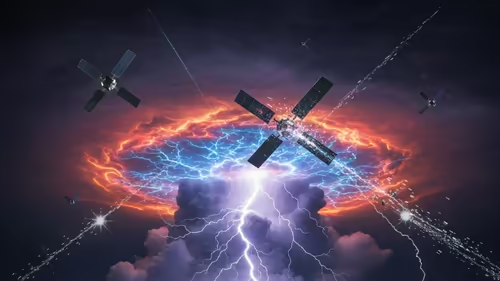
The problem arises in the layer of our atmosphere called the ionosphere. This region is filled with charged particles (ions and electrons). A lightning strike is a massive discharge of electricity that doesn’t just flash in the sky; it sends powerful electromagnetic pulses rippling through the atmosphere. These pulses can cause sudden, localized changes in the Total Electron Content (TEC) of the ionosphere .
Think of the ionosphere as a lens for satellite signals. When the TEC changes abruptly, it’s like that lens suddenly warps. The satellite signal passing through this disturbed patch gets bent and delayed, which throws off the timing calculation in your receiver. The result? Your location appears to be somewhere it’s not—a classic GPS error.
GPS Errors: What the New Study Actually Found
While scientists have long known that solar activity and geomagnetic storms can disrupt satellite signals, this new research specifically isolates the impact of terrestrial lightning. The study examined data from severe lightning events and correlated them with anomalies in GPS signal quality .
Key findings include:
- Signals from satellites that were in the same general direction as a lightning strike showed measurable distortion and noise.
- The effect was strong enough to cause “cycle slips,” where the receiver loses its lock on the satellite’s signal phase, a critical component for high-precision positioning .
- The research demonstrated that the influence on the GPS output waveform increased with the intensity of the injected lightning pulse, proving a direct causal relationship .
This is a significant step forward because it moves the conversation from theoretical possibility to documented, measurable impact. It’s not just the sun; it’s the storm clouds right above us.
Real-World Implications: When a Wrong Turn Isn’t Just Annoying
For most of us, a few meters of inaccuracy on a map app is a minor annoyance. But for other applications, it’s a major safety concern:
- Aviation: Aircraft rely on highly precise GNSS for landing approaches, especially in poor visibility. Even a small error can be critical.
- Maritime Navigation: Ships navigating narrow channels or docking need pinpoint accuracy. A sudden GPS jump could lead to a collision.
- Surveying & Construction: These industries use centimeter-level GPS for their work. Lightning-induced errors can ruin an entire day’s measurements.
- Emergency Services: When you call for help, dispatchers use your phone’s GPS to find you. An error could send them to the wrong location, wasting precious time.
Understanding this vulnerability is the first step toward building more resilient systems. For now, it’s a reminder that our technology is deeply intertwined with the natural world.
Is Your Device at Risk? Understanding the Scope
It’s important to note that this phenomenon doesn’t mean your phone will be permanently damaged by a nearby strike—that’s a different kind of electrical surge issue. The disruption is temporary and atmospheric. The signal itself is degraded as it travels from the satellite to your device.
The risk is highest during active thunderstorms, particularly in regions with frequent and powerful lightning. If you’re using a standard smartphone for navigation, the system may simply show a “weak signal” or become temporarily inaccurate until the atmospheric disturbance passes. More advanced, dual-frequency receivers used in professional settings are better at correcting for some of this ionospheric interference, but they are not immune .
For practical advice on staying safe during electrical storms, check out our [INTERNAL_LINK:thunderstorm-safety-tips] guide.
Conclusion: Navigating a World of Atmospheric Interference
The discovery that lightning strikes can directly cause GPS errors is a fascinating reminder of our planet’s complex systems. Our reliance on satellite technology is immense, yet it remains vulnerable to the very atmosphere it must pass through. While this research won’t stop the next thunderstorm, it provides crucial data for engineers and scientists working on the next generation of more robust and reliable navigation systems. Until then, if your GPS starts acting up during a storm, you’ll know it’s not just your phone—it’s the power of nature at work.
Sources
- Times of India: “Lightning too can affect your GPS accuracy, satellite signals” .
- Nobuaki, K. (2024). “Global Navigation Satellite System Precise Positioning” .
- Wanli, Z. (2021). “Study on damage effects of lightning electromagnetic pulse” .
- Bohlke, Sokkia Corp. on thunderstorm effects on GPS .
- Research paper: “Direct Impact Monitoring of Lightning Activity on the GPS” .
- Official resources from the U.S. Government’s GPS website on how GPS works and its vulnerabilities.