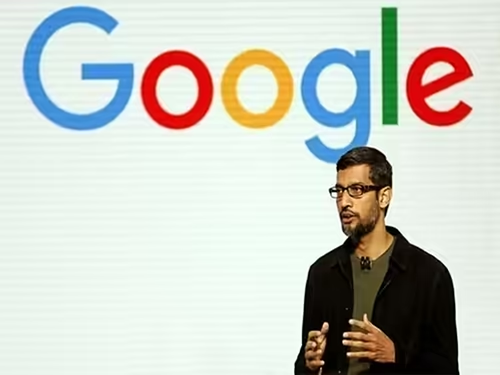
A courtroom clash with billion-dollar implications is heating up in Silicon Valley. At its center is a single, explosive question: Should Google be forced to share its most valuable asset—its proprietary search data—with its fiercest competitors, including ChatGPT-maker OpenAI? The tech giant has fired back at a recent Google court ruling, calling it a dangerous overreach that could expose its crown jewels before its day in court even arrives .
Table of Contents
- The Controversial Court Ruling Explained
- Google’s Core Defense: Trade Secrets and User Choice
- Is Google Really a Monopoly? The Competition Debate
- Broader Implications for the AI and Tech Industry
- What Legal Precedent Is at Stake?
- Conclusion: A Defining Moment for Tech Regulation
- Sources
The Controversial Court Ruling Explained
The dispute stems from an ongoing antitrust lawsuit filed by the U.S. Department of Justice (DOJ), which accuses Google of illegally maintaining a monopoly in the online search market . As part of the pre-trial discovery process, a lower court judge issued an order compelling Google to share some of its internal search query data with a select group of its rivals, including Microsoft (which backs OpenAI) and other companies involved in the case .
The goal of this data sharing, according to the DOJ, is to allow these competitors to independently analyze whether Google’s search results are truly superior or if its dominance is simply the result of anti-competitive practices like exclusive default agreements with phone makers and web browsers.
Google’s Core Defense: Trade Secrets and User Choice
Google is not taking this lying down. In an urgent appeal to a higher court, the company has argued that the Google court ruling is fundamentally flawed and premature. Their primary objections are twofold:
- Protection of Trade Secrets: Google contends that its search algorithms and the vast dataset of anonymized user queries that power them are its most critical intellectual property. Handing this over, even under a strict confidentiality agreement, poses an “unacceptable risk” of exposing its core trade secrets to direct competitors who are also key players in the rapidly evolving AI race .
- Voluntary User Preference: Google insists that its market dominance isn’t the result of coercion but of user choice. “People choose Google because they want to, not because they have to,” the company argues, pointing to the ease with which users can switch to rival search engines like Bing or DuckDuckGo . They believe the court’s order ignores this basic reality of a competitive market.
Is Google Really a Monopoly? The Competition Debate
This case cuts to the heart of a massive debate about the nature of competition in the digital age. The government’s position is that Google’s web of default agreements—making its search engine the automatic choice on Android phones and Chrome browsers—creates an insurmountable barrier for new entrants, effectively locking out competition before it even begins .
Google, however, paints a different picture. It points to the intense and well-funded competition it faces, not just from traditional search engines but from a new wave of AI-powered chatbots like ChatGPT and Claude. These AI systems are increasingly becoming a primary way for users to find information, posing a direct and significant threat to Google’s core search business. This, Google argues, is proof that the market is dynamic and far from monopolistic .
Broader Implications for the AI and Tech Industry
The outcome of this specific dispute over data sharing could have ripple effects across the entire technology sector, especially in the red-hot field of artificial intelligence.
- For AI Startups: If courts can compel a company to share its proprietary training data, it could level the playing field for smaller firms that lack the resources to collect such vast datasets. However, it could also stifle innovation if companies fear their R&D investments will be handed to rivals.
- For Big Tech: A precedent that forces data sharing could become a powerful new tool for regulators worldwide, fundamentally changing how dominant tech platforms operate and defend their market positions [INTERNAL_LINK:big-tech-antitrust-cases].
- For Consumers: The ultimate impact on consumers is unclear. More competition could lead to better, more innovative products. But if it discourages investment in large-scale data collection and model training, it could slow down AI progress overall.
What Legal Precedent Is at Stake?
This isn’t just about one company’s data; it’s about setting a legal standard for future antitrust cases. Historically, courts have been cautious about forcing a company to share its intellectual property with competitors, a principle established in cases like Aspen Skiing Co. v. Aspen Highlands Skiing Corp. However, the DOJ is arguing that in markets defined by network effects and data dominance, traditional remedies are insufficient .
The appeals court now faces a complex balancing act: ensuring a fair trial for the government’s monopoly claims while protecting a company’s legitimate right to safeguard its confidential business information. The decision will be closely watched by every major tech firm in the world.
For a deeper understanding of the legal framework surrounding monopolies and competition, the U.S. Federal Trade Commission provides a clear overview of anti-competitive conduct.
Conclusion: A Defining Moment for Tech Regulation
The fight over this Google court ruling is far more than a procedural squabble. It represents a pivotal moment in the ongoing struggle to regulate the immense power of Big Tech. On one side is the government’s push for a more open and competitive digital marketplace. On the other is a tech giant’s fierce defense of its proprietary assets in an era where data is the new oil. The appeals court’s decision will send a powerful signal about the future of innovation, competition, and corporate secrecy in the AI-driven economy.
Sources
- Google to court: Cannot share data with ChatGPT-maker OpenAI.
- US files antitrust lawsuit against Google over search dominance.
- Google warns of ‘irreparable harm’ from data-sharing order.
- Google argues users choose its search engine willingly.
- DOJ alleges Google’s default deals stifle competition.
- AI chatbots are emerging as a real threat to Google Search.
- Legal precedent on forced sharing of intellectual property.