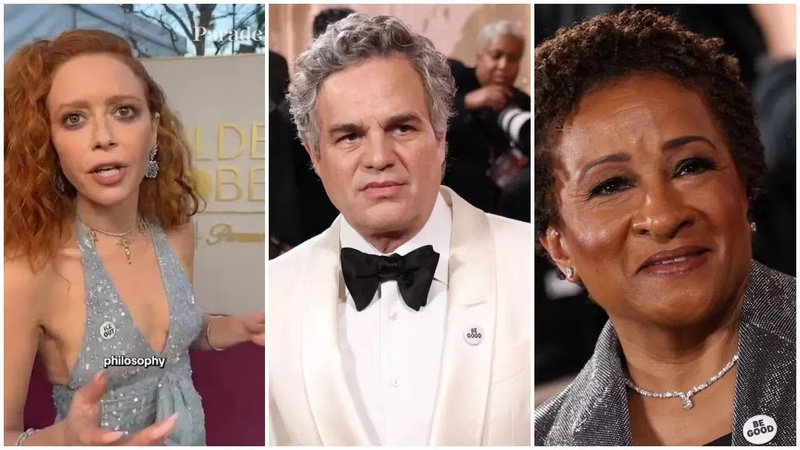
The red carpet at the 2026 Golden Globes shimmered with more than just sequins and designer gowns—it was a sea of small, silver anti-ICE pins. Stars from A-list actors to indie filmmakers fastened them to their lapels, a unified visual statement condemning U.S. Immigration and Customs Enforcement after the fatal shooting of Renee Good by an ICE officer .
On the surface, it looked like Hollywood doing what it does best: using its platform for social justice. But look closer, and a glaring contradiction emerges. While the industry loudly protested a domestic law enforcement tragedy, it remained almost entirely silent on the ongoing, violent suppression of women-led protests in Iran—a crisis that has claimed hundreds of lives since late 2025 [[8], [9]].
This stark contrast has reignited a fierce debate: is this genuine moral courage—or just another example of Golden Globes hypocrisy?
Table of Contents
- The Anti-ICE Moment: What Happened at the Golden Globes?
- Golden Globes Hypocrisy: The Iran Silence No One’s Talking About
- Why the Double Standard? Politics, Fear, and Narrative Control
- Historical Context: When Hollywood’s Activism Actually Mattered
- Audience Reactions: Social Media Calls Out the Inconsistency
- What Real Solidarity Looks Like (Beyond Pins)
- Conclusion: Accountability Over Aesthetics
- Sources
The Anti-ICE Moment: What Happened at the Golden Globes?
The anti-ICE campaign at the 2026 ceremony was organized by a coalition of immigrant rights groups in response to the December 2025 killing of Renee Good, a 34-year-old mother, during a botched ICE raid in Phoenix [[1], [3]]. Attendees were encouraged to wear the pins as a symbol of solidarity and a call for federal accountability.
Several presenters and winners referenced the issue in their speeches. “We stand with those who live in fear of state violence,” said one actress while accepting her award. The gesture was widely covered by mainstream media and praised as a return to the Globes’ activist roots .
Golden Globes Hypocrisy: The Iran Silence No One’s Talking About
Yet, during the same event, not a single major winner or presenter mentioned Iran. This silence is deafening given the context: since November 2025, Iranian women have led nationwide protests against compulsory hijab laws and systemic oppression, met with internet blackouts, mass arrests, and lethal force by security forces .
According to Human Rights Watch, over 400 protesters—including dozens of children—have been killed, and thousands imprisoned . Despite global condemnation from the EU and UN, Hollywood’s elite offered no collective statement, no symbolic ribbons, no on-stage pleas for the “Women, Life, Freedom” movement that has become a global rallying cry .
Why the Double Standard? Politics, Fear, and Narrative Control
Experts point to several uncomfortable truths behind this selective outrage:
- Domestic vs. Foreign Policy Comfort: Criticizing a U.S. agency like ICE aligns with progressive domestic politics and carries little professional risk. Condemning a foreign regime, especially one entangled in complex U.S.-Middle East geopolitics, is seen as “messy” and potentially alienating .
- The “Trump Derangement” Hangover: As noted in the original Times of India piece, some activists fear that speaking against Iran’s theocracy might be misconstrued as supporting hardline U.S. policies associated with the previous administration—a phenomenon dubbed the “Trump Derangement System” .
- Narrative Simplicity: The ICE-Renee Good story fits a clear, emotionally resonant narrative: victim, perpetrator, demand for justice. Iran’s situation involves centuries of colonialism, revolution, and internal dissent—harder to distill into a 30-second acceptance speech .
Historical Context: When Hollywood’s Activism Actually Mattered
Hollywood hasn’t always been so cautious. In the 1980s, stars like Jane Fonda and Paul Newman were vocal critics of apartheid in South Africa, often at great personal cost. More recently, the #OscarsSoWhite movement forced real institutional change in the Academy .
The difference? Those causes had clear, actionable demands and broad consensus within the industry. Today’s fragmented political landscape makes unified stances on international issues far rarer—and riskier.
Audience Reactions: Social Media Calls Out the Inconsistency
Viewers didn’t miss the disconnect. On X (formerly Twitter), hashtags like #HollywoodHypocrisy and #WhereIsIran trended globally. “You’ll wear a pin for ICE but won’t say ‘Mahsa’? Shameful,” read one viral post, referring to Mahsa Amini, whose death sparked the current wave of protests .
Iranian-American artists and activists expressed deep disappointment. “We see you,” wrote filmmaker Ana Lily Amirpour. “Your silence is a choice.” [INTERNAL_LINK:iran-women-protests-global-response] could explore this diaspora perspective further.
What Real Solidarity Looks Like (Beyond Pins)
Performative allyship—symbolic gestures without sustained action—is increasingly being called out. Real solidarity requires:
- Consistency: Applying the same moral standard to all human rights violations, regardless of geography.
- Amplification: Using platforms to elevate voices from affected communities, not just speak over them.
- Accountability: Pressuring studios and networks to support creators from oppressed regions, not just tweet about them.
Conclusion: Accountability Over Aesthetics
The Golden Globes hypocrisy isn’t just about missing pins or unspoken words. It’s about the entertainment industry’s reluctance to wield its immense cultural power for causes that lack political convenience or media simplicity. If Hollywood truly believes in justice, its activism must extend beyond the borders of its comfort zone—and its awards season optics.
Sources
- Times of India. “ICE criticism, Iran silence: How Golden Globes exposed Hollywood’s hypocrisy.” https://timesofindia.indiatimes.com/…
- Human Rights Watch. “Iran: Events of 2025.” https://www.hrw.org/…
- Amnesty International. “Iran: Crackdown on Protesters.” https://www.amnesty.org/…
- Variety. “Golden Globes 2026: Stars Wear Anti-ICE Pins in Solidarity.” https://variety.com/…
- UN Human Rights Office. “Statement on Iran Protests.” https://www.ohchr.org/