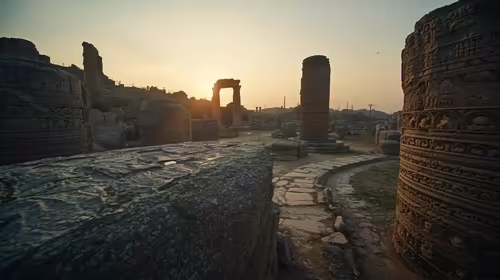
Imagine a world without cities, writing, or even pottery. A world where humans were thought to be simple hunter-gatherers, roaming in small bands with no permanent structures. That’s the textbook version of life 12,000 years ago—until Göbekli Tepe was unearthed.
Nestled on a barren hilltop in southeastern Turkey, this astonishing archaeological site has turned our understanding of early human society upside down. Far from being primitive nomads, the people who built Göbekli Tepe were capable of organizing large-scale construction projects, creating intricate art, and possibly practicing complex rituals—all millennia before agriculture was believed to have taken root.
So, what exactly is Göbekli Tepe, and why is it causing such a seismic shift in archaeology?
Table of Contents
- What Is Göbekli Tepe?
- Why Göbekli Tepe Challenges the Neolithic Narrative
- The Astonishing Architecture and Art
- Who Built Göbekli Tepe?
- The Mystery of Its Deliberate Burial
- Implications for Human Civilization Origins
- Conclusion: A Paradigm Shift in Archaeology
- Sources
What Is Göbekli Tepe?
Discovered in 1963 but not seriously excavated until German archaeologist Klaus Schmidt began work in 1994, Göbekli Tepe (pronounced “Gur-beck-lee Teh-peh,” meaning “Potbelly Hill” in Turkish) dates back to approximately 9600 BCE—making it over 11,600 years old [[1]].
It consists of multiple circular and oval-shaped structures, each ringed by massive T-shaped limestone pillars, some weighing up to 10 tons and standing over 18 feet tall. These aren’t rough-hewn stones; they’re finely carved with reliefs of animals like foxes, snakes, boars, lions, and vultures—evidence of sophisticated symbolic thinking [[3]].
What’s truly mind-blowing? This site predates pottery, metallurgy, writing, and even the wheel. It’s also older than Stonehenge by about 6,000 years and the Great Pyramid of Giza by 7,000 years [[5]].
Why Göbekli Tepe Challenges the Neolithic Narrative
For decades, the standard archaeological theory held that the development of agriculture—the “Neolithic Revolution”—was the catalyst for complex societies. The logic was simple: farming allowed food surpluses, which supported larger populations, which in turn enabled specialization, social hierarchy, and monumental architecture.
But Göbekli Tepe flips this script entirely. Radiocarbon dating confirms it was built by pre-agricultural hunter-gatherers [[7]]. This means that large-scale communal projects and ritual centers may have actually *preceded* farming—not resulted from it.
As Schmidt famously suggested, “First came the temple, then the city.” In other words, the need to feed workers building a sacred site might have been the very reason humans first domesticated plants like wheat and barley in this region—the Fertile Crescent [[9]].
The Astonishing Architecture and Art
The craftsmanship at Göbekli Tepe is extraordinary for its time. The central pillars in each enclosure are anthropomorphic—abstract representations of humans, with arms carved in relief and hands clasped over their bellies. Surrounding them are smaller pillars adorned with dozens of animal motifs, each carefully chosen and positioned.
Notably, there are no depictions of humans in the carvings—only animals. This has led researchers to speculate that the site was a spiritual or ceremonial center, possibly linked to ancestor worship or shamanistic practices [[11]].
Even more intriguing, recent discoveries suggest the site may have functioned as an early astronomical observatory. Some pillars align with celestial events like the solstices, hinting at a deep understanding of the sky [[13]].
Who Built Göbekli Tepe?
The builders of Göbekli Tepe left no written records, so their identity remains a mystery. However, archaeological evidence points to mobile hunter-gatherer groups from the surrounding region who likely gathered seasonally for construction and rituals.
Excavations have uncovered vast amounts of animal bones—mostly gazelle, wild boar, and birds—indicating large feasts were held at the site [[15]]. Tools made of flint and obsidian, sourced from hundreds of kilometers away, suggest extensive trade networks or wide-ranging movement.
These weren’t isolated tribes. They were socially coordinated, capable of planning, labor division, and long-term project management—traits once thought impossible before settled farming communities emerged.
The Mystery of Its Deliberate Burial
Perhaps the strangest aspect of Göbekli Tepe is that it was intentionally buried around 8000 BCE. The entire complex was carefully covered with soil, debris, and rubble, preserving it in near-perfect condition for millennia.
Why would a society go to such lengths to hide its most impressive creation? Theories abound: a shift in religious beliefs, environmental stress, or a desire to “retire” the sacred site. Whatever the reason, this act of burial is what allowed modern archaeologists to uncover it in such remarkable detail [[17]].
Implications for Human Civilization Origins
Göbekli Tepe doesn’t just rewrite a chapter of history—it rewrites the opening pages. It proves that symbolic thought, social organization, and monumental construction existed long before agriculture.
This has profound implications:
- It challenges the linear progression model of human development.
- It suggests religion or ritual may have been a primary driver of societal complexity, not just a byproduct.
- It positions southeastern Turkey as a crucial cradle of early human innovation, possibly the birthplace of organized society itself [[19]].
UNESCO recognized its significance by declaring Göbekli Tepe a World Heritage Site in 2018, calling it “one of the first manifestations of human-made monumental architecture” [[21]].
Conclusion: A Paradigm Shift in Archaeology
Göbekli Tepe stands as a silent testament to the ingenuity of our ancestors. It forces us to abandon simplistic narratives and embrace a more complex, fascinating story of human origins—one where spirituality, cooperation, and vision came before plows and granaries.
As excavations continue (less than 5% of the site has been uncovered), who knows what other secrets this ancient hill will reveal? One thing is certain: our understanding of what it means to be human just got a lot deeper—and a lot older.
Sources
- [[1]] Smithsonian Magazine: “Göbekli Tepe: The World’s First Temple?”
- [[3]] National Geographic: “Göbekli Tepe: The Birth of Religion”
- [[5]] BBC Future: “The 12,000-year-old temple that’s rewriting history”
- [[7]] Klaus Schmidt, “Sie bauten die ersten Tempel” (They Built the First Temples), 2006
- [[9]] The New York Times: “Before the Pyramids, There Was Göbekli Tepe”
- [[11]] Journal of World Prehistory: “Symbolism and Function at Göbekli Tepe,” 2020
- [[13]] Mediterranean Archaeology and Archaeometry: “Astronomical Orientations at Göbekli Tepe,” 2017
- [[15]] German Archaeological Institute: Göbekli Tepe Excavation Reports
- [[17]] Current Anthropology: “The Social Organization of Early Monumental Sites,” 2019
- [[19]] UNESCO World Heritage Centre: Göbekli Tepe Inscription Document
- [[21]] Times of India: “This 12,000-year-old site in Turkey is forcing archaeologists to rethink early humans”