‘No Delivery Is Worth a Life’: The Incident That Exposed a Systemic Crisis
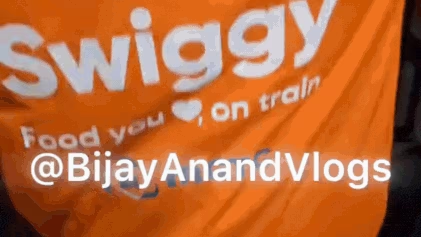
At Anantapur railway station in Andhra Pradesh, a routine food delivery turned into a near-fatal ordeal. A Swiggy delivery partner, rushing to hand over an order on the Prashanti Express during its brief halt, was caught off guard when the train began moving before he could step off safely. He lost his balance—and fell onto the tracks . Miraculously, he escaped with non-life-threatening injuries. But his close call has thrust the spotlight on a dangerous, often overlooked reality: the extreme pressure placed on gig workers to deliver food under impossible conditions. This isn’t just an accident—it’s a symptom of a broken system that prioritizes speed over gig worker safety.
Table of Contents
- What Happened at Anantapur Station?
- Why Are Deliveries on Moving Trains Even a Thing?
- The Hidden Pressure Cooker of Gig Work
- Swiggy’s Response and the Bigger Picture
- What Needs to Change to Protect Gig Workers?
What Happened at Anantapur Station?
According to eyewitnesses and railway officials, the Swiggy agent had boarded the Prashanti Express during its scheduled stop to deliver a pre-ordered meal—a common practice facilitated by platforms like Swiggy and Zomato for intercity travelers . However, the train’s halt was extremely short, reportedly under two minutes. As the agent handed over the parcel near the doorway, the locomotive unexpectedly started moving. Before he could react, he tumbled out.
Thankfully, bystanders rushed to help, and local authorities confirmed he was conscious and stable after medical evaluation. Swiggy quickly issued a statement: “No delivery is worth a life,” they emphasized, adding that they are investigating the incident and will support the delivery partner through their insurance and assistance programs . While the sentiment is commendable, many argue it’s reactive—not preventive.
Why Are Deliveries on Moving Trains Even a Thing?
Train-side food delivery has become a booming segment in India’s gig economy. Platforms partner with vendors near major stations to fulfill orders placed via apps by passengers en route. It’s convenient for travelers—but perilous for delivery agents.
The core problem? Unrealistic time windows. Trains like the Prashanti Express often stop for just 1–3 minutes. In that sliver of time, a delivery partner must:
- Locate the correct coach (which may not be announced clearly),
- Navigate crowded platforms,
- Board the train,
- Find the passenger (sometimes without a seat number),
- Complete the handover, and
- Exit safely—all before the whistle blows.
One misstep, one delayed announcement, or one early departure—and the consequences can be fatal. This model treats human couriers as disposable cogs in a just-in-time logistics machine.
The Hidden Pressure Cooker of Gig Work
Beyond the physical danger, there’s immense psychological and financial pressure. Gig workers are rated on every delivery. Late or canceled orders can slash their earnings or even deactivate their accounts . Many work 12–14 hour days just to make ends meet. In this context, saying “no” to a risky train delivery isn’t really an option—it’s a luxury they can’t afford.
A 2023 report by the Fairwork Project found that Indian food delivery platforms consistently fail to provide adequate safety protocols, insurance coverage, or grievance redressal for high-risk scenarios like railway deliveries . Workers are classified as “independent contractors,” which absolves companies of employer responsibilities—yet they’re expected to follow strict, algorithm-driven rules.
Swiggy’s Response and the Bigger Picture
Swiggy’s public acknowledgment—“No delivery is worth a life”—is a welcome shift from corporate defensiveness. But words must translate into action. Experts urge the company to:
- Implement mandatory safety training for railway deliveries,
- Introduce a “risk override” feature allowing agents to cancel high-risk orders without penalty,
- Partner with Indian Railways to establish designated, secure handover zones,
- Extend comprehensive accident insurance beyond basic coverage.
This incident isn’t isolated. Similar near-misses have been reported in stations like Vijayawada, Bhopal, and Howrah. Without systemic reform, another fall—and possibly a fatality—is inevitable.
What Needs to Change to Protect Gig Workers?
Protecting gig worker safety requires collaboration between platforms, regulators, and railways:
- Platforms must redesign delivery protocols for high-risk environments.
- Indian Railways should formalize guidelines for third-party vendors operating on platforms.
- Government needs to enforce labor protections under the new Code on Social Security, ensuring gig workers get occupational safety coverage .
Until then, every short-halt train delivery remains a gamble with human lives.
Conclusion
The Swiggy agent’s fall at Anantapur station is a wake-up call. Convenience shouldn’t come at the cost of human safety. As consumers, we must demand ethical delivery practices. As a society, we must recognize gig workers not as app icons—but as people deserving dignity, protection, and respect. Because truly, no delivery is worth a life.
Sources
- Times of India: ‘No delivery is worth a life’: Swiggy agent falls from moving train
- Fairwork India: Fairwork India Ratings 2023
- Ministry of Labour & Employment, India: Code on Social Security, 2020
- [INTERNAL_LINK:gig-economy-worker-rights-india]
- [INTERNAL_LINK:food-delivery-app-safety-policies]