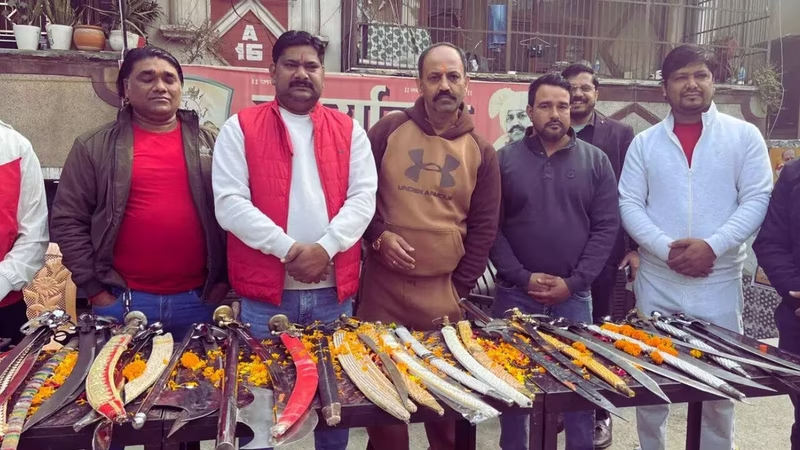
In the quiet lanes of Ghaziabad’s Shalimar Garden, an event unfolded on December 29, 2025, that sent shockwaves through the nation. Members of a group calling itself the Hindu Raksha Dal (HRD) weren’t handing out flyers or sweets—they were distributing swords, machetes, and axes . Their chilling justification? ‘What’s happening in Bangladesh can happen in India too.’ This act of vigilantism, which led to the arrest of ten members and the registration of an FIR against their leader, Pinky Chaudhary, and 45 others, is more than just a local crime. It’s a stark warning sign of rising fear and a disturbing echo of a regional crisis .
Table of Contents
- The Ghaziabad Incident: What Went Down?
- Who is the Hindu Raksha Dal?
- The Bangladesh Connection: A Real or Perceived Threat?
- Why the Ghaziabad Sword Distribution is a National Alarm Bell
- Conclusion: Navigating Fear and Facts
- Sources
The Ghaziabad Incident: What Went Down?
The scene was surreal. In a residential colony, a stall was set up not for a community fair, but to arm residents. Police reports confirm that over 250 weapons, including swords, were seized during the operation that followed the public distribution . The group’s leader, Pinky Chaudhary, fled the scene, leaving ten of her associates to be detained. The stated motive was to encourage Hindus to ‘defend themselves,’ a direct reference to the escalating violence against the Hindu minority in neighboring Bangladesh .
The act wasn’t just illegal; it was profoundly destabilizing. Distributing weapons in a civilian area is a direct assault on public order and sows seeds of deep communal distrust. The police have rightly treated this as a serious crime that disrupted public peace and incited fear .
Who is the Hindu Raksha Dal?
The Hindu Raksha Dal describes itself as a ‘patriotic body of persons sworn to protect the nation of Hindustan from foreigners and traitors’ . However, it is widely regarded as a fringe Hindutva organization with a history of inflammatory actions. The group has been linked to other acts of violence, including claiming responsibility for the JNU violence in a past incident .
Often operating on the fringes of larger socio-political movements, groups like the HRD leverage real or perceived threats to minority communities to build a narrative of siege and justify their militant stance. Their recent activity in Ghaziabad is a prime example of this tactic in action .
The Bangladesh Connection: A Real or Perceived Threat?
The HRD’s invocation of Bangladesh is not a random bogeyman. It points to a very real and ongoing crisis. Following the political upheaval in August 2024 that led to the resignation of Prime Minister Sheikh Hasina, Bangladesh has witnessed a sharp and alarming rise in violence against its Hindu minority .
According to the U.S. Department of State, the first half of 2025 alone saw 258 reported incidents of attacks on minority communities in Bangladesh, with Hindus being the primary target . These attacks have included the burning of homes, looting of businesses, and desecration of temples, creating a climate of terror for a community that feels abandoned and vulnerable .
While the situation in Bangladesh is indeed dire, the leap to arm civilians in India is not a solution but a dangerous escalation. It conflates a complex geopolitical situation in a neighboring country with the internal security dynamics of India, potentially importing a foreign conflict onto our own soil.
Why the Ghaziabad Sword Distribution is a National Alarm Bell
This incident transcends a single act of vigilantism. It represents a dangerous trend that every citizen should be concerned about:
- Erosion of State Monopoly on Force: When private groups start arming citizens, they directly challenge the state’s fundamental role as the sole legitimate wielder of force. This is a slippery slope toward lawlessness.
- Manufacturing of Communal Fear: Groups like the HRD often thrive on amplifying fear. By distributing weapons, they are not just reacting to a threat; they are actively creating a narrative of imminent, violent conflict that may not exist at that scale in Ghaziabad.
- Potential for a Self-Fulfilling Prophecy: Arming one community based on fear of another is a recipe for disaster. It can provoke a counter-reaction, leading to a cycle of violence and distrust that is incredibly difficult to break.
The proper channels for addressing security concerns, whether real or perceived, are through dialogue with local authorities, community policing, and legal frameworks—not through the street-level distribution of medieval weapons .
Conclusion: Navigating Fear and Facts
The Ghaziabad sword distribution incident is a complex and troubling event. It is rooted in a genuine and horrific crisis facing Hindus in Bangladesh, a fact that cannot be ignored. However, the response from the Hindu Raksha Dal—arming civilians in a peaceful neighborhood—is not protection; it is provocation.
India’s strength has always been its ability to manage its vast diversity through its constitutional framework and its robust, if imperfect, institutions. The answer to regional instability is not to replicate its chaos at home but to reinforce our own commitment to law, order, and communal peace. The police action in Ghaziabad is a necessary first step, but the larger conversation about fear, security, and the role of fringe groups in our society must continue. For more on rising communal tensions in South Asia, see our in-depth analysis on [INTERNAL_LINK:communal-tensions-south-asia].
Sources
- Ghaziabad Police Reports on Sword Distribution Incident [[1], [3], [6]]
- Background on Hindu Raksha Dal [[7], [9], [15]]
- U.S. Department of State – Bangladesh Human Rights Reports
- Reports on Bangladesh Hindu Persecution from 2024-2025 [[18], [22]]