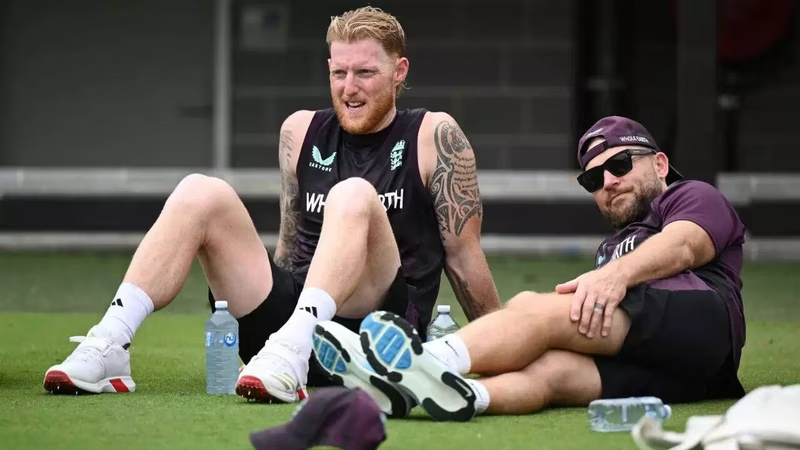
The dust hasn’t even settled on England’s Ashes defeat in Australia, but the knives are already out—and they’re being wielded by one of their own. Geoffrey Boycott, the 85-year-old former England opener known for his uncompromising views, has delivered a blistering verdict on the current regime led by Ben Stokes, Brendon McCullum, and ECB managing director Rob Key.
In a candid and emotionally charged assessment, Boycott didn’t just criticize tactics—he accused the leadership of selling English cricket fans “a lie for three years.” His core argument? That the much-hyped “Bazball” revolution, while entertaining and initially successful in home conditions, was built on a foundation of recklessness with no real accountability—especially when faced with the relentless pressure of an Ashes tour down under .
Table of Contents
- Boycott’s Scathing Verdict on Bazball
- Geoffrey Boycott on the Lack of Player Accountability
- Bowling Woes and Selection Missteps
- A Glimmer of Hope: Jacob Bethell’s Century
- What’s Next for England Cricket?
Boycott’s Scathing Verdict on Bazball
When Bazball first arrived in 2022, it was hailed as a breath of fresh air. Aggressive batting, fearless declarations, and a win-at-all-costs mentality led to thrilling victories against India and Pakistan at home. But Boycott argues that this approach was never stress-tested against elite, sustained opposition in alien conditions.
“You can play that way at Lord’s or Headingley,” Boycott stated, “but not in Perth, not in Melbourne, not when the ball is seaming and bouncing unpredictably for five days.” He believes the philosophy ignored the fundamental truth of Test cricket: that survival and patience are often prerequisites for success, especially in Australia .
Geoffrey Boycott on the Lack of Player Accountability
Perhaps Boycott’s most damning criticism isn’t about tactics, but culture. He contends that under the Stokes-McCullum-Key triumvirate, players were shielded from consequences. Early wins created a bubble where poor individual performances were excused in the name of “positive intent.”
“They were told, ‘Just go out and express yourself,’” Boycott lamented. “But cricket isn’t just about expression—it’s about responsibility. When you fail repeatedly in the same way, you should be dropped. That accountability has been missing.” This lack of discipline, he argues, left the team mentally unprepared for the grind of a five-Test Ashes series .
Bowling Woes and Selection Missteps
While much of the focus has been on batting collapses, Boycott also highlighted critical failures in England’s bowling department. Injuries to key pacers like Jofra Archer and Mark Wood were inevitable, but the selection panel’s inability to build a resilient, multi-pronged attack proved costly.
England often fielded four seamers with similar styles, lacking a genuine spinner who could exploit dry Australian pitches later in matches. The over-reliance on Ollie Robinson and Chris Woakes, both excellent bowlers in English conditions, backfired when they struggled with pace and bounce overseas .
Key selection decisions—such as persisting with inconsistent all-rounders or overlooking proven county performers—were, in Boycott’s view, symptomatic of a leadership more focused on narrative than substance.
A Glimmer of Hope: Jacob Bethell’s Century
Amid the wreckage, Boycott did find one bright spot: 20-year-old Jacob Bethell’s magnificent, unbeaten 134 in the final Test at Sydney. Facing a fired-up Australian attack on a wearing pitch, Bethell showed composure, technique, and grit—qualities Boycott feels have been undervalued in the Bazball era.
“That innings gave me hope,” Boycott admitted. “It showed you can be positive without being foolish. He played within himself, respected the good balls, and punished the bad ones. That’s how you succeed in Test cricket, not by swinging from the first ball every time .”
What’s Next for England Cricket?
Boycott’s critique raises existential questions for English cricket. Can Bazball evolve to meet the demands of global Test competition, or is it a home-condition gimmick destined to fail abroad? The ECB now faces a pivotal choice: double down on the current philosophy or introduce a more balanced, context-aware approach.
As noted by ECB’s official review process, major structural changes are expected post-Ashes . Whether those changes include a philosophical shift—or even personnel adjustments at the top—remains to be seen. But one thing is clear: voices like Boycott’s will ensure the debate is loud, public, and impossible to ignore.
Final Summary
Geoffrey Boycott’s post-Ashes broadside is more than just nostalgia—it’s a call for realism in an era of hyper-aggression. By accusing England’s leadership of selling a “lie” through the unchecked promotion of Bazball, he has ignited a crucial conversation about balance, accountability, and what truly constitutes sustainable success in Test cricket. While Jacob Bethell’s century offers a blueprint for the future, the path forward for England will require more than just intent—it will demand intelligence, adaptability, and, above all, honesty.
Sources
- Times of India. (2026, January 9). Ashes: ‘Sold a lie for three years’ – Boycott rips into England. Retrieved from https://timesofindia.indiatimes.com/sports/cricket/ashes/sold-a-lie-for-three-years-85-year-old-england-legend-geoffrey-boycott-rips-into-brendon-mccullum-and-ben-stokes-after-ashes-thrashing/articleshow/126417477.cms
- ESPNcricinfo. (2026). England’s Ashes 2025-26 Tour: Match Reports & Analysis.
- ECB. (2026). Post-Ashes Review Framework. Retrieved from https://www.ecb.co.uk
- The Guardian. (2026, January 8). Geoffrey Boycott: “England’s approach was naive in Australian conditions”.