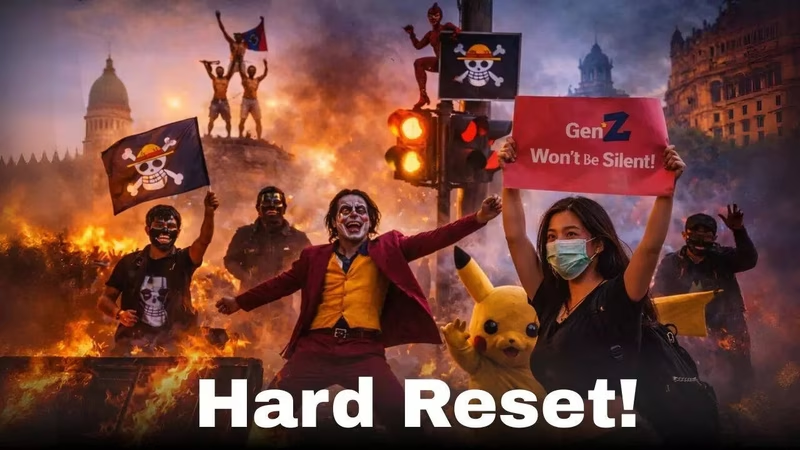
Remember when everyone wrote off Gen Z as a bunch of phone-obsessed, politically apathetic kids? Tell that to the streets of Kathmandu, Rabat, and Lima in 2025. What the world witnessed wasn’t just a protest; it was a full-blown Gen Z political awakening—a seismic shift from digital snark to organized, boots-on-the-ground power that left governments scrambling. This wasn’t a flash in the pan. It was a carefully orchestrated, meme-fueled revolution that redefined modern activism.
Table of Contents
- The Meme is the Message
- From Viral Trends to the Streets: Gen Z’s 2025 Protests
- Why 2025 Was the Tipping Point for Gen Z
- The Anatomy of a Gen Z Movement
- Beyond the Hashtag: The Real-World Impact
- Conclusion: The Future Belongs to the Awakened
- Sources
The Meme is the Message
For Gen Z, a meme is more than just a joke; it’s a primary language of political discourse. In an age of information overload, memes provide a lightning-fast, emotionally resonant way to dissect complex issues like corruption, inequality, and climate inaction . These aren’t just funny images; they’re sophisticated cultural critiques packaged for a TikTok attention span .
Studies show that Gen Z views memes as a legitimate and powerful form of political participation, capable of building emotional resonance and collective identity around a cause . A political meme can travel from a private Discord server to a million Instagram feeds in an hour, creating a shared understanding and a sense of urgency that traditional news outlets simply can’t match . This was the digital kindling that would soon ignite into a global fire.
From Viral Trends to the Streets: Gen Z’s 2025 Protests
The true test of any movement is its ability to move from the screen to the street. And in 2025, Gen Z passed that test with flying colors. A new “youthquake” emerged worldwide, with young people organizing and executing massive demonstrations in a stunning display of real-world power .
The map of their rebellion was global:
- Nepal: Protests erupted against social media bans and systemic corruption, with Gen Z leading the charge .
- Morocco: Decentralized, anonymous collectives like “GenZ 212” organized ongoing demonstrations against political exclusion .
- Peru, Kenya, and India: From Lima to Nairobi to major Indian cities, young people filled the streets, their demands echoing a unified global frustration .
These weren’t leaderless mobs. They were highly organized, digitally-native campaigns that used platforms like Instagram and Discord not just to spread a message, but to coordinate logistics, share safety information, and build resilient, leaderless structures that were incredibly difficult for authorities to dismantle .
Why 2025 Was the Tipping Point for Gen Z
So, what made 2025 the year everything changed? It was a perfect storm of factors.
First, a decade of witnessing political failure—from the climate crisis to economic inequality and global pandemics—had built up an immense reservoir of frustration. Gen Z, who grew up in this chaos, realized that waiting for a “seat at the table” was a fool’s errand. As one activist put it, they were “no longer willing to cope, stay low-key, or wait their turn” [[Original]].
Second, the digital tools of organization had matured. The lessons learned from earlier online movements were applied with far greater strategic sophistication. They knew how to go viral, how to protect their identities, and how to translate digital momentum into physical presence.
The Anatomy of a Gen Z Movement
These new movements have a distinct DNA:
- Digital-First Strategy: It all starts online, with a meme or a hashtag that captures a collective mood.
- Leaderless Organization: Power is distributed, making the movement agile and resistant to decapitation.
- Physical Presence as Proof: The ultimate goal is to show up in person, proving that their online numbers translate to real-world power .
- Cross-Border Solidarity: Gen Z in Nepal shares tactics with activists in Peru, creating a global playbook for resistance .
Beyond the Hashtag: The Real-World Impact
The impact of this Gen Z political awakening is already being felt. Governments that once dismissed online chatter are now investing heavily in social media monitoring and disinformation campaigns to counter it. Policy agendas are being forced to shift, however reluctantly, to address the core issues of this new generation.
More importantly, Gen Z has redefined what civic engagement looks like. They’ve proven that “streets were not obsolete” [[Original]] and that their fluency in digital culture is a superpower, not a distraction. They’ve shown that authenticity, speed, and collective action can cut through the noise of traditional politics.
Conclusion: The Future Belongs to the Awakened
2025 was not the beginning of Gen Z’s political journey, but it was its most powerful declaration of presence yet. By masterfully blending the digital and the physical, the humorous and the serious, they have forged a new path for activism in the 21st century. The era of writing them off is over. The political establishment now faces a generation that is not only awake but is also organized, connected, and ready to fight for its future. For a deeper look at how digital culture is reshaping society, explore our analysis on [INTERNAL_LINK:Digital-Culture-and-Society].
Sources
- Times of India: From memes to movements: How 2025 became the year of political awakening for Gen Z
- Foreign Policy: The Transformative Potential of the Global Gen Z Movement
- Al Jazeera: From Nepal to Peru, Kenya to India — 2025 saw a new wave of Gen Z protests
- The New Humanitarian: Gen Z Movements and the “Future of Protest”
- BBC News: From Kathmandu to Lima, Generation Z took to the streets
- Journal of Digital Media & Policy: Generation Z and Political Memes: Exploring the Role of User-Generated Content
- The Guardian: Gen Z and the Language of Memes
- Reuters: 2025 Nepalese Gen Z protests
- France 24: 2025 Moroccan Gen Z protests