Table of Contents
- The Snow Glove Test That Broke the Internet
- What Is Gemini Personal Intelligence?
- How It Works: Reading Your Gmail to Help You Live Better
- Sundar Pichai Calls It a Defining Moment for AI
- Privacy Concerns and User Control
- The Future of Personal AI: Beyond Snow Tips
- Conclusion: Is This the Next Big Leap in AI?
- Sources
Imagine asking your phone, “Are these gloves good for snow?” and instead of a generic search result, it replies: “Yes—they’re waterproof, rated for -20°C, and you bought them from REI last week.” That’s not science fiction. That’s Gemini Personal Intelligence in action—and it’s already here in beta.
The moment went viral when tech analyst Max Weinbach tested Google’s latest AI feature, and Google CEO Sundar Pichai himself responded, calling it a “powerful example” of how AI can become truly personal . But beneath the convenience lies a profound shift in how artificial intelligence interacts with our digital lives.
The Snow Glove Test That Broke the Internet
Weinbach’s simple query—“Are my new gloves suitable for snow?”—seemed innocent enough. But what happened next stunned even seasoned AI observers. Gemini didn’t just scrape product specs online. It accessed Weinbach’s Gmail, located his order confirmation from an outdoor retailer, parsed the product description, and synthesized a confident, contextual answer .
“It knew I’d bought them. It knew the brand. It even quoted the temperature rating,” Weinbach said in a follow-up post. The demo wasn’t scripted; it was a real-time test of Gemini’s ability to connect personal data with practical reasoning—a capability Google is now branding as **Personal Intelligence**.
What Is Gemini Personal Intelligence?
Gemini Personal Intelligence is a new beta feature within Google’s Gemini app that allows the AI to access and reason over a user’s personal data—like emails, calendar events, photos, and documents—to provide tailored, context-aware responses. Unlike traditional AI assistants that rely on public knowledge, this system acts like a “digital memory” for your life.
Key characteristics include:
- Contextual Awareness: Understands your habits, purchases, and schedules.
- Cross-App Integration: Pulls data from Gmail, Google Photos, Drive, and more (with permission).
- Proactive Assistance: Can anticipate needs—like reminding you to pack gloves before a ski trip based on your calendar.
- On-Device Processing (Where Possible): Sensitive data is processed locally to enhance privacy .
This isn’t just smarter search—it’s AI that *knows* you.
How It Works: Reading Your Gmail to Help You Live Better
Under the hood, Gemini uses advanced natural language understanding and secure data indexing to link your queries to relevant personal content. When you ask about snow gear, it scans for recent shopping confirmations, travel itineraries, or even weather-related calendar events.
Importantly, this feature is opt-in and governed by strict permissions. Users must explicitly enable “Personal Intelligence” and grant access to specific data sources. Google emphasizes that no data is used to train its core models without consent .
Still, the implications are huge. Imagine asking:
- “When’s my passport expiring?” → Gemini checks your email for renewal notices.
- “What did the doctor say about my vitamin D?” → It pulls notes from a health portal email.
- “Did I already RSVP to Mom’s birthday?” → It scans your calendar and event invites.
This transforms Gemini from a tool into a true personal assistant [INTERNAL_LINK:future-of-ai-assistants].
Sundar Pichai Calls It a Defining Moment for AI
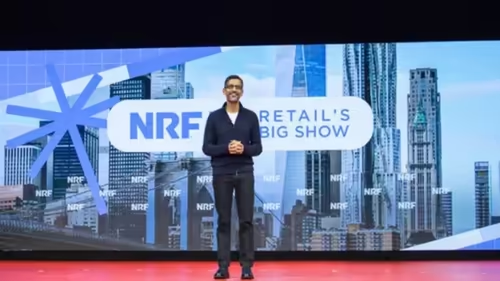
When Weinbach shared his snow glove demo on social media, Sundar Pichai didn’t just like the post—he replied directly: “This is exactly the kind of use case we envisioned with Personal Intelligence. AI that helps you navigate your own life” .
For Pichai, this represents the evolution of AI from “information retrieval” to “life augmentation.” In a recent interview with Wired, he described Personal Intelligence as “the next frontier”—where AI moves beyond answering questions to helping users make better decisions based on their unique circumstances .
It also positions Google ahead of rivals like Apple and Microsoft, who are still largely confined to device-level automation without deep cross-service reasoning.
Privacy Concerns and User Control
Of course, giving an AI access to your emails raises red flags. Critics warn that even with opt-in controls, the potential for misuse—whether through data leaks, profiling, or accidental exposure—is real.
Google insists it’s built with “privacy by design”:
- All personal data access requires explicit user permission.
- Data is encrypted in transit and at rest.
- Users can delete their AI interaction history anytime.
- No personal data is shared with advertisers.
Nonetheless, experts from the Electronic Frontier Foundation urge caution: “Convenience shouldn’t come at the cost of surveillance—even self-surveillance,” said a recent statement .
The Future of Personal AI: Beyond Snow Tips
The snow glove example is just the tip of the iceberg. Google envisions Gemini Personal Intelligence evolving into a holistic life coach:
- Health Companion: Track symptoms, medication schedules, and lab results.
- Financial Advisor: Analyze spending patterns and suggest budgets.
- Travel Concierge: Auto-generate packing lists based on destination and weather.
But the real power lies in synthesis—connecting dots across your digital life to offer insights you might miss. As one Google engineer put it, “We’re not building a smarter Siri. We’re building your second brain.”
Conclusion: Is This the Next Big Leap in AI?
Gemini Personal Intelligence marks a pivotal moment in artificial intelligence—not because it’s flashy, but because it’s useful. By grounding AI in the reality of our daily lives, Google is making technology feel less like a tool and more like a trusted partner. Yet, with great power comes great responsibility. The success of this vision hinges not just on technical brilliance, but on earning and maintaining user trust. One thing’s for sure: the era of generic AI is over. The age of personal intelligence has begun.