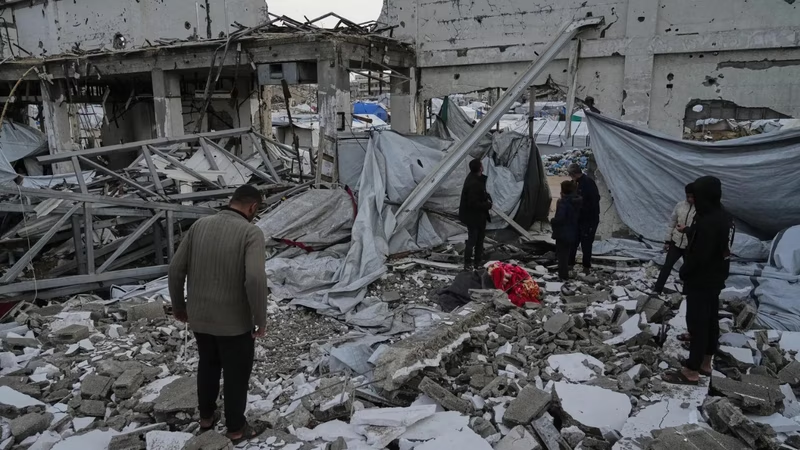
The fragile calm in Gaza may be just the beginning. In a significant diplomatic development, U.S. Special Envoy for Middle East Peace Steven Horsford announced that the internationally backed Gaza peace plan has now moved into phase two—a stage focused on demilitarisation, humanitarian recovery, and the creation of a new “technocratic” Palestinian governance structure.
This marks a pivotal shift from the initial goal of halting violence to addressing the root causes of instability. But while the framework sounds orderly on paper, its real-world execution faces immense political, security, and humanitarian challenges—especially with Hamas still controlling parts of Gaza and Israel demanding ironclad security guarantees.
Table of Contents
- What Is Phase Two of the Gaza Peace Plan?
- From Ceasefire to Demilitarisation: Key Objectives
- The Controversial Push for Technocratic Governance
- Who Will Oversee Demilitarisation?
- Hamas Response and Palestinian Public Opinion
- Israeli Security Demands and Regional Stakes
- Conclusion: Can Phase Two Succeed Without Political Legitimacy?
- Sources
What Is Phase Two of the Gaza Peace Plan?
According to U.S. officials, the three-phase roadmap—brokered with input from Egypt, Qatar, and the UAE—was always designed to evolve beyond a simple truce. Phase one achieved a temporary ceasefire and hostage-prisoner exchange. Now, Gaza peace plan phase two aims to:
- Begin the process of disarming militant groups, particularly Hamas;
- Facilitate large-scale humanitarian aid and reconstruction;
- Establish an interim civilian administration composed of non-partisan experts (“technocrats”);
- Lay groundwork for eventual Palestinian Authority (PA) return to Gaza.
Critically, this phase avoids immediate talk of elections or statehood—focusing instead on “stability first,” a stance heavily influenced by Israeli security concerns .
From Ceasefire to Demilitarisation: Key Objectives
Demilitarisation is the most sensitive pillar. The U.S. envisions a Gaza stripped of heavy weapons, tunnels, and military infrastructure. But who will enforce this?
Israel insists it must retain overriding security control. Arab states propose an international or regional force—perhaps led by Turkey or Jordan—but Israel rejects any foreign military presence near its border. This deadlock could stall the entire process.
Meanwhile, humanitarian efforts are accelerating. The World Food Programme reports that over 80% of Gaza’s 2.3 million residents remain food insecure . Phase two prioritizes reopening key corridors like the Kerem Shalom crossing to enable consistent aid flow—a prerequisite for any lasting stability.
The Controversial Push for Technocratic Governance
Perhaps the most debated element is the call for a “technocratic” government. U.S. officials argue that neither Hamas (viewed as a terrorist group by the West) nor the current Palestinian Authority (seen as corrupt and ineffective in Gaza) can credibly lead reconstruction.
Instead, they propose a cabinet of engineers, doctors, economists, and civil administrators—apolitical figures tasked solely with service delivery. Similar models have been tried in Lebanon and post-invasion Iraq, with mixed results.
But critics warn: governance without legitimacy is unsustainable. “You can’t build peace with bureaucrats alone,” said Dr. Noura Erakat, a human rights attorney. “People need representation, not just ration cards.”
Who Will Oversee Demilitarisation?
No clear mechanism exists yet. Options under discussion include:
- Expanded UN role: Unlikely due to U.S. and Israeli opposition to UNIFIL-style mandates.
- Arab League peacekeepers: Supported by Egypt and Saudi Arabia, but lacks enforcement power.
- Reformed Palestinian security forces: Trained by the U.S. and EU, but distrusted by Gazans after years of collaboration with Israel.
Without a credible, neutral enforcer, demilitarisation risks becoming a hollow promise—or worse, a pretext for indefinite Israeli occupation.
Hamas Response and Palestinian Public Opinion
Hamas has not formally rejected phase two—but it has issued stern warnings. A senior official told Al Jazeera: “Any attempt to impose a government without popular consent will be seen as occupation by another name.”
Public sentiment in Gaza is equally complex. While many blame Hamas for the devastation, there’s deep skepticism toward Western-backed solutions. A recent PCPSR poll found 68% of Palestinians oppose any governance model that excludes elected factions—even if technocratic .
Israeli Security Demands and Regional Stakes
Prime Minister Benjamin Netanyahu’s coalition remains adamant: no reconstruction until all hostages are freed and Hamas is “destroyed.” Yet U.S. officials privately acknowledge that total eradication is unrealistic.
The real test lies in normalization deals. Saudi Arabia has linked any potential Israel-Saudi accord to “meaningful progress” on Palestinian self-determination. If phase two stalls, the entire Abraham Accords expansion could collapse—raising the stakes far beyond Gaza.
Conclusion: Can Phase Two Succeed Without Political Legitimacy?
The shift to Gaza peace plan phase two reflects a sobering truth: stopping bullets is easier than building trust. Demilitarisation and technocratic rule may offer short-term stability, but long-term peace requires inclusive politics—not just administrative efficiency.
As one diplomat put it: “You can’t govern a people who feel erased.” Whether this phase becomes a bridge to peace or another dead end depends on whether the international community listens to Palestinians—not just about what they need, but who they want to lead them.