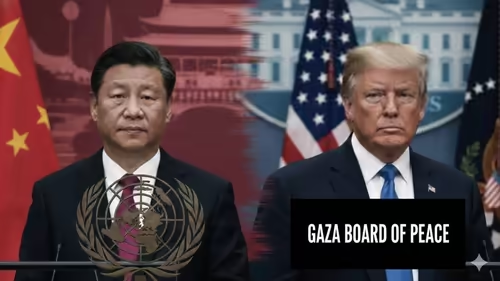
In a move that’s equal parts diplomatic theater and geopolitical chess, former U.S. President Donald Trump has floated a bold new idea: a Gaza Board of Peace. On the surface, it sounds like a humanitarian effort to resolve one of the world’s most intractable conflicts. But dig deeper, and you’ll find a far more complex narrative—one that questions the very foundations of the post-war international order. The proposal has drawn sharp reactions worldwide, with China emerging as an unlikely champion of the United Nations system. Is this really about Gaza? Or is the real target the UN itself?
Table of Contents
- What Is the Gaza Board of Peace?
- China’s Surprising Defense of the UN
- Is the UN the Real Target?
- Geopolitical Implications: US vs China on Global Governance
- Historical Context: America’s Shifting Stance on Multilateralism
- Conclusion: A New Era of Fragmented Diplomacy?
- Sources
What Is the Gaza Board of Peace?
While details remain sparse, Trump’s proposed Gaza Board of Peace appears to be a U.S.-led coalition aimed at brokering a ceasefire and long-term stability in Gaza. Unlike traditional UN-backed peace efforts, this initiative would reportedly operate outside established multilateral frameworks—potentially sidelining institutions like the Security Council or the International Court of Justice. The U.S. has already extended invitations to key global players, including China, to join the board. Notably, Beijing has not yet confirmed participation but issued a firm statement reaffirming its commitment to a “UN-centered international system” .
China’s Surprising Defense of the UN
In a twist few anticipated, China—often criticized for challenging Western-led norms—has positioned itself as a staunch defender of the United Nations. In its official response to the U.S. invitation, China’s Foreign Ministry emphasized that “the authority and effectiveness of the UN must be safeguarded” and that “international disputes should be resolved within the framework of international law” . This stance marks a strategic pivot: by aligning with the principles of multilateralism, Beijing seeks to portray itself as a responsible global stakeholder, contrasting sharply with Washington’s perceived unilateralism. It’s a masterstroke of soft power—and a direct challenge to American diplomatic hegemony.
Is the UN the Real Target?
Critics argue that the Gaza Board of Peace isn’t truly about Gaza at all. Instead, they see it as part of a broader pattern: the deliberate erosion of multilateral institutions that don’t align with U.S. interests. During his first term, Trump withdrew from the World Health Organization, UNESCO, and the UN Human Rights Council—moves widely interpreted as a rejection of global consensus in favor of “America First” policies . Creating a parallel peace mechanism could further marginalize the UN, especially if major powers endorse it. As one European diplomat anonymously noted, “If this board gains traction, it sets a dangerous precedent: powerful nations can bypass the UN whenever it’s inconvenient.”
Geopolitical Implications: US vs China on Global Governance
This episode highlights a growing ideological rift between the U.S. and China over how the world should be governed:
- U.S. Approach: Preference for ad-hoc coalitions, bilateral deals, and leader-driven initiatives (e.g., Abraham Accords, AUKUS).
- Chinese Approach: Public advocacy for rules-based order, sovereign equality, and institutional legitimacy—even while expanding its own influence through bodies like the Belt and Road Initiative.
Ironically, China’s defense of the UN may be less about idealism and more about strategy. By championing the status quo, Beijing positions the U.S. as the disruptor—potentially swaying Global South nations wary of Western interventionism. For more on shifting alliances, see our analysis on [INTERNAL_LINK:global-south-geopolitics].
Historical Context: America’s Shifting Stance on Multilateralism
The tension isn’t new. Since the Cold War, U.S. engagement with the UN has oscillated between leadership and skepticism. While Presidents like George H.W. Bush and Barack Obama actively leveraged the UN for collective action (e.g., Gulf War, Paris Agreement), others—particularly Trump—viewed it as a constraint on sovereignty. The proposed Gaza Board echoes past U.S. attempts to create alternative forums, such as the Coalition of the Willing during the Iraq War. Yet today’s multipolar world makes unilateralism riskier. As the Brookings Institution notes, “No single nation, not even the U.S., can solve transnational crises alone” .
Conclusion: A New Era of Fragmented Diplomacy?
Trump’s Gaza Board of Peace may never materialize—but its mere proposal has already reshaped the diplomatic landscape. By forcing nations to choose between loyalty to established institutions and alignment with U.S. power, it accelerates a trend toward fragmented, competing spheres of influence. China’s unexpected defense of the UN underscores a new reality: in the 21st century, the battle for global order isn’t just fought with armies or economies, but with narratives about legitimacy, law, and who gets to set the rules. Whether this leads to renewed cooperation or deeper division remains the trillion-dollar question.
Sources
- Times of India: Trump’s Board of Peace: Is UN the real target? China emerges as unlikely defender
- United Nations Charter: UN Charter Principles
- Brookings Institution: The Future of Multilateralism
- Council on Foreign Relations: U.S. Withdrawals from UN Agencies