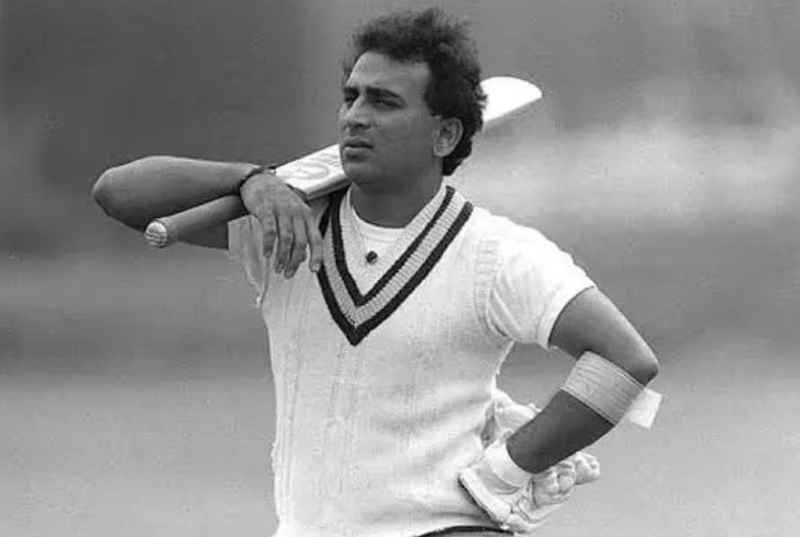
Imagine carrying the weight of a nation’s cricketing hopes—and then adding the ghost of Don Bradman to the load.
That was Sunil Gavaskar’s reality in December 1983. On December 28, he had just etched his name above the Don by scoring his **30th Test century**, breaking a record that many thought would stand forever. The world applauded. The pressure should have eased.
But the very next day—December 29, 1983—Gavaskar walked back into the cauldron of Chepauk, facing the most fearsome fast-bowling attack in history, and played an innings so monumental it redefined Indian batting forever. His unbeaten **236 against the West Indies** wasn’t just a score; it was a statement of resilience, mastery, and historical redemption.
This is the story of the Gavaskar 236 vs West Indies—an innings that stood as India’s highest Test score for 17 years and cemented the Little Master’s legacy beyond statistics.
Table of Contents
- The Bradman Barrier: Shattered
- Gavaskar 236 vs West Indies: The Historic Innings
- Why This Innings Was a Masterclass in Pressure Batting
- The Record That Stood for 17 Years
- Gavaskar’s Legacy Beyond the Numbers
- How Modern Batsmen Compare
- Summary
- Sources
The Bradman Barrier: Shattered
For decades, Don Bradman’s 29 Test centuries were the Everest of batting. Even the greatest—Sobers, Richards, Boycott—never came close. Then came Gavaskar.
On Day 4 of the 6th Test against the West Indies in Chennai, Gavaskar reached his 30th century, silencing critics who said he’d slowed down in his twilight years. The achievement alone would’ve been career-defining. But Gavaskar wasn’t done.
Gavaskar 236 vs West Indies: The Historic Innings
Returning on Day 5, Gavaskar didn’t play like a man who’d just made history. He played like a man with a mission.
Against a West Indies pace battery featuring **Malcolm Marshall, Michael Holding, and Joel Garner**—at the peak of their powers—Gavaskar unleashed a symphony of textbook strokes. He drove with precision, cut with authority, and defended with unwavering concentration.
By stumps, he was **236 not out off 425 balls**, having struck 23 boundaries. India declared at 524/7, but the real story was Gavaskar’s dominance over an attack that had terrorized batsmen worldwide .
Why This Innings Was a Masterclass in Pressure Batting
What made this knock extraordinary wasn’t just the runs—it was the context:
- Back-to-Back Historic Feats: Scoring a double-century the day after breaking Bradman’s record required immense mental fortitude.
- Opposition Quality: The 1 983 West Indies team is widely regarded as the greatest Test side ever. Scoring big against them was rare; dominating them was legendary.
- Home Ground, High Expectations: Playing in Chennai, Gavaskar carried the emotional weight of a home crowd desperate for a hero.
As cricket historian Ramachandra Guha noted, “This innings proved Gavaskar wasn’t just technically sound—he was psychologically unbreakable.”
The Record That Stood for 17 Years
Gavaskar’s 236* became India’s highest individual Test score—a record that would endure until **VVS Laxman’s 281** in the 2001 Kolkata Test against Australia.
For nearly two decades, young Indian batsmen looked to this innings as the benchmark of excellence. It wasn’t just about size; it was about **quality under fire**. Even Sehwag’s explosive 319 in 2008, while bigger, lacked the defensive rigor Gavaskar displayed against genuine pace.
Gavaskar’s Legacy Beyond the Numbers
Gavaskar finished his career with **10,122 Test runs**, 34 centuries, and an average over 51. But his true legacy lies in how he changed Indian cricket:
- He proved Indian batsmen could thrive overseas.
- He set standards for discipline, preparation, and technique.
- He paved the way for Tendulkar, Dravid, and Kohli by showing that greatness was possible.
The 1983 Chennai innings was his ultimate validation—a performance that blended history, skill, and defiance.
How Modern Batsmen Compare
Today’s batsmen benefit from better pitches, advanced analytics, and lighter bats. Yet, few have faced the raw hostility of 1980s West Indies pace on lively Indian tracks.
Virat Kohli once said, “Reading about Gavaskar’s 236 makes you realize how tough it was back then. We complain about reverse swing—imagine facing Holding at 90 mph on a fifth-day Chennai pitch!”
For more on cricketing legends, explore [INTERNAL_LINK:greatest-indian-batsmen] and [INTERNAL_LINK:west-indies-fast-bowling-era].
Summary
The Gavaskar 236 vs West Indies on December 29, 1983, was more than a double-century. It was a historic sequel to his Bradman-breaking feat, a masterclass against the world’s best bowlers, and a national record that inspired generations. In an age of fleeting records, this innings remains a timeless testament to courage, technique, and the quiet brilliance of India’s first batting immortal.
Sources
- Times of India: OTD: Gavaskar’s 236* — a day after overtaking Bradman
- ESPNcricinfo: Scorecard: India vs West Indies, 6th Test, Chennai 1983
- International Cricket Council (ICC): ICC Feature: Celebrating Sunil Gavaskar’s Legacy
- Wisden Almanack: Wisden on Gavaskar’s 236: The Innings That Defined an Era