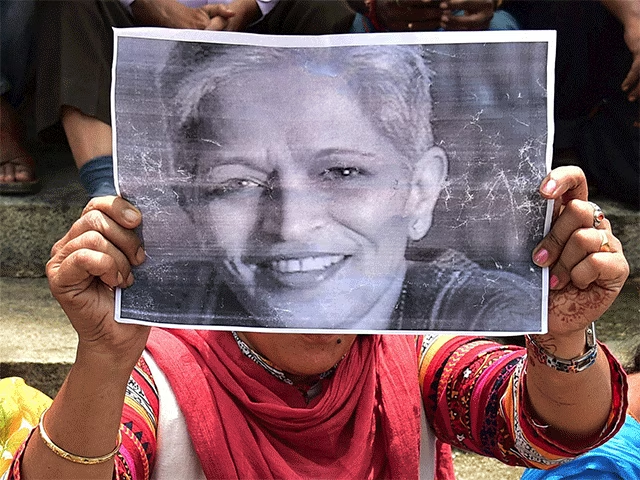
The very idea that someone charged with the brutal murder of a prominent journalist could seek public office is enough to make your blood boil. Yet, that’s exactly what’s unfolding in Maharashtra right now. Shrikant Pangarkar, one of the primary accused in the 2017 assassination of journalist and activist Gauri Lankesh, has officially filed his nomination papers to run in the January 15, 2026, Jalna Municipal Corporation elections—as an independent candidate .
This development isn’t just a local political story; it’s a seismic event that strikes at the core of India’s democratic values, judicial integrity, and the safety of its press corps. How did we get here? And what does this mean for the families of victims, the rule of law, and the future of civic engagement in Maharashtra?
Table of Contents
- Who Is Shrikant Pangarkar? The Gauri Lankesh Murder Accused
- The Controversial Candidacy: Gauri Lankesh Murder Accused in Jalna Civic Polls
- Political Backdrop: From Shiv Sena to Independent Run
- Legal and Ethical Implications: Can an Accused Hold Public Office?
- Public and Political Reaction: A Nation Divided
- What Happens Next? The Road to January 15
- Conclusion
- Sources
Who Is Shrikant Pangarkar? The Gauri Lankesh Murder Accused
Shrikant Pangarkar is not just any political aspirant. He stands accused in one of India’s most high-profile and politically charged murder cases of the last decade—the targeted killing of Gauri Lankesh, a fearless journalist known for her staunch criticism of right-wing extremism and her advocacy for minority rights .
Lankesh was shot dead outside her Bengaluru home on September 5, 2017. The investigation, led by a Special Investigation Team (SIT), uncovered a chilling network allegedly linked to a larger conspiracy involving multiple murders of rationalists across the country. Pangarkar, a resident of Jalna in Maharashtra, was arrested as part of this probe and remains an accused in the ongoing trial .
The Controversial Candidacy: Gauri Lankesh Murder Accused in Jalna Civic Polls
In a stunning turn of events, Pangarkar has now entered the electoral fray for the Jalna Municipal Corporation polls scheduled for January 15, 2026 . He is running as an independent candidate, a decision that has sent shockwaves through civil society, media circles, and opposition political parties.
His nomination represents a direct challenge to the principle that those facing serious criminal charges—especially for crimes against free speech and democracy itself—should be barred from seeking the public’s trust. The move raises urgent questions about the vetting process for candidates and the loopholes that allow individuals with grave allegations to stand for office.
Political Backdrop: From Shiv Sena to Independent Run
Pangarkar’s political journey adds another layer of complexity. In October 2024, he joined the Eknath Shinde-led faction of the Shiv Sena ahead of the Maharashtra Assembly elections . This move was met with immediate backlash, forcing Chief Minister Shinde to cancel a planned public event in Jalna due to the ensuing controversy .
However, it appears his formal association with the party was short-lived or perhaps never solidified into a ticket for the civic polls. His current status as an independent candidate suggests either a strategic retreat by the Shiv Sena or a personal decision by Pangarkar to forge his own path in local politics, away from the intense scrutiny that comes with a major party’s banner.
Legal and Ethical Implications: Can an Accused Hold Public Office?
Under current Indian election law, a person is only disqualified from contesting elections upon being **convicted** and sentenced to two or more years in prison. Being merely an accused in a case, no matter how serious, does not legally bar someone from running for office.
This legal reality, however, clashes violently with ethical expectations. Critics argue that allowing individuals facing charges of murder, terrorism, or corruption to hold public office undermines the integrity of democratic institutions and sends a dangerous message about accountability. The Supreme Court of India has repeatedly urged Parliament to enact stricter laws to prevent criminals from entering politics, but legislative action has been slow and inconsistent.
Public and Political Reaction: A Nation Divided
The announcement of Pangarkar’s candidacy has triggered a firestorm of reactions:
- Opposition parties have condemned the move, calling it a “mockery of democracy” and demanding immediate disqualification.
- Journalist unions and free speech advocates are organizing protests, stating that this is a direct attack on press freedom and a signal that violence against journalists can be rewarded with political legitimacy.
- Civil society groups are petitioning the Election Commission of India to intervene, though their legal grounds are limited.
- Local residents in Jalna are reportedly divided, with some viewing him through a local patronage lens, while others are deeply disturbed by the national implications.
What Happens Next? The Road to January 15
With the election date set for January 15, 2026, all eyes will be on Jalna. Will voters endorse a man accused of silencing one of India’s bravest voices? Or will they reject this candidacy as a stain on their city’s conscience?
Meanwhile, legal challenges may still emerge. While a direct disqualification is unlikely, petitions could be filed questioning the acceptance of his nomination on procedural or ethical grounds. The case also reignites the national conversation about electoral reform—a conversation that Gauri Lankesh herself would have fiercely championed.
Conclusion
The entry of a Gauri Lankesh murder accused into the Jalna civic polls is more than a political anomaly; it’s a stress test for Indian democracy. It forces us to confront uncomfortable truths about the intersection of crime, politics, and justice. As the nation watches, the people of Jalna will soon deliver a verdict—not just on a candidate, but on the values they wish their democracy to uphold.
Sources
- Times of India: Maha civic polls: Gauri Lankesh murder accused in fray
- The Hindu: Gauri Lankesh murder accused joins Shinde Sena
- Supreme Court of India: Lily Thomas vs. Union of India (on criminalization of politics)
- [INTERNAL_LINK:gauri-lankesh-murder-case-timeline]
- [INTERNAL_LINK:maharashtra-civic-elections-2026-guide]