Introduction: A Win That Feels Like a Wound
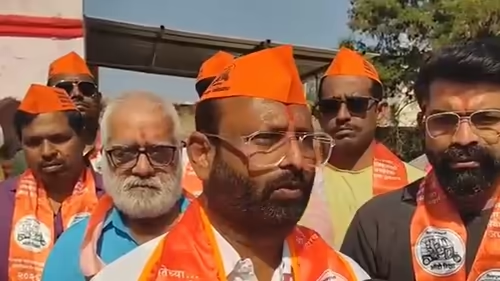
The dust has barely settled on Maharashtra’s civic elections, but one result from the Jalna civic polls has sent shockwaves far beyond the city limits. Shrikant Pangarkar, a man formally charged in the brutal 2017 assassination of journalist and activist Gauri Lankesh, has been elected as a corporator from Ward 13 . Running as an independent candidate, Pangarkar secured a decisive victory with a margin of 2,621 votes . This isn’t just a political win; it’s a moment that forces us to confront uncomfortable questions about our society, our justice system, and the complex relationship between crime and electoral legitimacy.
Table of Contents
- Who is Shrikant Pangarkar? The Man Behind the Headlines
- The Gauri Lankesh Case: A Brief Recap
- From Shiv Sena to Independent: A Political Journey
- The Jalna Civic Polls: Victory and Its Aftermath
- National Reaction: Outrage and Debate
- Conclusion: What Does This Victory Mean for Indian Democracy?
- Sources
Who is Shrikant Pangarkar? The Man Behind the Headlines
Shrikant Pangarkar is not a new face in Jalna’s political circles. His career began under the banner of the undivided Shiv Sena in 1996 . He successfully served as a municipal councillor from 2001 to 2006 . However, his path diverged when he was reportedly denied a party ticket in 2011, leading him to join the right-wing Hindu Janjagruti Samiti . His political journey took another sharp turn in October 2024 when he briefly joined the Eknath Shinde-led faction of the Shiv Sena . Yet, this affiliation was short-lived, and he contested the recent Jalna civic polls as an independent candidate .
The Gauri Lankesh Case: A Brief Recap
The 2017 murder of Gauri Lankesh, a prominent Kannada journalist known for her fierce criticism of right-wing extremism, was a watershed moment for press freedom in India. The Special Investigation Team (SIT) probing the case eventually named Shrikant Pangarkar as an accused . He was formally charged in 2021 and spent time in judicial custody before being granted bail by the Karnataka High Court in September 2024 [[1], [7]]. It is crucial to note that under Indian law, an accused is presumed innocent until proven guilty. However, the gravity of the charges—a conspiracy to murder a journalist—casts a long and dark shadow over any public role he might assume.
From Shiv Sena to Independent: A Political Journey
Pangarkar’s political identity has been fluid. While he claims he never truly left the Shiv Sena , his official record shows affiliations with other groups after being denied a ticket . His brief stint with the Shinde-led Shiv Sena in late 2024 was met with immediate backlash, forcing the party to cancel the event where he was to be formally inducted . This history of shifting loyalties culminated in his decision to run as an independent in the Jalna civic polls, a move that ultimately proved successful but at a significant cost to his public image and the political discourse.
The Jalna Civic Polls: Victory and Its Aftermath
Pangarkar’s victory in Ward 13 of the Jalna Municipal Corporation is a stark reality of local politics . He defeated his nearest rival, BJP’s Raosaheb Dhoble, by a substantial margin . His supporters celebrated the win as a personal triumph, a return to his political roots in the city he once served. For them, it may be a vote for a known local figure rather than a verdict on a distant legal case. However, the optics are undeniably jarring. An individual facing trial for a high-profile murder is now a public representative entrusted with the welfare of his constituents. This creates an immediate and profound conflict between local loyalty and national principles of justice and ethical governance.
National Reaction: Outrage and Debate
The news of Pangarkar’s win has triggered widespread condemnation from journalists’ unions, civil society groups, and opposition parties across the country. Many see it as a direct insult to Gauri Lankesh’s legacy and a dangerous precedent that normalizes serious criminal charges within the political sphere. The core of the debate revolves around a critical question: Should individuals facing grave charges, especially those involving attacks on democratic institutions like a free press, be allowed to hold public office? This case has reignited calls for stronger anti-defection laws and stricter ethical vetting for candidates, a conversation that can be followed on platforms like The Wire, which has extensively covered the Gauri Lankesh case .
Conclusion: What Does This Victory Mean for Indian Democracy?
Shrikant Pangarkar’s success in the Jalna civic polls is a complex and deeply troubling event. It is a testament to the power of local networks and name recognition, but it also exposes a dangerous gap in our political ecosystem. While the legal process must take its course, his elevation to a position of public trust sends a chilling message about the value we place on justice and the safety of our journalists. This victory is not just a local Jalna story; it is a national wake-up call that demands a serious conversation about the integrity of our democratic institutions and the kind of leaders we choose to represent us. The shadow of Gauri Lankesh’s murder looms large over this result, reminding us that some wounds are too deep for a simple electoral win to heal.
Sources
- Times of India: Jalna civic polls: Gauri Lankesh murder accused Shrikant Pangarkar celebrates victory
- The Wire: Coverage on Gauri Lankesh Case
- India Today: Reports on Shrikant Pangarkar’s political moves
- [INTERNAL_LINK: gauri-lankesh-murder-case-timeline]
- [INTERNAL_LINK: maharashtra-civic-elections-2026-analysis]