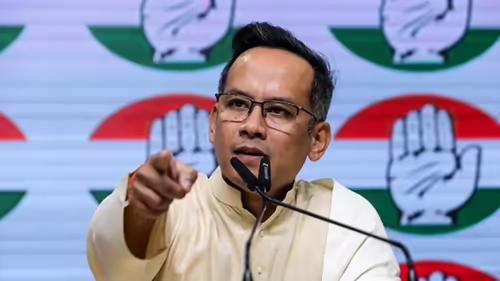
Political tensions in Assam have flared once again—but this time, the battle isn’t just about votes or policy. It’s about truth, judicial integrity, and the dangerous weaponization of language. At the center of the storm is Congress MP Gaurav Gogoi, who has accused Assam Chief Minister Himanta Biswa Sarma of telling a “blatant lie” by falsely claiming that the Supreme Court of India used the term ‘Miya Muslims’ in its judgments.
The controversy erupted after Sarma referenced the apex court while defending his use of the term—a label many consider derogatory and exclusionary when applied to Bengali-origin Muslim communities in Assam. Gogoi didn’t mince words: he called the CM’s claim not just misleading, but a deliberate distortion of judicial authority. And now, he’s urging the Supreme Court itself to take notice.
Table of Contents
- What Are ‘Miya Muslims’—And Why the Term Is Controversial
- Gaurav Gogoi Slams Assam CM Over Supreme Court Misquote
- Did the Supreme Court Really Use the Term?
- The Political Stakes in Assam
- Why Misquoting the Judiciary Matters
- Conclusion: A Test for Truth in Public Discourse
- Sources
What Are ‘Miya Muslims’—And Why the Term Is Controversial
‘Miya’ is a term historically used to refer to Bengali-speaking Muslims in Assam, many of whom trace their roots to migrations during British colonial rule or post-Partition movements. While some community members have reclaimed the word in poetry and cultural expression (notably through the ‘Miya poetry’ movement), it is widely perceived as pejorative when used by political figures—especially in contexts that question their citizenship or legitimacy.
In Assam’s charged socio-political landscape, where the National Register of Citizens (NRC) and Citizenship Amendment Act (CAA) have fueled deep anxieties, labeling an entire community as ‘Miya’ can carry undertones of othering and exclusion. Critics argue such rhetoric fuels polarization and undermines social cohesion.
Gaurav Gogoi Slams Assam CM Over Supreme Court Misquote
In a strongly worded statement, Gaurav Gogoi accused Chief Minister Himanta Biswa Sarma of “misusing the name of the Supreme Court” to legitimize his remarks. “It is a blatant lie,” Gogoi declared, emphasizing that no judgment from the apex court has ever used the phrase ‘Miya Muslims’ in the manner suggested by the CM [[1]].
Gogoi went further, urging the Supreme Court to take suo motu cognizance of the CM’s comments. “When public officials attribute false statements to the highest court in the land, it erodes public trust in both democracy and the judiciary,” he warned [[2]]. His intervention underscores a growing concern among opposition leaders about the normalization of factual distortions in political discourse.
Did the Supreme Court Really Use the Term?
A quick search through official Supreme Court judgments reveals no instance where the bench has formally or informally referred to any group as ‘Miya Muslims’ in a legal or constitutional context. While lower courts or individual affidavits might contain colloquial references, the apex court maintains strict neutrality in its language—especially on sensitive identity issues.
Legal experts confirm that attributing such terminology to the Supreme Court is not only inaccurate but potentially damaging. As constitutional scholar Dr. Menaka Guruswamy noted in a past interview, “The judiciary’s credibility hinges on precision. When politicians blur that line, they’re playing with fire” [[3]].
The Political Stakes in Assam
This isn’t just about semantics—it’s about strategy. Assam remains a critical battleground state, with demographics playing a decisive role in electoral outcomes. The BJP-led government, under Himanta Sarma, has consistently framed its narrative around ‘protecting indigenous identity,’ often positioning Bengali-origin Muslims as outsiders.
Meanwhile, the Congress and its allies, including Gogoi, are trying to rebuild a secular coalition that appeals across ethnic and religious lines. By calling out the CM’s alleged falsehood, Gogoi is doing more than fact-checking—he’s attempting to reframe the debate around accountability and truth.
For deeper insights into Assam’s complex identity politics, see our analysis on [INTERNAL_LINK:assam-citizenship-crisis-explained].
Why Misquoting the Judiciary Matters
When a sitting chief minister invokes the Supreme Court to justify controversial remarks, it does three dangerous things:
- It lends false legitimacy to divisive rhetoric by cloaking it in judicial authority.
- It confuses the public about what the court actually stands for, muddying civic understanding.
- It undermines judicial independence by turning the court into a political prop rather than a neutral arbiter.
In a democracy, the separation between political speech and judicial pronouncement must be sacrosanct. Blurring that line—even through implication—sets a dangerous precedent.
Conclusion: A Test for Truth in Public Discourse
The clash between Gaurav Gogoi and Himanta Biswa Sarma over the ‘Miya Muslims’ remark is more than a political spat. It’s a microcosm of a larger crisis: the erosion of factual integrity in public life. In an era where misinformation spreads faster than facts, holding leaders accountable for what they say—and what they falsely claim others have said—is not just necessary; it’s existential.
As Gogoi’s call for Supreme Court intervention echoes across newsrooms, one thing is clear: in Assam, and across India, the battle for truth is now part of the political battlefield.
Sources
- Times of India: Gaurav Gogoi slams Assam CM over ‘Miya Muslims’ remarks
- The Hindu: Assam CM faces backlash over ‘Miya Muslims’ comment
- Supreme Court of India: Judgments Database
- Indian Express: What is Miya poetry and why is it controversial?
- Mint: Gogoi demands action against Sarma for misquoting SC