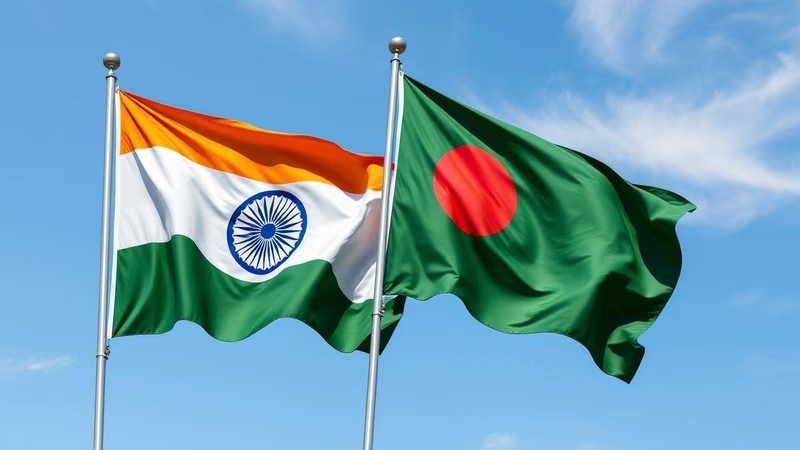
The ticking clock has begun. In just under a year, a crucial chapter in South Asian history will either be renewed or rewritten. The Ganges Water Sharing Treaty, the bedrock of water cooperation between India and Bangladesh since 1996, is set to expire in December 2026. The stakes couldn’t be higher, and both nations are already taking decisive action to navigate this complex diplomatic terrain.
Beyond a mere bureaucratic expiration date, this treaty represents the lifeline for millions. It governs the flow of the Ganga and Padma rivers, dictating water availability for agriculture, industry, and daily survival in a region already feeling the acute pressure of climate change. The recent initiation of joint water level measurements isn’t just a technical procedure—it’s a clear signal that both countries are taking the renewal process with the utmost seriousness.
Table of Contents
- What is the Ganges Water Sharing Treaty?
- Why Are India and Bangladesh Measuring Water Levels Together?
- Ganges Water Sharing Treaty 2026: The Key Sticking Points
- The Deep Impact on Agriculture and Livelihoods
- Climate Change: A Wild Card in the Negotiations
- Conclusion: A Shared Future Depends on Shared Waters
- Sources
What is the Ganges Water Sharing Treaty?
Signed in a moment of hard-won diplomatic triumph on December 6, 1996, the Ganges Water Sharing Treaty was designed as a 30-year pact to finally resolve a decades-long dispute over the river’s waters . The core of the agreement revolves around a complex formula for sharing the river’s flow during the critical dry season, from January to May, when water is most scarce.
The treaty established a guaranteed minimum flow for Bangladesh at the Farakka Barrage, the crucial Indian structure that diverts water into the Bhagirathi-Hooghly river system to keep the port of Kolkata navigable. This formula is dynamic, based on average flows, but it has provided a crucial framework for predictability and cooperation for nearly three decades . Without it, the relationship between the two neighbors could easily have been poisoned by the specter of water scarcity.
Why Are India and Bangladesh Measuring Water Levels Together?
The recent joint monitoring initiative, which began on January 1, 2026, is far more than a routine check-up. It’s a foundational step in the renewal process. Teams from both nations are now conducting bi-weekly measurements at key points: 3,500 feet upstream of the Hardinge Bridge on the Padma River in Bangladesh and at the Farakka Barrage point in India [[14], [18]].
This collaborative data collection, which will run until May 31, 2026, serves several critical purposes:
- Building a Shared Baseline: It creates an agreed-upon, real-time dataset on current river conditions, essential for any fair negotiation.
- Demonstrating Good Faith: The act of working side-by-side on the riverbank is a powerful symbol of commitment to a cooperative solution.
- Informing Future Models: The data gathered will be invaluable for understanding the current state of the river, which is heavily influenced by shifting climate patterns, and for modeling future scenarios.
Ganges Water Sharing Treaty 2026: The Key Sticking Points
While both nations have expressed a desire to renew the treaty, the path forward is fraught with complex challenges. The renewal is not a simple copy-paste of the 1996 agreement. Several key issues are likely to dominate the negotiations:
Beyond the Dry Season
The current treaty only covers the dry season (January-May). Bangladesh has long sought a year-round agreement to provide greater stability for its long-term planning in agriculture and water resource management . India, however, has been cautious, citing its own growing water demands and the need to manage its internal river systems.
The Farakka Barrage and Beyond
The Farakka Barrage remains the epicenter of the water-sharing debate. For Bangladesh, it’s a symbol of upstream control. For India, it’s a critical piece of infrastructure. The negotiations will inevitably revolve around its operation and whether the existing formula for water release is still equitable in today’s context of changing river flows .
Data Transparency and Joint Management
A more robust framework for sharing hydrological data in real-time and establishing stronger joint management protocols through the existing Joint River Commission is a likely demand from Bangladesh to ensure the treaty’s provisions are verifiable and enforceable .
The Deep Impact on Agriculture and Livelihoods
The Ganges isn’t just a river; it’s an economic engine. In Bangladesh, a reliable flow of Ganges water is absolutely vital for sustaining agricultural productivity, especially in the parched northwest region during the dry season . It supports the massive Ganges-Kobadak Irrigation Project, which is a cornerstone of the country’s food security .
A failure to secure a new treaty could have devastating consequences:
- Reduced Crop Yields: Water scarcity would directly lead to lower production of key crops like rice and wheat.
- Increased Salinity Intrusion: Lower river flows in the dry season allow saltwater from the Bay of Bengal to creep further inland, poisoning farmland and drinking water sources .
- Economic Instability: Disruptions to agriculture would ripple through the entire economy, affecting millions of livelihoods dependent on the farming sector .
Climate Change: A Wild Card in the Negotiations
Perhaps the most formidable challenge facing the negotiators is the shadow of climate change. The Ganges basin is acutely vulnerable, with its flow heavily dependent on the monsoon and glacial melt from the Himalayas—both of which are being disrupted by a warming planet .
Recent studies point to a disturbing trend: while overall water flow might increase due to more intense rainfall events, the distribution is becoming more erratic . This means longer, more severe dry spells punctuated by catastrophic floods. This volatility makes the static formulas of the 1996 treaty potentially obsolete.
The negotiators must now design a new agreement that is not just a division of water, but a resilient framework for managing uncertainty. They need a treaty that can adapt to a future where the river’s behavior is far less predictable . This could involve incorporating adaptive management clauses or establishing mechanisms to adjust water shares based on real-time climate data.
Conclusion: A Shared Future Depends on Shared Waters
The ongoing talks over the Ganges Water Sharing Treaty are about far more than diplomatic niceties. They are a test of whether two nations can rise above their individual needs to manage a shared, life-sustaining resource in an era of unprecedented environmental stress. The joint water measurements are a promising first step, a tangible demonstration of the cooperation that will be essential for success. The world will be watching, as the outcome of these negotiations will shape the ecological and economic future of one of the most densely populated regions on Earth. Failure is not an option for the millions who depend on the Ganges for their very survival. For more on transboundary water issues, explore our in-depth analysis on [INTERNAL_LINK:global-water-diplomacy].
Sources
- Institute for Defence Studies and Analyses: Renewal of the Ganga Waters Treaty
- The Daily Star: BD, India start Ganges-Padma water monitoring
- JSTOR: The Ganges Water-Sharing Treaty: Genesis & Significance
- ResearchGate: A critical review of the Ganges Water Sharing arrangement
- ScienceDirect: Climate change impacts on water resources of the Ganges
- Times of India: India, Bangladesh begin talks on Ganges treaty