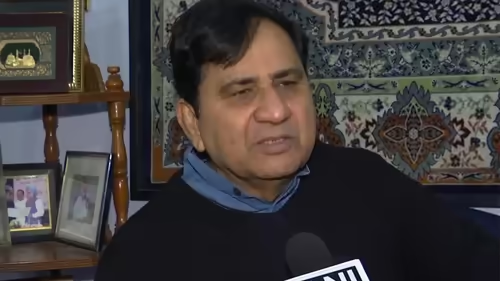
In the often-opaque world of Indian political dynasties, a startling claim has emerged from a former insider, casting a long shadow over one of the Indian National Congress’s most significant internal events. Former Union Minister and ex-Congress leader Shakeel Ahmad has made a bold and controversial statement about the 2022 Congress presidential polls, asserting that the result was a foregone conclusion dictated by a single, powerful force: the Gandhi family .
This isn’t just gossip from a disgruntled ex-member; it’s a direct challenge to the party’s long-standing narrative of being a democratic institution. Ahmad’s remarks cut to the heart of a persistent criticism—that despite its public image, the Congress functions more like a family enterprise than a modern political party.
Table of Contents
- The Explosive Claim: “Whoever They Support Will Win”
- Context of the 2022 Congress Presidential Polls
- Shakeel Ahmad’s Journey and Credibility
- Broader Implications for Congress Internal Democracy
- Political Reactions and Fallout
- Conclusion: A Party at a Crossroads
- Sources
The Explosive Claim: “Whoever They Support Will Win”
Shakeel Ahmad’s central assertion is as simple as it is damning. He stated plainly, “Whoever Gandhi family supports will win,” in reference to the party’s 2022 presidential election . This statement implies that the complex process of delegate voting, candidate manifestos, and internal campaigning was merely a formality—a democratic charade to legitimize a decision already made in the corridors of power within the Gandhi household.
His comments directly target the party’s leadership structure, suggesting that figures like Mallikarjun Kharge, who ultimately won the election against Shashi Tharoor, were not chosen by the collective will of the party cadre but were anointed by the family. This perspective reframes the entire election as a top-down exercise in power consolidation rather than a genuine contest of ideas.
Context of the 2022 Congress Presidential Polls
The 2022 election was a historic moment for the Congress. It was the first time in over two decades that the party president was to be chosen through an internal election, ending the long tenure of Sonia Gandhi as interim president. The contest between veteran leader Mallikarjun Kharge and intellectual parliamentarian Shashi Tharoor was billed as a battle for the party’s future soul—between organizational experience and a push for modernization.
While the party officially celebrated the election as a triumph of its internal democracy, Ahmad’s recent revelations suggest a different reality. His claim adds fuel to the speculation that existed at the time, where many political analysts noted the subtle yet powerful signals of support from the Gandhi family for Kharge, which likely swayed a large bloc of undecided delegates.
Shakeel Ahmad’s Journey and Credibility
To understand the weight of Ahmad’s statement, one must consider his background. As a former Union Minister and a long-time Congress leader, he was not a peripheral figure but someone who operated at the highest echelons of the party. His resignation from the Congress in November 2025, following the Bihar assembly polls, was itself a significant event .
Since leaving the party, Ahmad has been openly critical of its leadership, particularly Rahul Gandhi, whom he has accused of being “darpok” (cowardly) and “insecure” . While his status as a former member might lead some to question his motives, his insider knowledge provides a unique and credible perspective on the party’s internal mechanics. His claims are not those of an outsider looking in, but of an insider who has decided to speak out.
Broader Implications for Congress Internal Democracy
Ahmad’s revelation is not an isolated incident but part of a larger, recurring theme of criticism against the Congress. The core issue he highlights is the lack of internal democracy in Congress party. For a party that positions itself as the primary opposition to the BJP and a champion of democratic values, this is a profound contradiction.
This centralized control has several consequences:
- Stifled Innovation: New leaders and fresh ideas struggle to gain traction without the blessing of the central leadership.
- Organizational Weakness: State units become dependent on directives from the top, weakening their ability to respond to local issues.
- Public Distrust: Voters increasingly see the party as out of touch and dynastic, which erodes its electoral base.
For the Congress to rebuild its credibility, it must address this fundamental flaw. Without genuine internal democracy, efforts at reform and revival may be seen as superficial.
Political Reactions and Fallout
Unsurprisingly, Ahmad’s comments have not gone unnoticed. The ruling BJP has seized on his statements as proof of the Congress’s hypocrisy. BJP leader Gaurav Vallabh, for instance, used the remarks to argue that the Congress delegates are not independent actors but mere instruments of the Gandhi family’s will .
Within the Congress, the official response has been silence or dismissal, a strategy that often fails to quell the narrative. The party’s inability to convincingly counter such claims from a former senior leader only serves to reinforce the perception Ahmad has described. This ongoing controversy is a significant distraction for a party that is trying to regroup after a series of electoral setbacks.
Conclusion: A Party at a Crossroads
Shakeel Ahmad’s candid take on the Congress presidential polls is more than just a personal grievance; it’s a stark diagnosis of a systemic problem. His claim that the Gandhi family’s support is the ultimate decider in party affairs is a powerful indictment of the party’s internal culture. For the Indian National Congress to present itself as a viable alternative to the electorate, it must move beyond these dynastic shadows and embrace a truly democratic and inclusive structure. Until then, revelations like Ahmad’s will continue to chip away at its foundational legitimacy and public trust.