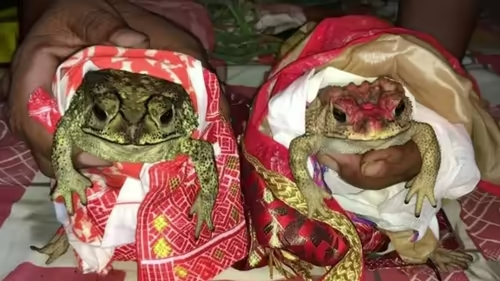
Picture this: a decorated altar, flower garlands, a priest chanting Sanskrit mantras—and two frogs dressed in miniature bridal finery, sitting patiently as they’re declared husband and wife. No, it’s not a scene from a fantasy novel. This is frog marriages in India, a centuries-old folk ritual performed across rural India to invoke rainfall during prolonged droughts.
While it might sound whimsical—or even absurd—to urban onlookers, for millions of agrarian families, this ceremony is a lifeline. Rooted in deep ecological wisdom and spiritual belief, the practice reflects a profound relationship between humans, animals, and the monsoon—the very pulse of Indian agriculture.
Table of Contents
- What Exactly Is a Frog Marriage?
- Mythological Roots: Why Frogs?
- Where in India Are Frog Weddings Held?
- Inside the Ceremony: A Step-by-Step Breakdown
- Science or Superstition? The Ecological Logic
- Why This Ritual Still Matters Today
- Conclusion: More Than Just a Quirky Tradition
- Sources
What Exactly Is a Frog Marriage?
A frog marriage—or Bhek Vivah in Hindi—is a symbolic Hindu ritual where two live frogs (one male, one female) are ceremonially wedded by a village priest. The belief is that Lord Indra, the Vedic god of rain and thunderstorms, is angered by human misdeeds. By performing this sacred union, communities seek to appease him and trigger much-needed rainfall.
Unlike human weddings, these ceremonies are swift, often lasting under an hour, but are conducted with full Vedic rites: kanyadaan (giving away the bride), mangalsutra tying, and even aarti. After the vows, the frogs are released into a nearby pond or field—hopefully just before the clouds burst open.
Mythological Roots: Why Frogs?
Frogs aren’t chosen at random. In Indian folklore, they’re seen as harbingers of rain. Their croaking intensifies before monsoons, making them natural barometers of weather change. Ancient texts like the Rigveda even contain hymns dedicated to frogs, celebrating their role in announcing the arrival of life-giving rains.
According to popular myth, Lord Indra once cursed a celestial being to be born as a frog. Only through a virtuous act—like participating in a sacred marriage—could the curse be lifted, and in doing so, Indra would be moved to send rain. Thus, the ritual became a bridge between divine will and earthly need.
Where in India Are Frog Weddings Held?
While the practice is most famously associated with eastern and northeastern states, frog marriages in India occur across diverse regions:
- Assam & West Bengal: Common in flood-prone yet drought-vulnerable districts like Dhubri and Cooch Behar.
- Odisha & Chhattisgarh: Performed by tribal communities during summer dry spells.
- Maharashtra & Karnataka: Documented in villages of Marathwada and North Karnataka, especially during El Niño years.
- Uttar Pradesh & Bihar: Occur in agrarian belts where kharif crops depend entirely on timely monsoons .
Each region adds its own cultural flavor—some use clay idols instead of live frogs; others include community feasts post-ceremony.
Inside the Ceremony: A Step-by-Step Breakdown
Here’s how a typical Bhek Vivah unfolds:
- Frog Selection: Village elders or children catch two healthy frogs—one slightly larger (symbolizing the groom).
- Decoration: The frogs are bathed, adorned with turmeric paste, and draped in red and yellow cloth or flower garlands.
- Puja Setup: A small mandap is erected near a pond or banyan tree. Idols of Lord Indra or Varuna (god of water) may be placed.
- Vedic Rituals: A local priest performs the wedding rites, often adapting human marriage mantras for amphibians.
- Release & Prayer: The couple is released together into water, followed by collective prayers for rain within 3 days.
Remarkably, many villagers report rainfall within 48–72 hours—though meteorologists attribute this to seasonal timing rather than divine intervention.
Science or Superstition? The Ecological Logic
Is it mere superstition? Not entirely. Ethnobiologists argue that such rituals encode practical ecological knowledge. Frogs breed only when humidity and soil moisture reach certain thresholds—conditions that often precede rain. So, the very act of finding active frogs may signal that rain is imminent.
Moreover, these ceremonies foster community cohesion during climate stress. As Dr. Madhav Gadgil, renowned ecologist and former member of the National Advisory Council, notes, “Indigenous rituals like frog marriages are not anti-science—they’re pre-scientific adaptations that helped societies survive uncertainty” .
Why This Ritual Still Matters Today
In an age of climate crisis and erratic monsoons, frog marriages in India are experiencing a quiet resurgence. Farmers, disillusioned by failed forecasts and groundwater depletion, are turning back to ancestral wisdom.
But it’s more than desperation—it’s identity. These rituals affirm a worldview where nature isn’t a resource to exploit, but a partner to negotiate with. They also serve as powerful educational tools, teaching younger generations about biodiversity and seasonal cycles.
For travelers interested in authentic cultural experiences, witnessing a frog wedding offers a rare window into India’s living heritage. Just remember: it’s not entertainment—it’s a prayer wrapped in petals and hope.
Conclusion: More Than Just a Quirky Tradition
Dismissing frog marriages in India as primitive folklore misses the point entirely. This ritual is a testament to human ingenuity in the face of environmental unpredictability—a blend of faith, observation, and community action that has endured for millennia. In a world racing toward technological fixes for climate change, perhaps there’s wisdom in listening to the croak of a frog… and the hearts of those who honor it. To explore more unique Indian traditions, check out our feature on [INTERNAL_LINK:indigenous-rituals-of-india].
Sources
- Times of India: A wedding invitation to the clouds: Inside India’s frog marriages
- UNESCO Intangible Cultural Heritage: Traditional ecological knowledge systems
- Gadgil, M. (2019). Culture and Conservation: India’s Living Traditions. Oxford University Press.